SwordWeave · v0.1 alpha · Free digital edition
Player's Handbook
Imagine a person. Give them rules. Play a shared story.
Rules edition: v0.1 alpha · 12 October 2026 · Free digital edition.
Read, make, play
SwordWeave is a construction-led tabletop roleplaying game. You invent a person, acquire understandable permissions and rules, and propose what they do in a world shared with friends. You do not need to choose a fixed class or buy a finished heritage to begin.
This book is the player-facing teaching guide. Read Begin a shared story and Make someone you want to play first. Then follow the play chapters as questions arise. The primitive reference and complete worked records provide the definitions you need offline. The free Game Master's Guide helps the person running the world; the System Reference Document states the same framework for lookup and reuse.
You need: people to play with, character records, a way to take notes, and dice or a roller capable of d20 and your actual output dice. The website is useful but not required. Agree the setting, character budget, equipment and expectations with your table.
Edition: v0.1 alpha. One numerical upkeep rule remains explicitly pending; its notice appears in the upkeep chapter. The rest of this book presents the current agreed framework. Examples illustrate their stated situations, not universal spell prices.
Begin a shared story
SwordWeave is a tabletop roleplaying game. Each player portrays a character: someone with a place in the world, things they can do and something they want. The Dungeon Master, also called the Game Master, describes the surroundings and portrays the other people and creatures you meet. Your choices and their consequences create the adventure together.
You can play around a table or meet online. Bring a character sheet, a way to roll dice and a way to record changes. The website can help build and track a character, but you can also play with a printed sheet and notes.
Agree what you are playing
Before making characters, talk about the adventure. Are you explorers trying to reach a lost city, troublesome apprentices, people defending their home, or something else? Agree what kinds of situations you want to explore and which subjects should stay outside the game. Anyone can ask to pause or change an uncomfortable scene.
Ask the DM which starting level or Build Unit budget to use, which existing creations fit the setting and whether equipment has a separate allowance. A simple beginning helps a new group learn; a higher starting budget gives a more developed character. The table chooses the starting point together.
Describe what you want to accomplish
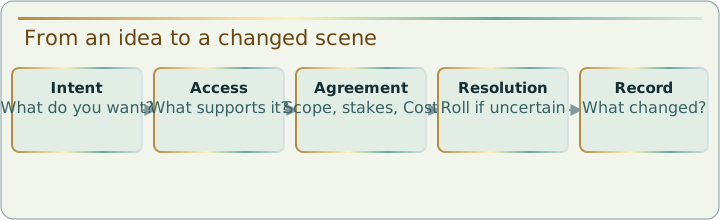
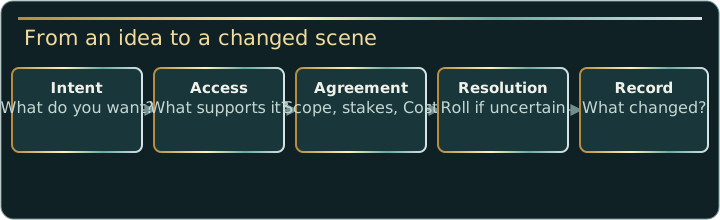
The DM presents a situation. Describe your character's intent in ordinary words. You can ask what they see, hear or already know before committing to an attempt.
An intent gives the conversation direction. You do not need a saved ability whose title describes the exact situation. Ordinary actions depend on the circumstances and your character's competence. Extraordinary workings use the permissions your character owns.
A primitive is a reusable rule or permission. A water-shaping character might own a domain permission for Water and a verb permission for changing its form. Those ingredients can support several ideas: draw water along a ledge, shape a barrier or redirect a stream. Each attempt still needs a workable scope and an agreed resolution.
Give exciting ideas a chance
Core rule - the Rule of Cool. Give an exciting idea a fair hearing. Talk through what makes it possible, what it risks and how it will resolve. The rules help everyone understand the attempt and its consequences.
The table can agree an unusual application or exception when it makes the scene coherent and engaging. State that agreement clearly. Being able to reach a window through a collapsing roof can depend on the route, timing and danger, even if a similar jump was easy elsewhere.
Mira's group might decide that a rushing channel of water can support a brief rescue. Holding it open could restrict her other workings, require continuous attention or leave her unable to shape water for a while afterward. The cost can be mechanical, narrative or both. Vitality damage is one possible consequence among many.
Agree the attempt before rolling
Work through these questions together:
- What is the intended result? Name what you are trying to change or achieve.
- What makes it possible? Check ordinary circumstances and any required permissions.
- What is the actual scope? Describe the target, reach, output, timing and persistence.
- What is at stake? Agree the difficulty, cost and relevant consequences, including what failure can mean.
- How will it resolve? Decide whether it happens directly, needs a check or needs another suitable procedure.
You may accept those terms, narrow the attempt, spend more time or try another approach. Useful questions can prevent an unnecessary roll or reveal a better plan.
Neither working needs to match a catalogue title. Their differences affect access, effort and consequences.
Read a die roll
Dice answer uncertain questions. A d20 is a twenty-sided die. 1d4 means one four-sided die; 4d10 means roll four ten-sided dice and add their results.
For an ordinary check, roll a d20 and add the relevant bonus. A DC, or Difficulty Class, is the number the total must meet or beat. The DM chooses a suitable check and establishes what the result means. Straightforward, uncontested actions may happen without a roll.
Your check generally includes the relevant current attribute, training where it applies and other applicable modifiers. The sheet can display their combined bonus. Add that displayed total once.
Default - advantage and disadvantage. Applicable sources stack according to their authored rules. Cancel opposing stacks one-for-one. Each remaining stack adds one resolution die: with two advantages, roll three dice and keep the highest; with two disadvantages, keep the lowest. If they cancel completely, roll one die. A particular primitive may state different stacking behavior.
Carry the result forward
Apply the agreed outcome and describe the changed scene. Spend resources, change current Vitality or record a consequence when needed. A consequence should say what it does and what ends it. “Exhausted voice: cannot maintain sung workings until recovered” tells the table more than an unexplained condition name.
Other characters act from that new situation. In combat, the group coordinates a shared round through Council, Fast, Measured and Heavy. The combat chapter explains that rhythm; ordinary conversation and exploration do not need to be forced into a combat round.
Recognize the kinds of guidance
Throughout this handbook, Core rule identifies the shared framework, and Default identifies the supplied procedure. Authored rule belongs to a particular primitive, item or working. Optional guidance offers a treatment your table can choose. An Example illustrates one situation, and an App note explains a digital control.
Tables can agree variations. Keep the actual agreement clear, especially when someone is learning the game or joining an established group.
Make someone you want to play
Begin with a person and a purpose
Write a short concept: who the character is, something they can do and what draws them into the adventure. Their history can grow through play.
Mira is a curious courier who learned to shape water while travelling with a river caravan. Her teacher has disappeared. She wants to find them and keeps getting distracted by people who need help.
That concept suggests useful permissions and a reason to act. It does not require a fixed class or a prescribed sequence of abilities.
Choose the foundation
Your three attributes are Physical, Mental and Magical. Physical describes bodily approaches; Mental describes perception, thought and interaction; Magical describes extraordinary understanding and expression. Their numerical values are used directly in relevant checks and formulas.
Default - starting attributes. Allocate a total of 10 among the three base attributes, with each from -1 to +5. Later primitives can change the resulting values. Keep the base allocation distinct from those contributions.
A proficient attribute supports its associated practices and saves. Particular practice training can also be acquired through authored rules. Your choices should fit the concept; the foundation does not impose a class.
The ten practices are:
| Attribute | Practices |
|---|---|
| Physical | Prowess, Finesse, Fieldcraft |
| Mental | Awareness, Reason, Knowledge, Influence |
| Magical | Mysticism, Communion, Intuition |
You can attempt ordinary tasks without training. Training adds the applicable Proficiency Bonus; it is not permission to try the task at all. Relevant extraordinary permissions still matter.
Buy useful permissions
Build Units, abbreviated BU, are the purchase budget for reusable primitives. A default level 1 foundation has 25 BU. Agree a different starting level or budget with the DM when appropriate.
A character foundation needs owned verb and domain access in its character build. A verb tier establishes the kind of change you can attempt; a domain establishes the subject you can work with. Read their actual definitions. Equipment cannot substitute for those foundation requirements.
When the corresponding categories are absent, Touch range and 1d4 output are free baselines. Further reach and different output dice can be acquired through suitable primitives. Larger output, several targets or unusual selectivity can still change an attempt's pressure and cost.
Prices in the Library and builder are suggestions and authored choices. You may invent a primitive, choose a price and discuss it with the DM. Conditions, limits and stacking can justify different prices. The DM can accept the proposal or ask you to adjust it before using it at their table.
Mira's level 1 Proficiency Bonus is 2. Her trained Knowledge bonus is Mental 3 plus PB 2, for +5. If Magical is selected for her DC, the baseline is 5 + PB 2 + Magical 4 = 11. Her baseline maximum Vitality is (10 + PB 2) × level 1 = 12, before relevant modifiers.
This ledger teaches the accounting. Your character's prices and rules need the same table agreement.
Organize your history and abilities
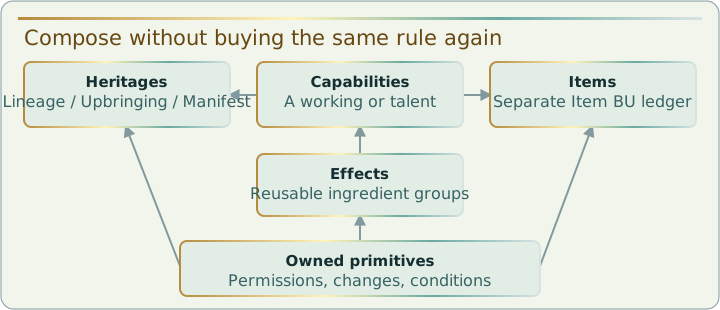
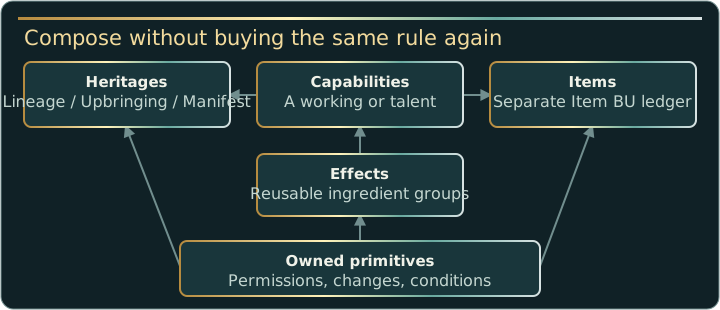
Lineage describes ancestry or species. Upbringing describes background and training. Manifest describes a role or current expression of the character. These heritages can organize primitives into a coherent foundation.
You can develop your own heritages, adapt an existing one or use several where the concept and table agreement support them. A heritage name alone grants no additional mechanics. Check the actual ingredients and count purchases appropriately.
An effect groups related outcomes or ingredients. A capability organizes a complete working or ready intent. Once you own its ingredients, describing another arrangement does not buy the same primitives again. A new arrangement still needs suitable permissions, scope and resolution.
Keep items separate
Items have their own Item BU accounting. Agree an equipment allowance with the DM rather than assuming it is included in the character's 25 BU.
Default - equipped slots. You have six universal equipment slots. An ordinary equipped item uses one; a two-handed item uses two. A particular item can have a higher agreed requirement, and primitives can extend your available slots. Size does not automatically multiply that requirement.
A small courier might be allowed to wield an unusually large sword with a three-slot requirement or another consequence. Describe the adjustment on that item so everyone knows how to apply it.
Load tracks what you carry and remains separate from equipped slots and Item BU. An unequipped item can still contribute Load.
Check that the character is ready
Before the first scene, make sure you can explain:
- Your character's purpose and how they connect to the party.
- Their base attributes, training and current check bonuses.
- The purchased verb and domain permissions that support their special actions.
- Purchased BU, unspent BU and separate equipment accounting.
- Current and maximum Vitality, equipped gear and any actual drawbacks.
Drawbacks are optional. Accept their real consequences before using any permitted mirror credit; a descriptive personality flaw does not automatically produce BU. Detailed mirroring and progression rules appear in the budget chapter.
App note. Quickbuild and complete creation both produce characters you can keep developing. A form may offer one slot for each heritage type as a convenience. That form does not replace the table's agreement about the character's concept.
Read and compose your abilities
You have a concept and a purchase ledger. Now turn those ingredients into things you can explain and use. You can use something from the Library, adapt it or build your own. All three approaches use the same construction rules.
Start with the intended result
Describe what you want in ordinary words before choosing a name or mechanical format. “Guide water from one vessel into another” gives the table something to judge. A title such as River Hand helps you find the working again, but its description and ingredients establish what it does.
Ask which parts of the result need extraordinary access. Moving an ordinary bucket can be an ordinary action. Shaping its contents from across a room requires the relevant permissions. A primitive can grant a permission, change a number or establish a particular rule; read its definition rather than relying on its icon or family name.
Read the main building blocks
The Market organizes base primitives into families. Begin with the following questions:
| Question | Relevant foundations |
|---|---|
| What kind of change can I make? | Verb access |
| What can I work with? | Domain access |
| How is the working arranged or delivered? | Structure and targeting |
| How far does it reach? | Range |
| What output can I express? | Intensity and dice |
| How does it persist or respond? | Duration, triggers and particular authored rules |
| What changes on my sheet? | Attribute/practice grants, numerical modifiers, senses, mobility, defenses and other augmentations |
These questions are a way to read a working, not a requirement to purchase one primitive from every family. Use your baselines and owned rules, then identify any additional permission the proposed result actually needs.
Default reference - access tiers. The base verb, domain and structure families use four access tiers with suggested anchors of 4, 8, 12 and 16 BU. Their meanings differ by family. Verb Tier II describes changing existing states; Domain Tier II describes a different breadth of subjects. Owning one does not grant the other.
Range and output use their own ladders. Near Range permits 30 ft with a current suggested cost of 4 BU. The d8 output permission also has a current suggested cost of 4 BU, but it grants a die type, not distance. A shared price does not make two primitives interchangeable. The reference tables collect these base definitions; authors and the table can agree different prices for their actual rules.
Make an effect, then a capability when useful
An effect groups related ingredients or outcomes so you can reuse them. A capability organizes a working, talent or ready intent. A capability can contain primitives directly and can also use effects. An effect need not be created as a separate card before every capability.
For each construction, record:
- Its name and intended result.
- The ingredients and what each contributes.
- The recipient or target, scope and applicable conditions.
- Any numerical change, output, trigger or duration it actually establishes.
- Stacking, limits and ending conditions where they matter.
- How it is proposed and resolved in play, including any agreed continuation requirement.
Keep a permanent acquired rule distinct from the temporary result of using it. Owning a water-shaping permission does not mean every water structure is permanent. Owning a die type does not automatically heal every injured target or establish resistance to incoming damage.
Keep one purchase ledger
Organizing the same acquired ingredient in several effects, capabilities or heritages does not repurchase it. Count the underlying acquisitions, including any deliberately acquired additional occurrences. Read each rule's restrictions before deciding that several appearances create several contributions.
Mira already owns all five purchases in her 24-BU ledger. Guided Water and River Hand organize some of those ingredients; they do not increase her total to 48 BU or produce extra free copies of the rules. If she later acquires a new ingredient, record that acquisition and its cost.
Build a heritage around the person
A heritage connects mechanics to ancestry, experience or current expression. Choose Lineage, Upbringing or Manifest according to what the creation represents. Include the rules and capabilities that support its description, and identify the actual acquisitions it contains.
You can adapt this upbringing or write a new one. A compelling biography can remain descriptive; mechanical benefits need their actual rules. Likewise, a descriptive flaw becomes a purchased drawback only through its agreed mechanical or narrative terms and the applicable mirror rules.
Write a new primitive when your idea needs one
First state the rule in readable language. Identify who receives it, what it permits or changes, when it applies, how it stacks and any limit. Propose a BU price and explain the scope or restrictions behind it. Review it with the DM before relying on it in a build.
A useful review asks whether two readers would apply the rule the same way. “See heat” needs a scope: what sense is granted, what it can distinguish, what blocks it and whether it locates a target well enough for a working. “Gain a bonus while wet” needs the affected check or metric, the amount, the meaning of wet and its stacking treatment.
You do not need a catalogue entry whose name exactly matches your concept. The base families provide vocabulary and examples for authoring. Their suggested prices help the conversation; the author and table settle the actual rule and price.
Agree consequences as part of the working
Consequences are part of play and can also be part of an authored rule. They can change numbers, restrict an action, consume a resource, affect the surroundings or create a narrative obligation. The same condition name can describe different consequences in different situations.
Before committing, agree what the consequence means and when it applies. A clear record includes:
| Detail | Example of an agreed consequence |
|---|---|
| Source and affected subject | Mira maintains a difficult water channel. |
| Actual change | She must keep directing it and cannot use this same working for a second channel at the same time. |
| When it applies | While she continues maintaining this channel. |
| How it ends | Ending the working releases the restriction and the unsupported water falls away. |
| Recovery or follow-up | If the attempt causes another lasting consequence, record its own ending or recovery terms. |
This is an example agreement, not a universal limit of one channel or one maintained capability. Other circumstances can support another scope, cost or continuation requirement.
If the agreed cost is Vitality, record the amount and timing. If it is lost access until a task is completed, record that task. A new round or rest does not erase a consequence whose stated ending has not occurred. Agree lasting injuries and other special recovery needs explicitly.
An attempt can have a small or negligible cost when the situation supports it. Ambition, urgency and danger affect the appraisal. BU buys reusable mechanics; execution has its own agreed consequences. Do not spend BU every time you use a purchased primitive unless a particular agreed rule establishes a different purchase or consumption arrangement.
Try the construction in a scene
Test more than its most favorable use. Ask what happens when the target is hidden, the proposed result is larger, the actor is interrupted or two rules contribute at once. Clarify missing terms before the construction becomes hard to apply during a tense scene.
Mira can guide nearby water in a calm room without assuming the same outcome for a flooded, collapsing stairwell. The latter adds moving obstacles, frightened people and urgency. Her access remains the foundation; the table appraises this attempt and agrees its resolution.
App note. The Library provides examples and the Atelier helps organize and inspect creations. Keep the actual ingredient definitions with an offline character record. A saved card is convenient, but the table's agreed rules and the character's acquisitions determine what is available.
Resolve uncertainty
You do not roll because you named a practice. You roll when the result is uncertain and the difference matters. Explain how you approach the problem. The DM and players establish the relevant attribute or practice, the opposition or DC, and what the possible outcomes mean.
Default check: roll d20 + the relevant current attribute + applicable training + applicable modifiers. Meet or beat the agreed DC. Use the attribute's actual value; Physical 3 contributes +3, not a converted score modifier.
If your sheet already shows a combined practice bonus, add that bonus once. Mira's trained Knowledge is Mental 3 + PB 2 = +5. A roll of 9 gives 14. Against DC 12, that succeeds. Adding Mental and PB again would incorrectly give 19.
Ten practices, many approaches
| Attribute | Practice | Ways it might matter |
|---|---|---|
| Physical | Prowess | Force, exertion or holding a contested position. |
| Physical | Finesse | Precise movement, careful manipulation or concealment through movement. |
| Physical | Fieldcraft | Practical survival, handling hazards or stabilizing an injured companion. |
| Mental | Awareness | Noticing relevant details or following a visible development. |
| Mental | Reason | Analysis, deduction or understanding a mechanism. |
| Mental | Knowledge | Recalling learned information or applying a familiar discipline. |
| Mental | Influence | Persuading, negotiating or expressing a credible threat. |
| Magical | Mysticism | Understanding or applying extraordinary workings. |
| Magical | Communion | Relating to or communicating through an appropriate extraordinary connection. |
| Magical | Intuition | Interpreting an extraordinary impression or choosing through granted insight. |
These are examples of approaches, not exhaustive permission lists. Ordinary attempts remain available without training. Extraordinary results require their actual access. A social check does not automatically give control over another character's decisions.
Default. Proficiency adds PB where applicable. Expertise uses twice PB when granted. A repeated grant of the same training does not itself add another PB. A separate explicit numerical bonus follows its own conditions and stacking rules.
PB starts at 2. Its baseline is 2 + floor((level - 1) / 4), before active modifiers. The explicit floor is part of this formula; the ordinary rounding rule elsewhere is upward.
Attacks, saves and your DC
Default attack. Roll d20 + the relevant current attribute + applicable PB training + attack modifiers against the target's DC. Meet or beat it to hit, then resolve the actual damage or effect separately. A miss does not deal the hit's damage unless a specific rule says otherwise. Use the displayed combined attack bonus once.
Default save. A recipient resisting a save-based capability rolls d20 + the relevant current attribute + applicable saving-throw training + save modifiers against the user's DC. The actual capability/source determines the appropriate Physical, Mental or Magical save and the outcome of success/failure. The chosen proficient attribute grants PB to its own saving throw; other saves do not gain that PB automatically. An additional training grant can establish it at its stated scope.
Example. An attack roll of 11 with +6 gives 17 against DC 15: it hits. If the chosen construction instead calls for a save, the recipient rolls that save against the user's DC; it is not a second automatic roll after the hit.
An attack tests whether an attempted attack succeeds. A saving throw tests an actor's resistance to an effect. Your working's actual delivery and the table's resolution determine which is appropriate; using a capability does not demand both an attack and a saving throw by default.
Default. Your selected-attribute DC is 5 + current PB + the chosen eligible current modified attribute + direct DC modifiers. Mira's Magical 4 and PB 2 give DC 11. Physical, Mental and Magical saving throws remain separate values. They do not imply three different character DCs. Use the relevant save and its actual granted training or modifiers.
Read authored result floors, ceilings and fixed-result rules at their stated scope. A minimum check result does not raise the attribute itself. An attribute increase can instead affect every derived number based on it. Do not add an automatic natural-20 success, natural-1 failure or critical-damage multiplier unless the table or an authored rule has established one.
Advantage can stack
Default. Apply the sources' conditions and uniqueness rules, then cancel advantage and disadvantage one-for-one. Each remaining stack adds one resolution die. Roll N + 1 dice for N net stacks: keep the highest for advantage and the lowest for disadvantage. With none remaining, roll one die. Add the applicable static bonus once after selecting the die.
Examples. Two advantages and one disadvantage leave one advantage: roll 2d20, highest. Two advantages without opposition give 3d20, highest. Two disadvantages give 3d20, lowest. Stacking does not bypass a primitive that expressly forbids repeated contributions.
Act together in combat
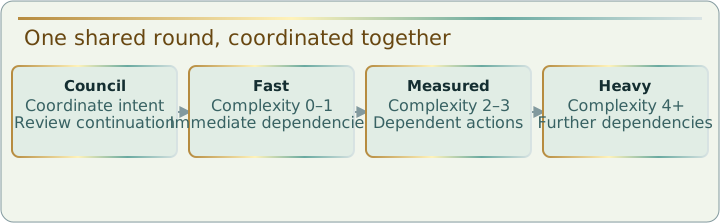
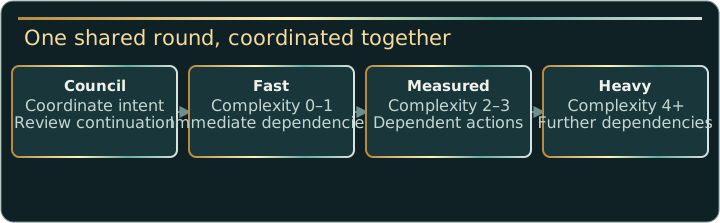
A combat round is a shared problem. Your party can coordinate a plan, resolve simpler actions before dependent ones and respond when the situation changes. SwordWeave uses Council → Fast → Measured → Heavy. There is no default initiative roll or imported bonus-action sequence.
Council: make the plan understandable
Describe one coherent Main Intent. Coordinate with your allies and establish which actions depend on another result. The DM describes what the opposition is visibly attempting. Check access, timing, scope and stakes before commitment.
Default tracks: Fast resolves Complexity 0-1; Measured resolves 2-3; Heavy resolves 4+. Complexity concerns timing dependencies, not a ranking of damage or power. A straightforward powerful strike need not become Heavy merely because it has large output. Agree a rushed or altered timing with its actual access and consequences.
Track where the round leaves everyone. When a path collapses in Fast, an action planned for Heavy must use the changed route rather than an imaginary unchanged battlefield.
Clashes and contests
Use a Reaction Clash when opposing intents meet within a track and arriving first matters. Roll d20 + relevant attribute + PB if trained, with applicable rules. The higher result acts first. On a tie, the GM resolves simultaneously or follows the stronger fictional position.
Use an Active Contest when efforts directly oppose: holding a door against someone forcing it open, or slipping past a watchful opponent. Agree a suitable approach for each side. Use the relevant combined practice bonus once where a practice applies. The higher result wins the immediate struggle.
Losing timing does not automatically erase your Main Intent. If a guard rings a bell before you seize their arm, the alarm has sounded; seizing the arm may still be possible. If your plan has become impossible, pivot: redirect it, reduce the scope or accept another sensible consequence before resolution.
One independent reaction
Default. You have one Reaction Slot each round, reset at Council. A reaction needs a clear event you can perceive and an available response you can perform. Its default scope is immediate, Complexity 0-1, and self/touch or one target. Relevant access and position still matter. A larger response needs a specific permission or explicit table ruling.
Pause the triggering event, resolve the reaction, then continue. A reaction can occur before or after your Main Intent. It does not automatically cancel the event it responds to.
Example. Neri catches an ally slipping beside them. Being nearby and able to catch them establishes the opportunity. Saving everyone falling across a distant broken bridge is a different scope; spending a Reaction Slot alone does not grant that rescue.
Move across the round
Default. Your Speed is movement available across the whole round. Spend some or all, divide it among tracks or valid reactions, and include it in an intent or move independently where the situation permits. Beginning a later track or using a reaction does not give a fresh allowance.
Example. Speed 30 ft supports moving 10 ft in Fast and 20 ft in Heavy. Moving farther needs an appropriate speed primitive or an agreed Cost/consequence. Actual routes, interference and hazards still apply; reach is not permission to pass through a wall.
| Size | Walking Speed | Default swimming/climbing |
|---|---|---|
| Tiny | 15 ft | 8 ft |
| Small | 25 ft | 13 ft |
| Medium | 30 ft | 15 ft |
| Large | 40 ft | 20 ft |
| Huge | 60 ft | 30 ft |
| Gargantuan | 90 ft | 45 ft |
Swimming/climbing default to half base speed rounded up. Authored rules can change these values. Flight and burrowing require their relevant grants.
A bridge round
Example. Mira will restrain a guard's alarm arm; Sol will build a supported path across a gap; Neri will move an injured friend once the path exists. At Council they agree access, movement, timing and what failure risks. The guard reaches for the bell while another opponent attacks the support.
In Fast, Mira clashes with the guard. Suppose the guard wins timing: the bell rings, and Mira can still try to restrain them if possible. Damage to the support changes Sol's construction. In Measured, Sol completes a smaller path at the agreed continuing cost. Neri uses that path in the agreed order. A nearby slip can create a valid reaction opportunity; a more elaborate dependent attempt resolves in Heavy.
Before the next Council, record damage, costs, current positions, continuing requirements and unresolved consequences. The party crossed, but pursuers now know where to look. Success at the crossing did not erase the alarm.
Optional guidance: surprise. There is no universal surprise subsystem. A table might let prepared enemies complete a round before surprised participants respond. The circumstances or an agreed d20 check may change that treatment. An ambush does not automatically entitle every enemy to a free round.
Push the limits
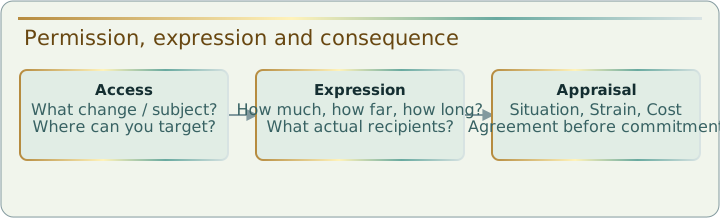
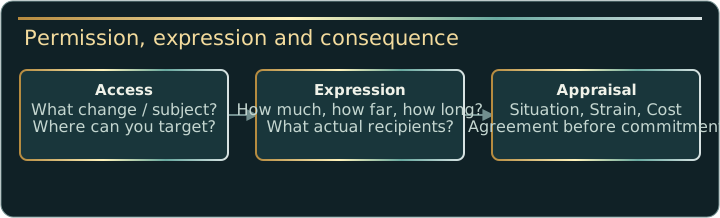
Owned access establishes what you can propose. The particular attempt establishes how much pressure it creates. d10 output and Very Far reach do not make four dice against a distant crowd as effortless as one die at Touch range. Describe the chosen output, recipients, area, distance, duration and timing; the table appraises the whole result.
Scale, impact and complexity
Scale asks how much is affected. Impact asks how strongly the result changes it. Complexity asks how the working's parts depend on each other. Environment, opposition, available support and urgency matter too.
Raising dice count, area, targets or duration does not require a separate acquisition for every dial by default. It can increase Strain and Cost. Adding a new behavior, such as healing allies inside an enemy-harming blast, may require additional access and a different construction. Neither a bigger die nor a higher payment silently grants the behavior.
Core rule. Locate a specific target through a relevant sense. Vision, granted blindsight, tremorsense or another suitable method can establish its location. Range alone does not reveal it. Without that location, propose targeting a known spot or area and resolve uncertainty; the desired creature might not be there.
An authored working can establish another targeting method, including scrying, broad weather control or any qualifying target within a stated range. Agree its actual scope and exceptions. Extreme reach can extend by DM agreement, but extra distance does not supply knowledge of the target.
Agree a Cost before committing
Strain is a 0-6 appraisal guide, from effortless through light effort, noticeable strain, heavy burden, dangerous instability, critical risk and catastrophic consequence. A grade is not an automatic Vitality bill or a fixed chance of success.
Cost can be Vitality, a resource, a numerical penalty, exposure, a restriction, environmental change or a narrative consequence. It may be negligible. Agree what applies, when it applies and what failure means. Interruption has no universal refund rule.
Example. Heating a wet lock can scorch a tool or exhaust the actor. Setting a roof ablaze can spread fire into neighboring homes. Smaller scope, help or more time can change the proposed stakes. Ask for those alternatives before accepting a cost you did not intend.
Optional guidance: CV. A table can compare evaluated construction values. If minimum composition value B is 12 and the selected use A is 30, the scaling increase is A - B = 18; total CV is 30. These illustrate arithmetic, not a universal spell price. CV is not added to a roll and is not acquisition BU paid again. Numerical comparison supports appraisal; it does not capture every difference in environment or behavior.
Keep a working alive
When a working resolves, how long its result lasts, and what sustains it are three separate questions. Track answers the first, duration the second, upkeep the third. A fixed duration does not automatically require active maintenance.
Example. A flame can flash and end, remain for two rounds without further effort, or last while the actor sustains it. Write which construction applies. Continuing a working can spread its pressure over time; there is no compulsory numerical discount from doing so.
Ongoing consequences
Agree the maintenance requirement, its payment point within the shared rhythm and what happens if it cannot be met. Council is a useful agreed continuation point. A 4-Vitality requirement paid this round can be due again next round while the working continues. A loss of access until a task is completed instead lasts according to that ending condition. New rounds do not silently remove it.
Default. One maintained capability has one execution, one Strain appraisal and one upkeep track, even if it contains multiple effects. You may maintain several capabilities; their actual requirements accumulate. There is no default single-concentration limit.
A hit does not universally stop a working. Singing continuously may be threatened by silence. Burning incense may be threatened by losing the incense. An unconscious actor cannot continue a task they can no longer perform. Determine interference from the actual requirement, position, timing and consequence.
Alpha rule pending - damage-triggered Vitality upkeep. The creator has deferred the additional repayment threshold and damage-counter/reset/excess policy. This edition does not impose that scheme. Agree any temporary table treatment explicitly; ordinary continuation requirements remain usable. This notice does not alter upkeep paid through other mechanical, restrictive or narrative consequences.
Interfere with unfinished work
Describe a real way to interfere and establish the opportunity before the action resolves. Reach the actor, break an essential support, disrupt a required circle or use a suitable countering working. A reaction also needs its available slot and valid scope. Resolve the relevant attack, save, clash or contest; apply the agreed failure, partial result or continued execution.
Example. A gate needs an intact chalk circle. Scattering it before completion can threaten the actual construction. Missing the attempt does not stop the gate. Hitting its maker need not stop it if no agreed requirement is disrupted. Once an instant flash has resolved, its execution can no longer be interrupted retroactively; a resulting ongoing effect may still be disrupted through relevant access.
Survive and carry consequences
Vitality measures health, stamina and exertion. There is no universal separate mana pool or spell-slot track. Player baseline maximum Vitality is (10 + current PB) × level, then active maximum-Vitality rules. Current Vitality is a separate value; raising the maximum does not itself grant healing.
Damage has a source and domain
Physical, Magical and Psychic describe execution sources; fire, cold or another domain describes identity. Mental is an attribute, not an interchangeable name for Psychic source. Read the actual defense's source/domain scope.
Default. Resistance halves covered damage, rounded up; vulnerability doubles it; immunity negates damage within its stated scope. Multiple resistances do not quarter damage by default. Applicable resistance and vulnerability on the same instance cancel. Damage immunity does not automatically negate every associated consequence.
Example. Nine Magical Fire damage becomes 5 with matching resistance, 18 with matching vulnerability, or 9 when both apply. A mixed execution dealing 6 Physical Fire and 8 Magical Fire loses only 4 from its Magical portion under Magical-only resistance: total loss is 10. Establish whether mixed domains split one output or produce separate instances before applying defenses.
Apply the final damage as Vitality loss. Healing restores Vitality within the current maximum. App note. Manual damage fields do not automatically apply typed defenses; resolve them first.
Collapse is a rescue problem
Default. At zero Vitality, collapse leaves the character unconscious and incapacitated. The GM establishes contextual rescue stakes. Roughly a minute is guidance, not ten guaranteed safe rounds. Severe wounds or a hostile environment can shorten the opportunity.
Allies can dedicate an action track to Fieldcraft stabilization or a suitable creative use of owned primitives. The table agrees access, resolution and Cost; there is no universal stabilization DC. Successful stabilization halts the rescue countdown. It does not itself restore Vitality or wake the character. Healing above zero ends the dying state and restores consciousness unless another consequence prevents it. A stabilized character can recover through assisted rest; an actively dying character needs rescue first.
Massive damage. A single execution dealing at least twice maximum Vitality, or taking current Vitality to -maximum Vitality, can cause immediate death under the massive-damage rule. Establish lethal stakes before resolution. Use final damage after defenses and the current value before the hit; a sheet storing zero must not hide the overrun.
Example. Maximum 13, current 4 and final damage 17 gives 4 - 17 = -13. This reaches the negative-maximum boundary even though the blow is below 26. A blow of 26 reaches twice maximum independently. The contextual collapse rescue clock does not reverse an outright lethal result.
Recovery is agreed, not automatic
A short rest is a pause, perhaps 15 or 30 minutes. A long rest is overnight sleep or an equivalent meaningful recovery period, not a mandatory eight-hour timer. DM and players agree whether the circumstances earn either rest's effects. Elapsed time alone does not apply them.
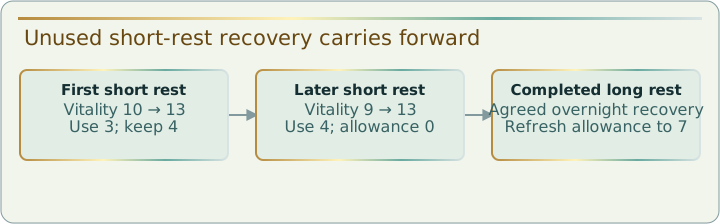
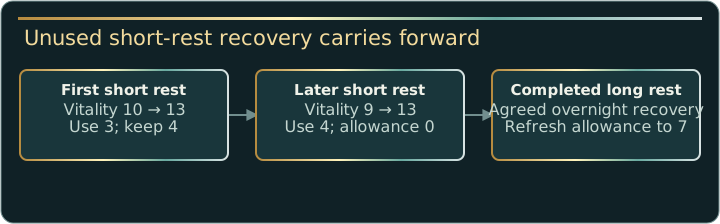
Default. Short rests share a finite allowance of half maximum Vitality rounded up between completed long rests. Only actual points restored consume it. Retain unused points for later agreed short rests. A completed long rest normally restores Vitality to maximum and refreshes that allowance; its healing is not charged against the short-rest pool.
| Example: maximum 13 | Actual recovery | Short-rest allowance left |
|---|---|---|
| Begin after a long rest | - | ceil(13 / 2) = 7 |
| At 10/13, agree a short rest | 3, reaching 13/13 | 4 |
| Later at 9/13, agree another short rest | 4, reaching 13/13 | 0 |
| Complete the next long rest | Normal full recovery | 7, refreshed |
The DM can adjust recovery by agreement. After poor sleep the table might allow 70% rather than full restoration; apply ordinary upward rounding when the chosen calculation needs it. A completed long rest still refreshes the short-rest allowance. Record the agreed amount rather than quietly assuming every rest is equally restorative.
Injuries, curses, access restrictions and other lasting consequences keep their own recovery requirements. Healing a burned character's Vitality does not automatically repair the destroyed map, remove a specific injury or satisfy an obligation. State what remains and how it can change.
Equipment and growth
An item can be an ordinary tool, a carrier for capabilities or a source of active modifications. Record what it actually provides, what must be equipped, its Item BU, Load and slot requirement. Describing a sword as enormous does not by itself write all those rules.
Default. You have six universal equipment slots. An ordinary equipped item uses one, a two-handed item uses two. A primitive can extend your slots. An agreed unusual item may require more or impose another consequence: a small character using an oversized sword might accept a 3-4-slot requirement. Size alone is not an automatic slot multiplier.
Load measures carrying; slots measure use. Equipped items still contribute Load. Capacity is size base + 5 × current Physical + applicable capacity bonuses. Load above capacity is encumbered; agree the resulting penalties or complications.
| Size | Base capacity | Ordinary Load per item |
|---|---|---|
| Tiny | 10 | Pouch rule |
| Small | 20 | 1 |
| Medium | 40 | 2 |
| Large | 80 | 4 |
| Huge | 160 | 8 |
| Gargantuan | 320 | 16 |
One pouch holds up to 1,000 tiny items and contributes 1 Load. A backpack organizes contents; changing capacity requires an actual rule. Use an item's explicit Load rule where granted. Keep purchase price or treasure value separate from Item BU and Load.
How an attack reaches a target
Projected vectors travel through space: arrows, beams or thrown blasts. Minor obstruction imposes -2 accuracy; ordinary half cover -4; total cover blocks the trajectory. Decide from the actual angle and path.
A direct manifestation appears at its target and ignores those intervening projected-cover penalties. It still needs a legitimate sensory location or authored targeting method. A wall does not become permission to locate an unseen foe. A visible head above cover may be reachable by a direct manifestation while the same barrier interferes with a traveling bolt.
Spend, develop and mirror deliberately
BU acquires mechanics. Item BU remains separate. Unspent acquisition budget can support a new primitive during play with table agreement; spending it does not undo progression. The DM and players agree rewards and pacing rather than follow a compulsory XP or per-session schedule.
Default progression reference. The literal cumulative table through level 21 includes its bracket spikes already. Do not add them again.
| Level | Cumulative BU | Baseline PB | Baseline maximum Vitality |
|---|---|---|---|
| 1 | 25 | 2 | 12 |
| 2 | 35 | 2 | 24 |
| 3 | 45 | 2 | 36 |
| 4 | 55 | 2 | 48 |
| 5 | 69 | 3 | 65 |
| 6 | 79 | 3 | 78 |
| 7 | 89 | 3 | 91 |
| 8 | 99 | 3 | 104 |
| 9 | 117 | 4 | 126 |
| 10 | 127 | 4 | 140 |
| 11 | 137 | 4 | 154 |
| 12 | 147 | 4 | 168 |
| 13 | 169 | 5 | 195 |
| 14 | 179 | 5 | 210 |
| 15 | 189 | 5 | 225 |
| 16 | 199 | 5 | 240 |
| 17 | 225 | 6 | 272 |
| 18 | 235 | 6 | 288 |
| 19 | 245 | 6 | 304 |
| 20 | 255 | 6 | 320 |
| 21 | 286 | 7 | 357 |
Active PB/Vitality modifiers change derived values. The explicit level-21 BU value is retained as supplied; replacing the table with a simplified +10 formula would lose its adjustment.
Mirroring reverses a compatible rule within its actual scope: add/subtract, min/max, multiply/divide and grant/revoke have supported opposites. A Set To rule has no automatic opposite. Accepted personal drawbacks still apply when a mirrored ingredient supplies credit; a descriptive reversal must also make sense.
Default debt ceiling: 4 × ceil(level / 4): 4 BU at levels 1-4, 8 at 5-8, 12 at 9-12 and so on. Ordinary unspent budget, available mirror credit and actual debt used are different figures. A ceiling is not a mandatory drawback purchase or automatic extra encounter budget. Review eligibility, acquisitions and the drawback's scope before applying credit.
Creation fills ordinary budget first, then eligible drawback credit, then any remaining overflow. Going beyond ordinary allowance requires DM agreement; creation cannot exceed the next-level ceiling or permitted drawback debt. The digital sheet's later warnings do not substitute for that agreement.
Your first scene, step by step
You can learn SwordWeave by playing one small situation. This chapter follows three players through a rescue, including their questions, a useful roll, an unsuccessful approach, and the record they carry forward. Read it as a conversation you can imitate. Its DCs and consequences belong to this example; they are not a universal rescue system.

The situation before the dice
The party reaches a mill above a canal. A worker is trapped on a balcony. A wooden support has cracked. There is a trough beside the road, a coil of rope, and a narrow maintenance stair. The balcony is 20 ft from the trough and 10 ft above the lower landing. Nobody is attacking the party. The urgency comes from the moving water and weakening building.
The DM gives those visible facts without requiring a check. The players know enough to make choices. They can ask about anything that would be evident to someone standing there: the rope's condition, the nearest window, the depth of the water, or whether the worker can move.
Mira, the water courier, can reshape existing water. Torren, a practical gatekeeper, has strong Physical approaches and training. Ilex, a records keeper, reads structures and speaks calmly to frightened people. Their complete builds appear in the next workshop. The scene is not designed to require all three special abilities. They can succeed through tools, cooperation, or a different plan.
Each question has changed the plan's reliability. None has spent an action merely because someone spoke. If speaking would itself create a risk in another scene, establish that risk there. Here the conversation supports a shared intent.
Identify the extraordinary part
Mira describes shaping the trough's existing water into a support. Water domain access identifies the subject; Verb II supports changing its form. Near permits the 20-ft reach. She is not creating water from nothing, permanently turning it into stone, or giving the worker a new sense.
The DM asks how the proposed support works. Mira wants a narrow moving channel to take some of the stair's weight while Torren braces it. That is more specific than “I fix the mill.” It also leaves the ordinary rope, strong landing, and worker's cooperation relevant.
The table agrees that the water can assist a short rescue under these circumstances. The support is temporary: Mira must keep directing it. They choose a Magical check to establish it before another shift. Failure means the water arrives too late to brace the upper stair, which then becomes unusable; the worker still has the balcony rail and the rope remains an alternative. The table has not agreed automatic death on a failed setup roll.
Mira can accept the attempt, narrow it further, or take the rope route instead. She accepts. Her combined Magical bonus is +6. A d20 result of 7 gives 13 against the agreed DC 12. The narrow support forms. Her acquired d8 output is not rolled: this construction is neither an attack nor a healing effect.
Let support change the next question
Torren moves to the landing. He does not need a second roll to notice the support Mira just created. He wants to climb the stairs and bring the worker down. The remaining uncertainty is whether he can keep the warped handrail and the worker steady while the water shakes the stairs.
The DM first asks what Torren uses. He anchors the rope on the intact lower post and gives the worker its free end. That preparation changes the possible failure. A slip can now leave them hanging from an anchored rope rather than falling immediately into the canal. Agree that change before the roll, not as a reward invented afterward.
The table selects Prowess for controlling the weight of the worker and rail. Torren has +7: Physical 5 and PB 2. The agreed DC is 13. He rolls 4, totaling 11. He does not bring the worker safely down yet. The upper rail breaks. They remain supported by the rope and Mira's channel, but the stair route has changed.
Torren's player has options. He can hold position while Ilex directs the worker toward the window. He can propose greater exertion with a consequence. He can release the damaged rail and trust the rope. The failed roll has produced a new decision, rather than asking him to roll the same unchanged check until it works.
Propose a narrower success
Torren asks to pull the worker onto the landing immediately. The DM offers a bounded consequence: he can do it, but his shoulder will be strained, imposing the agreed restriction that he cannot carry another person until treated and rested. This is an example ruling, not a fixed injury penalty attached to every Prowess failure.
Torren asks whether bracing the rope against the post would reduce that cost. The DM agrees, but someone must guide the worker so the rope does not cut across a broken edge. Ilex can do that from the safe bank. Ilex has not acquired a “rescue instruction” primitive; ordinary communication is available.
The group chooses the supported version. Ilex explains the movement clearly, Torren draws the worker in, and Mira keeps the water directed. The remaining situation is secure enough that the DM does not require another roll. The worker reaches the landing. Torren has accepted a lesser consequence: aching hands, requiring clean dressings before precise rope work becomes comfortable again. They record its actual meaning together.
Record what survived the scene
The party's record now includes a rescued worker, a damaged stair, a rope that needs inspection, and Torren's agreed hand consequence. Mira releases the water support; that maintenance restriction ends. Her future Water access remains hers. A temporary support disappearing does not erase the acquisition that permitted it.
The worker promises to introduce them to the lock keeper. This is a relationship created in play. It is not automatic BU, a purchased capability, or a mandatory reward. The table can separately agree an advancement award if the rescue completes an important campaign objective.
Before proceeding, the players check current Vitality and any actually paid costs. This scene's consequences were restrictive and environmental; nobody invents a damage bill after the rescue. Torren's hands remain affected until the agreed care occurs. A new scene does not clear the record automatically.
Learn from a different approach
The same scene can play differently. Ilex might ask the worker to crawl through the window while Torren holds a ladder. Mira might divert the pressure below the mill instead of supporting the stair. The party could evacuate the lower landing and wait for specialists if it is safe to do so.
Those choices use the same core loop: establish the result, check what supports it, set the scope and stakes, resolve meaningful uncertainty, and record the changed situation. The DM does not need to protect the water solution. Players do not need to imitate this conversation word for word.
Try it with your group. Change one fact: the worker cannot hear; the trough is empty; the balcony is 50 ft away; or the rope anchor is unstable. Ask which part of the plan changes. A missing water supply matters to a permission for reshaping existing water. Greater distance matters to Near. Neither is solved simply by declaring more damage dice.
Three people, three starting builds
These workshops show how a concept becomes a readable record. They use the default 25-BU level 1 foundation, a total of 10 base attributes, PB 2, and reference acquisition prices. Their unusual capabilities are explicitly authored examples. Review them with your own table before adopting them.
They are not classes. Nothing locks a gatekeeper into armor, a courier into water, or a records keeper into a career. Their purchases can develop in different directions. Keep the underlying ingredients when you reorganize a heritage; a title is not a second ledger.

Torren, the gatekeeper
Person first. Torren spent years keeping flood barriers working. He is physically strong, good at noticing what will fail, and reluctant to abandon someone behind a closed gate. His immediate goal is to deliver a warning to the next settlement. His connection to Mira is practical: her river knowledge helps him understand the warning's cause.
His base attributes are Physical 5, Mental 4, Magical 1. Physical is proficient. At level 1 that gives PB 2 to its three practices and its saving throw. Mental and Magical remain useful without training. He has not traded ordinary thinking for the right to lift things.
| Acquisition | Bound rule | BU |
|---|---|---|
| Verb I | Direct physical/perceptual interactions and simple force within the owned subject | 4 |
| Metal domain I | Grounded metal is an eligible subject; no control of minds, all matter, or every Tier I domain | 4 |
| d8 output | Permit d8 output for an appropriate authored damage/healing expression | 4 |
| Awareness proficiency | Add PB to relevant Awareness checks; does not train every Mental practice | 4 |
| Steady Hands | Add +2 to Finesse checks to thread or tie a rope while both hands are free | 4 |
| Defensive Save Upgrade: Mental | Grant PB training to the Mental saving throw | 4 |
| Total | Six acquisitions; no mirror credit | 24 |
The last two 4-BU entries are table-reviewed choices. Steady Hands is the authored example in the reference, not a universal price for every +2. The save-training grant applies to the saving throw, not to Reason, Knowledge, or Influence.
Derived record. Maximum Vitality 12; short-rest allowance 6; Physical-selected DC 12. Prowess, Finesse, and Fieldcraft are +7. Awareness is +6. Reason, Knowledge, and Influence are +4. Mysticism, Communion, and Intuition are +1. Physical save +7; Mental save +6; Magical save +1. When Steady Hands qualifies, the relevant Finesse check becomes +9; the ordinary Finesse line stays +7.
Gate Crew Upbringing organizes Awareness proficiency and Steady Hands: 8 BU already counted. Iron Hand Manifest organizes Verb I, Metal I, and d8: 12 BU already counted. Mental save training remains another acquisition. Torren can describe a lineage without assigning it mechanics; the absence of a purchased lineage does not leave his character incomplete.
Iron Knock, authored capability. At Touch, use eligible direct force through existing metal to strike a located target. Example expression: one attack using Physical training, +7, against the target's DC; on a hit, 1d8 Physical Metal damage. This direct expression does not reshape an entire gate, create metal, gain reach, or automatically disarm the recipient. The table appraises unusual output or extra recipients separately. It has no ongoing upkeep in this example.
Working gear. A Medium two-handed canal hook has Item BU 0, Load 2, and two equipped slots. A Medium rope bundle has Item BU 0, Load 2, and one slot when actively equipped. If the table treats a worn working coat as an equipped item, it has Item BU 0, Load 2, and one slot. These are three explicit ordinary item records, not grants of armor or damage reduction. Total Load 6; equipped use four of six slots. Capacity is 40 + 5 × Physical 5 = 65. Tools have setting availability or prices separately from Item BU.
Three test uses. Iron Knock can strike a metal obstacle at contact under its actual rule. It cannot reach a guard 30 ft away using Touch alone. It does not quietly become Verb II reshaping when Torren wants to turn a lock into a key. The party can still use ordinary tools or ask for a bounded exception.
Mira, the river courier
Mira's full record appears in Worked records. Here the important construction decision is restraint. Her concept suggests many abilities, but she begins with a small reusable vocabulary: Verb II, Water I, Near, d8, and Knowledge proficiency. She spends 24 BU and leaves one unspent.
Her attributes are Physical 3, Mental 3, Magical 4, with Magical proficient. Maximum Vitality 12; short-rest allowance 6; Magical-selected DC 11. Her Physical practices are +3. Mental practices are +3 except trained Knowledge +5. Magical practices are +6. Saves are Physical +3, Mental +3, Magical +6.
She arranges Water, Verb II, and Near into Guided Water, then River Hand. She can also define Canal Impact, a separate authored example using those same acquisitions plus d8: drive existing located water along an actual projected path up to 30 ft, attack +6 against DC, and deal 1d8 Magical Water damage on a hit. A projected path is affected by its actual obstruction; direct manifestation requires a separately supported delivery arrangement.
Both capabilities reuse the same acquisitions: River Hand uses Water, Verb II and Near, while Canal Impact also uses d8. Her ledger stays 24. She does not gain two Water purchases or two simultaneous outputs because Water appears in two capability descriptions. Whether she can maintain one channel while launching another working depends on their agreed requirements and actual scope; there is no universal one-concentration limit.
Choice she postpones. Mira wants to restore a drowned person's breath. d8 output is not a healing permission. Grounded Water I does not automatically manipulate life or reverse death. She can rescue through ordinary aid, acquire a reviewed relevant construction later, or ask the table for a clearly scoped exceptional possibility. A sympathetic title such as “River's Mercy” supplies no missing behavior.
Her useful weakness. Dry surroundings matter because her present workings reshape existing water. This is a consequence of their recorded scope, not a mirrored drawback that automatically refunds BU. She carries a flask and asks where water is available. A companion who notices resources can be more useful than another die type.
Ilex, the records keeper
Person first. Ilex restores damaged maps and mediates disputes about old boundaries. They want to discover why two villages possess incompatible copies of the same canal charter. They are curious, careful, and willing to put themselves between angry people. Their unusual skill helps read physical documents; it does not decide whose rights are just.
Attributes: Physical 2, Mental 5, Magical 3. Mental proficient. Their foundation has 25 BU. They acquire a narrow grounded subject instead of an abstract information domain: Paper I concerns existing paper as material. Reading secret memories or rewriting belief would need a different subject and behavior.
| Acquisition | Bound rule | BU |
|---|---|---|
| Verb II | Reshape, redirect, combine, separate, transfer, or stabilize eligible existing states | 8 |
| Paper domain I | Grounded existing paper is an eligible subject; no control of all recorded knowledge | 4 |
| Mysticism proficiency | Add PB to Mysticism checks | 4 |
| Fieldcraft proficiency | Add PB to Fieldcraft checks | 4 |
| Steady Hands | Add +2 to Finesse checks to thread or tie a rope while both hands are free | 4 |
| Total | No mirror credit; 1 BU unspent | 24 |
Maximum Vitality 12; allowance 6; Mental-selected DC 12. Prowess and ordinary Finesse are +2; Fieldcraft +4. Mental practices are all +7. Mysticism +5; Communion and Intuition +3. Physical save +2; Mental save +7; Magical save +3. Mysticism proficiency does not train the Magical saving throw.
Archive Upbringing groups Paper I, Verb II, and Mysticism proficiency: 16 existing BU. Fieldcraft and Steady Hands are individual acquisitions. Their lineage is descriptive. They can later build a Manifest for a new role without losing their archive training.
Dry the Record, authored capability. At Touch, reshape or stabilize existing paper so a soaked sheet can be handled without immediately tearing. State what material is present and which damage is reversible in the scene. The capability does not reconstruct words that no longer exist, authenticate a lie, reveal invisible ink through walls, or grant Near reach. Time, tools, and uncertainty remain relevant. The free d4 baseline is available for suitable output constructions but is not needed for this task.
Play connection. Ilex can notice repeated marks through Awareness, compare accounts through Reason, recall a charter through Knowledge, or negotiate through Influence. All four have +7 from Mental proficiency, but they answer different questions. A good comparison may make a conclusion secure with no roll. A persuasive argument cannot force a frightened villager to adopt a belief against all evidence.
Check the three ledgers together
Each character has 24 positive acquired BU, 1 ordinary BU left, no mirror credit, and separately recorded equipment. The party's default progression reference is 3 × 25 = 75 Party BU, not 72 because three points are unspent. Spent acquisitions describe builds; Party BU represents their progression budgets for encounter comparison. Add actual resolved Item BU separately.
Torren and Mira can deal d8 output through their recorded expressions. Ilex can be useful without an extraordinary damage capability. Ordinary actions, resources, and relevant senses remain available to everyone. These records demonstrate a varied party rather than a mandatory frontline/healer/damage roster.
Before using them, ask each player to name one thing they can do, one limit, one relevant combined bonus, and one reason to cooperate. If someone cannot explain a capability, simplify its prose. A longer list is not automatically a better character.
Adapt a workshop without losing its accounting
Start with the desired change. Swapping Water for grounded Air changes Mira's subject, so rewrite the effect and tests; do not merely change the icon. Replacing Knowledge proficiency with a different 4-BU practice grant changes the affected checks while leaving the acquisition total unchanged. Replacing a 4-BU grant with a proposed 12-BU attribute increment changes the ledger and possibly the derived sheet.
A fork is a new authored definition. You can keep references to unchanged ingredients, record what you changed, and agree which version belongs to the character. Existing ownership does not imply a free unrelated upgrade simply because the new creation descended from an old one. Discuss replacement or retraining with the table; SwordWeave does not prescribe a universal fee.
A construction workshop
Use this chapter when an idea does not fit a ready-made entry. You can begin with a sentence and turn it into a primitive, effect, capability, or heritage. Every layer should make the result easier to understand. You do not need a nested container merely to make the card look complete.
Choose the smallest useful record
“Add +2 to Finesse checks to thread or tie a rope while both hands are free” is one primitive. Its amount, recipient, check, and condition are clear. It does not need an effect and capability to become valid.
“Guide existing water around an obstacle within 30 ft” uses several acquired ingredients. An effect can gather its recurring arrangement. A capability can explain how the character applies it. A heritage can connect those permissions to the character's history. These layers organize the same purchases; they do not invent additional power.
Use a direct primitive when one readable grant is enough. Use an effect when a group of ingredients is repeatedly useful together. Use a capability when the table needs a complete working, trigger, or use. Use a heritage when the character's ancestry, experience, or current expression gives those mechanics context.
Separate five kinds of statement
| Statement | What it establishes | What it does not establish |
|---|---|---|
| “Water is an eligible subject” | Bound domain permission | Every grounded domain; healing; automatic success |
| “Reshape existing states” | A kind of change within owned subject access | Infinite quantities; every causal rewrite |
| “Up to 30 ft” | Maximum permitted reach | Sight; passage through barriers; target knowledge |
| “Use d8 output” | Eligible output die type | A compulsory attack; dice count; extra recipients |
| “While singing” | A condition or continuation requirement | Automatic action economy; immunity to silence |
When a sentence mixes several categories, split it into readable clauses. “Sing to all allies, reveal hidden enemies, and restore everyone” might combine targeting, information, healing, recipients, and persistence. Review each contribution, rather than assigning one broad word a package of powers.
Write a useful condition
A condition should be something the table can identify. “While blessed” requires a definition of blessed. “While touching the marked stone” provides a clear event, but you must still decide whether a glove counts and what happens if contact ends during execution.
Choose conditions because they express the concept and create understandable decisions. A fragile condition that nobody can verify becomes an argument. A condition that is always true contributes no practical restriction. Neither automatically establishes a fixed discount: price is an authored proposal.
Workshop example. A player writes “Gain +2 Awareness near water.” The table asks what near means. They choose within 10 ft of an open body of water large enough to immerse a hand, while conscious and able to perceive it. The bonus applies to Awareness checks concerning changes in that water, not every Awareness check made beside a puddle. That is a narrower authored example; its price must be proposed and accepted separately.
The revised rule is easier to use. It also makes the player's desired scene clear. If they intended every observation beside water, they should say so and review that broader scope.
Choose an operation at the right level
An attribute bonus can affect its practices, trained save, selected DC, and other formulas that actually use the attribute. A bonus to one check affects that check only. A result floor constrains a result at its stated stage; it does not replace every contributing attribute. A grant establishes permission or training; repeating the same training grant does not stack PB endlessly.
Ask the author to show a before-and-after example. For Ilex, adding +1 Mental changes Mental from 5 to 6 if that grant is accepted within the actual limits. Their Mental-trained check total would become 8 before further modifiers. Adding +1 only to Knowledge leaves Reason, Awareness, Influence, and the selected DC unchanged. These are mechanically different proposals even if both have “clear thinking” in their names.
The app may support a precise numerical operation. Use it when it faithfully expresses the rule. If a rule is contextual, readable prose remains authoritative for the table. Automation should not fabricate an unconditional number for a conditional benefit.
Make stacking legible
The default is that applicable contributions stack unless their actual rules say otherwise. First check whether each source qualifies. Then check uniqueness, acquisition identity, and any authored cap. A primitive referenced twice in the same composition is not necessarily two acquired occurrences.
For probability bias, cancel opposing stacks and roll one extra resolution die per remaining stack. For static bonuses, apply the qualifying numerical contributions at their actual scope. For training, multiple grants of the same proficiency establish the same trained state rather than repeatedly adding PB. Those three behaviors should not be described with one vague “stacks” counter.
Example. Torren has trained Finesse +7. Steady Hands supplies +2 during qualifying rope work, giving +9. A second effect referencing the very same acquired Steady Hands does not add another +2. If he deliberately acquires an additional permitted occurrence, the table checks its actual stacking/uniqueness rule before applying it. A separate source of advantage changes the dice selected, not the +9 static bonus.
Test a trigger without inventing an extra action
“When an ally falls” defines an event. It does not, by itself, grant an unlimited free response. Write how the response interacts with the shared rhythm, available Reaction Slot, immediate scope, senses, and actual distance.
Example authored wording. “When a conscious ally within ordinary reach begins to fall, you may spend an available independent Reaction Slot to catch them with a free hand. Resolve the actual interference or weight through the table's chosen procedure.” This is a readable immediate response. It gives no remote rescue, extra slot, or automatic success.
An author who wants an additional reaction must state that economy change separately. An author who wants a distant catch needs relevant reach and behavior. A powerful story image can be supported by a clear construction; it does not need to hide those decisions.
Give a transformation boundaries
“Become a wolf” leaves important questions unanswered. Which size, speed, senses, defenses, and capabilities change? What remains from the character? Is gear carried, merged, dropped, or unchanged? What ends the form? Which actual acquisitions supply the changes?
Write the form's readable record. If it is only a cosmetic change, say so. If it grants a movement mode or sense, identify its scope. Do not silently copy every rule from a creature with a similar appearance. A small photograph or portrait cannot define a build.
For a beginner, a narrow form can be easier: fur, posture, and voice change; existing attributes and equipment remain; no new attacks or senses are granted. The player can add reviewed mechanics later. This gives them a playable starting point without pretending the full fantasy is already encoded.
Turn the construction into a heritage
A Lineage can express inherited or bodily features. An Upbringing can express learned skills, customs, and work. A Manifest can express a present vocation, awakened gift, or self-defined role. These are organizing meanings, not rules that every benefit must fit exactly one biological category.
Suppose Ilex develops Keepers of the Fold, an upbringing of map restorers. It contains their existing Paper I, Verb II, and Mysticism proficiency. Its description explains careful copying and why they mistrust a clean map without a date. The upbringing costs 16 of the already recorded BU. It grants no automatic language list, legal authority, or new sense because its members keep archives.
Another character can adapt it with Knowledge training or a different subject. Name the changed ingredients and ledger. Stories connect the mechanics to a person; the mechanics explain what the story lets that person actually do.
The three-use review
Test a normal use, a stretched use, and an outside-scope use. A normal use demonstrates the working at its intended scale. A stretched use checks how the table will negotiate effort, recipients, time, and consequences. An outside-scope use reveals missing access rather than pricing it as more of the same.
For River Hand, pour a small stream from a nearby trough, redirect a flood across a street, then restore a drowned person's life. The first may be secure. The second raises serious scope and consequences. The third introduces a different behavior; more water or more d8s does not establish it.
Record ambiguities revealed by these tests. If a player and DM interpret the same clause differently, settle it before a tense scene. You do not need a universal answer for every possible future use. You need an intelligible rule and a reliable conversation for the next one.
Adventures beyond a fight
SwordWeave's construction tools should expand your choices in conversation, investigation, travel, and work. A character who cannot deal spectacular damage can still carry an adventure. Start by asking what the situation needs and what your character can contribute.
Investigate through evidence
Distinguish what you can see from what you infer. A broken seal is a visible fact if you can inspect it. Who broke it can be uncertain. A check should answer a specific question: find a trace before it washes away, recognize a tool mark, or connect two accounts under time pressure.
Ask where the information might come from. People, documents, materials, and granted senses can supply different evidence. A magical impression can establish something its rule actually detects; it does not automatically become a complete account of the past.
Share discoveries with the party. A useful clue may let someone else act. If you fail one approach, try a different source or revise the question. Do not assume every failed check means the answer is forever unavailable, and do not assume repeating the same words gives endless safe attempts.
Negotiate with a person
Listen for what the other participant wants and can afford. Offer something relevant. A Watcher protecting a spawning bed may accept a flow plan that preserves it. A worker who needs immediate safety may care little about an elegant explanation of water mechanics.
Your Influence bonus helps resolve uncertainty in an actual approach. It does not replace the offer, erase another person's motives, or grant supernatural control. If a capability changes agency, read its exceptional behavior and agreed boundaries explicitly.
A successful negotiation can be a limited agreement. “We will open this route for one crossing if you repair the bank” is different from permanent allegiance. Record the terms. This avoids treating every good roll as a universal relationship upgrade.
Travel through a changing place
Ask what route offers, what it risks, and what the group knows. Distance, terrain, time, weather, and supplies can matter. Your table may use a travel procedure, but its ration costs, intervals, and weather rolls are campaign choices rather than hidden core rules.
Contribute through an approach: scout, read a map, negotiate passage, maintain equipment, or protect a route with a suitable working. Extraordinary mobility changes some obstacles while leaving others. Flight does not automatically find a hidden destination, carry the whole party, or protect companions from weather.
Tell the DM which uncertainty you want to engage with. A player interested in exploration may enjoy route choices. A group trying to reach the next scene quickly can summarize secure travel. The same rules support both when the table's intent is clear.
Work with ordinary tools
A ladder, lever, rope, cart, or reliable witness can solve a problem without BU. Their availability, material, strength, and use still matter. Ordinary permission is not a guarantee that a tool accomplishes an impossible task.
Torren can brace a gate with a hook. Ilex can copy a map by hand. Mira can carry water in a bucket. Their extraordinary acquisitions add possibilities; they do not revoke everyday competence. A saved capability name is not required before a player can propose an ordinary action.
Example. To move a heavy crate, the party uses rollers and a rope rather than buying telekinesis. The DM may ask for a check if the floor is unstable or time is short. If there is ample time and no meaningful uncertainty, they move it. The rolls serve the actual question, not a tax on creativity.
Share the spotlight deliberately
After explaining your approach, look for a place another player can contribute. A water channel needs a guide; a negotiation needs credible terms; a map needs someone who recognizes the terrain. Do not invent a compulsory team bonus. Let actual help change access, circumstances, stakes, or the chosen resolution when it makes sense.
You can also choose to step aside. Another character's specialist scene does not need your competing check. Ask a useful question, carry a consequence, or make their route safer. Your contribution can change the fiction without appearing as a large number on the sheet.
Consequences you can understand
A consequence is a change people can apply. Its name is shorthand for a rule or situation, not an imported package. This chapter contrasts several agreed records and follows them through recovery. These examples have no universal BU price or mandatory Strain grade.

Record a mechanical consequence
Example: trembling hands. After forcing a difficult mechanism, Torren accepts -2 to Finesse checks requiring delicate hand work until he receives care and completes an agreed short rest. The record identifies the recipient, exact check scope, amount, and ending condition.
The penalty does not reduce Physical, Prowess, movement, or every attack unless the actual agreement says so. Steady Hands can still qualify for rope work; its +2 and the consequence's -2 cancel numerically on a check to which both apply. That arithmetic does not mean the injury has ended. Keep the consequence until its recovery condition is met.
If the DM wants an injury that prevents the activity entirely, use an explicit restriction instead. A numerical penalty and a prohibition are different rules. Do not discover the prohibition only after adding the dice.
Record a restriction
Example: keep the song going. A maintained passage remains open while Ilex sings a continuous phrase and can hear its echo. They cannot speak another sentence without breaking that requirement. The table agrees the continuation point and the consequence of stopping: the passage closes safely at the next stated instant, leaving occupants on their current side.
This is a specific authored example, not a rule that every sung working has the same closure timing. Losing the echo can disrupt it because the requirement says so. Taking a wound is not universally enough. If Ilex is incapacitated and cannot sing, they cannot fulfill the task.
Write what others can observe. Companions can notice the song faltering and plan around the closing passage. The requirement becomes a playable part of the scene rather than a private surprise.
Record lost access
Example: exhausted current. Mira accepts that her Water reshaping access will be unavailable after an unusually demanding diversion until she spends quiet time at a natural moving stream, as agreed before the attempt. The consequence identifies which permission is blocked and what restores it.
Her acquired primitive remains in her ledger. She does not lose its ownership or receive automatic BU back. Other acquisitions and ordinary actions remain available within their own scope. A short or long rest clears the restriction only if the agreed ending actually includes that rest.
This type of consequence can be exciting when the player accepts it knowingly and still has useful choices. It can be frustrating when broad access loss is imposed without discussion. Ask what duration and recovery make the cost intelligible before accepting it.
Record an environmental change
Example: the diverted storehouse. A successful flood diversion protects the workers but sends water through a storage building. The consequence is damage to the building and supplies, plus the people affected by that damage. It is not necessarily a penalty on Mira's check bonus.
Healing her Vitality does not dry the storehouse. A rest does not erase responsibility. The party can help repair it, make restitution, dispute who authorized the diversion, or deal with the lost supplies. Those are future choices created by the result.
An environmental consequence should be visible enough to understand. Before commitment, the DM points out the available outlet and what lies beyond it. A player can choose another route or accept the cost. Hidden facts may still exist, but do not use them to conceal every meaningful stake.
Record a narrative obligation
Example: a borrowed key. The lock keeper loans a restricted key in exchange for returning it before the evening inspection and helping them explain the unauthorized opening. The obligation has people, timing, and possible responses. It grants no automatic negative number on the sheet.
If the party keeps the key, the situation changes: trust is damaged, the keeper needs an explanation, and access may close. The DM portrays those results from the actual motives and facts. A consequence can be serious without requiring an imported condition called “wanted.”
Such obligations are not automatic mirrored drawbacks. Mirror credit concerns eligible reversed acquisitions with accepted scope. An agreement made in a scene is not a universal source of free character budget.
Several consequences can coexist
Mira may maintain a channel, carry a Water restriction that begins after releasing it, and owe repairs for a flooded storehouse. Track each cause and ending separately. Ending the channel releases its active-maintenance requirement; it does not silently end the later restriction or the repair obligation.
For several maintained capabilities, requirements accumulate. One capability containing several effects has one upkeep track. Do not count every nested effect as a separate ongoing bill unless the actual construction makes them independent capabilities or explicitly establishes another requirement.
At Council, ask which agreed requirements recur now. In exploration, use their actual intervals or events. Upkeep may be material, restrictive, numerical, or narrative. It need not be damage, and it need not be identical every time if its agreed terms depend on the situation.
Use your remaining recovery
Maximum Vitality 13 gives an ordinary short-rest allowance of ceil(13/2) = 7. At 10/13, restore only the missing 3, leaving 4. Later, at 9/13, the remaining 4 can bring you to full. A third short rest cannot restore more from this exhausted pool unless an agreed rule or adjustment provides it. Being able to pause does not refill the allowance.
An agreed completed long rest normally heals to maximum and refreshes the pool to 7. Its healing is not charged against the short-rest allowance. Overnight recovery can be partial by agreement, but time alone does not apply it. Keep the actual restoration and the refresh decision explicit.
Short-rest healing is not permission to revive someone still actively dying without rescue. Stabilize through the chosen procedure first. Stabilization stops the countdown without granting consciousness or Vitality. Healing above zero normally wakes them unless another consequence prevents it.
Ask to revise an unclear record
If a consequence has no ending, ask what was intended. If its scope is too broad to apply consistently, propose readable terms. The purpose is to make the continuing situation playable, not to win an argument by exploiting a missing word.
Revisit an agreement between scenes when possible. A record can change with the table's consent. Do not silently erase a drawback because the session ended, and do not expand a narrow cost after someone already accepted it.
Keep your character growing
Growth is both new mechanics and a changing person. BU rewards are agreed by the table; there is no compulsory per-session schedule. A friendship, discovery, responsibility, or reputation can change a character even before a ledger changes.
Spend a reward with a purpose
Ask which new ability supports the experiences you want next. A courier who keeps finding hidden routes might want a sense, different reach, or improved training. A gatekeeper who becomes a mediator might develop Mental approaches. A records keeper might build a mobile workshop rather than a stronger attack.
Read the proposed ingredient, its cost, conditions, and dependencies. Check whether it duplicates a purchase you already own, grants a new behavior, or simply reorganizes existing acquisitions. Record the actual new acquisition once.
Do not erase advancement by spending its purchase budget. Progression totals and the unspent ledger answer different questions. When starting above level 1 or crossing a threshold, use the literal cumulative table and current formulas rather than reconstructing it from memory.
Rework a character transparently
You can discover that a construction is difficult to use or no longer fits the character. Discuss changing it with the DM. SwordWeave does not impose a universal retraining interval, fee, or free replacement rule. Your table can agree how to preserve the story and accounting.
Make a copy of the old record, identify replaced acquisitions, and resolve the resulting sheet. If the character uses a shared or published version, keep the version change intelligible. A private edit does not rewrite every other person's adopted character.
Current Vitality, consequences, and ongoing workings are gameplay state. A build change is not automatic healing or cancellation. Agree any legitimate state adjustment when the new maximum or access changes.
Use mirrors as real drawbacks
A mirrored acquisition must be eligible, understandable, and actually applied. The debt ceiling limits how much accepted drawback credit can be used; it does not create that credit automatically. Negative prose must have a real subject and ending or scope.
If you reverse a personal flight grant into lost flight, granting an ally flight elsewhere does not remove your own drawback. If a rule is conditional, the reversed rule follows its actual eligible scope. Set To does not have an automatic opposite. Your table can reject a reversal that is not coherent even when the UI can display a negative number.
Ask what decisions the drawback will create. A clearly bounded drawback can enrich the character. A loophole designed never to apply can leave the ledger misleading. Record positive spent, available credit, actual debt used, and ordinary unspent BU separately.
Arrive at the next session ready
Review current and maximum Vitality, remaining short-rest recovery, consequences and their endings, ongoing capabilities and continuation points, gear, and any purchases made since the last session. Keep the last meaningful position or goal in your notes.
Ask what the party wants to pursue. A short recap of unresolved choices often helps more than a complete transcript. If you cannot attend, agree what happens to your character and who, if anyone, may operate their sheet. Viewing a shared digital record does not itself give editing permission.
Questions players often ask
Do I need a class or a complete heritage?
No. Start with a concept and actual acquired permissions. Lineage, Upbringing, and Manifest organize content. A descriptive identity is valid without a compulsory mechanical package. The foundation still needs its required owned positive verb and domain access; read those actual purchases.
Can I invent a working during play?
Yes, when your owned ingredients and the ordinary circumstances support it. Explain the result, scope, targeting, timing, and consequences. A new arrangement is not automatically a new purchase. A genuinely missing behavior or ingredient needs acquisition, another source, or an explicitly agreed exception.
Must I roll for using a capability?
No. Roll for meaningful uncertainty using the chosen procedure. A safe, secure small task may resolve directly. An attack expression may use an attack; a resisted expression may use a save. They are not both mandatory merely because the record is called a capability.
Is every consequence damage?
No. Damage, restrictions, resources, environmental changes, obligations, and loss of access can all matter. Write the actual change and ending. Strain grades guide appraisal; they are not a universal Vitality invoice.
Does more BU mean more actions?
No. Budget does not grant extra Main Intents or reactions. Additional economy must be explicitly authored and agreed. “Boss,” “master,” “legendary,” or “advanced” is a descriptive title until its actual rule supplies an opportunity.
Can I affect someone I cannot see?
Locate a specific target through an applicable sense, which can be something other than ordinary sight. Otherwise, propose a known area or spot and accept uncertainty about who is there. Authored alternative methods can establish exceptions. Reach alone does not provide a targeting lock.
Does a long rest solve every problem?
No. The table agrees whether it earns its recovery effects. Vitality recovery and the short-rest pool follow their agreed procedure. Other consequences use their own ending conditions. Sleep does not automatically repair a map, satisfy a debt, or restore access withheld until a specific task.
Can we change a default?
Yes, by clear table agreement. Label the variation and explain its scope. Keep shared expectations consistent. Do not surprise a player with a new rule after they committed under the old one. When publishing a compatible variant, identify the changes rather than presenting them as unchanged core rules.
Follow a whole encounter
A short example can make a die roll clear without showing how the rest of the table works. This chapter follows a longer encounter. You will see plans survive a bad result, movement split across tracks, a reaction change a situation, and a victory that means more than defeating an opponent. The numbers belong to these example records. The DCs, timing judgments, and consequences belong to this particular table.
The players use Torren, Mira, and Ilex from Three people, three starting builds. All are Medium, level 1, and begin at 12 Vitality. Torren has Physical-trained practices +7 and DC 12. Mira has Magical-trained practices +6 and DC 11. Ilex has Mental-trained practices +7 and DC 12. Each has 30 ft of walking movement across a round and one independent Reaction Slot. Nobody has acquired extra action economy.

Put the problem where everyone can understand it
The party reaches a sluice beside a narrow dry bank. A damaged barge is drifting toward the gate. Opening the sluice carelessly will protect the barge but wash out a spawning bed. Keeping it closed will crush the barge against the gate. A Canal Watcher, the creature described in Worked records, protects the bed and warns people away from the wheel. A worker is trying to keep a rope attached to an anchor post.
For this example, the useful positions lie along the same bank. The party starts at the 0-ft mark. The wheel is at 30 ft, the anchor at 35 ft, and the Watcher initially at 40 ft. Ilex can see the worker's old charter; Mira can see water beside the wheel. Beyond the anchor, a secure landing at 50 ft can receive people from the barge. These positions are a simple teaching sketch. The table agrees actual routes rather than treating every distance as an unobstructed straight line.
The DM explains the visible pressure: the barge is getting closer, the wheel can be turned, and the Watcher points toward eggs in the shallow water. The players do not need to roll to receive the premise. They ask whether the wheel's ordinary latch works, whether the worker can hear, and whether water exists on the safe side of the bed. The latch works but cannot hold against a full surge; the worker can hear; a smaller side channel can take some water.
There are several possible goals. The party could drive the Watcher away, preserve the spawning bed, rescue the crew without opening the gate, or negotiate a controlled diversion. They choose to open a safe channel, get the barge through, and avoid harming the bed. That goal helps them judge their actions. Reducing an enemy's Vitality is not a required measure of success.
First Council: connect the intentions
Torren wants to reach the wheel and control its opening. Mira wants to redirect existing water through the side channel so Torren is not fighting the full pressure. Ilex wants to get close enough to read the charter and show the Watcher that the workers are using a permitted route. Their intentions support one another but do not become one character's action.
Mira's Water I, Verb II, and Near Range support reshaping located existing water within 30 ft. The table describes a narrow diversion, not control of the whole river. It must be established before Torren opens the wheel fully. The agreed ongoing requirement is that Mira keep one hand directed toward this channel and refrain from a second Water working until she releases it. This particular limit expresses this attempt's concentration and support. It is not a universal SwordWeave concentration rule.
Torren can walk to the wheel and turn a mechanism using ordinary tools and Prowess. He does not need a special “sluice turning” purchase. Ilex can read and speak through ordinary access. Paper I does not automatically tell Ilex whether the charter's claim is legally valid; their evidence and reasoning must establish that separately.
The table puts the Watcher's straightforward Water Impact in Fast. Mira's setup and Torren's dependent opening resolve in Measured, in that order. Ilex's read-and-explain intent resolves in Heavy after the outcome of the opening is evident. This placement is an example appraisal of dependencies, not a permanent rule that reading always takes Heavy or that water is always Measured.
The opposition's visible intent is useful information. It does not reveal every possible hidden fact or promise that the Watcher cannot change its response later. Torren accepts the risk. His player knows his current and maximum Vitality before committing.
First Fast: danger arrives before the setup
Torren moves 10 ft along the dry bank. Mira moves 10 ft to a better viewing point. Ilex moves 10 ft toward the worker. Each has used only part of their own allowance. They have not received an extra Main Intent for making that movement.
The Watcher at 40 ft now has Torren, at 10 ft, exactly 30 ft away. Its Near reach is sufficient. It can locate him and has an unobstructed projected path. Its Water Impact uses attack +3 against Torren's DC 12. The DM rolls 10, for 13: a hit. The example 1d8 output rolls 5. Torren has no matching acquired resistance, so he loses 5 Vitality, falling from 12 to 7.
A hit does not automatically consume Torren's reaction, cancel his intent, or move him. This Water Impact did not include a knockback rule. His player records 7/12 and continues. He could propose a valid response if a relevant opportunity existed, but he does not spend the slot simply to reroll a hit he dislikes.
Mira's water channel has not resolved yet. The party cannot retrospectively claim that it intercepted the attack. Nor does Torren's injury automatically stop Mira's uncompleted work. Timing asks what exists now, who is actually affected, and what requirements are threatened.
First Measured: resolve the dependencies in order
Mira shapes the smaller side channel. They agreed a Magical check against DC 12, with failure meaning she cannot establish a safe diversion in time. Her combined bonus is +6. She rolls 8, for 14. The water takes the smaller route, and the maintenance requirement begins. No damage die is needed for this result.
Torren spends his remaining 20 ft to reach the wheel at 30 ft. His total movement for the round is now 10 + 20 = 30 ft. He has none remaining unless another real permission or agreed consequence provides it. Arriving at Measured does not refresh his Speed.
He opens the latch and controls the wheel against the reduced pressure. Prowess is +7. Against the agreed DC 13, a roll of 6 gives 13, meeting the target. The gate begins to open. The table applies the success they agreed: enough controlled flow for the barge's next approach, with Torren holding the wheel until it can be braced.
His success does not mean the spawning bed is invulnerable or the whole encounter is finished. The worker's rope remains strained. The barge must still be guided. Mira remains committed to her channel. All those facts can matter in the next round.
First Heavy: evidence can change an opponent
Ilex moves another 10 ft, reaching 20 ft and using 20 total. They are close enough to hear and read the worker's held document. The document visibly includes a spawning-bed clause and a sketch of the side channel. The DM does not call for a check merely to read legible words under these circumstances.
Ilex explains that the party is preserving the shallow flow rather than draining it. The Watcher hears them but sees Torren holding the gate open. It demands proof that the full surge will not follow. The conversation does not force immediate agreement. The evidence gives the party a meaningful question for the next Council: can they secure the wheel and show the safe route?
At round end, the players make a short record. A long transcript would slow the scene. A few relevant entries prevent forgotten resources and imaginary movement.
| Actor | Position along bank | Movement spent this round | Current Vitality | Continuing state |
|---|---|---|---|---|
| Torren | 30 ft, wheel | 30 ft | 7/12 | Holding wheel; reaction unused |
| Mira | 10 ft, viewing point | 10 ft | 12/12 | Directing one channel; reaction unused |
| Ilex | 20 ft, charter | 20 ft | 12/12 | Has identified the relevant clause; reaction unused |
| Watcher | 40 ft | No movement in this example | 13/13 | Warns against an uncontrolled surge |
The Watcher's Vitality has not changed because nobody attacked it. Its attitude may change through the party's evidence and actions. A creature's social response is not automatically locked to whether it has lost a particular percentage of health.
Second Council: make a plan from the changed scene
Movement and the independent Reaction Slot refresh for a new round. Current Vitality does not. Torren is still at 7/12. Mira's continuing requirement is reviewed at the agreed Council point. She can fulfill it now; this example has no additional Vitality payment. The pending damage-triggered upkeep scheme is not used.
Torren proposes fitting a brace between the wheel and anchor. Mira will release the original diversion only after the wheel is secured, then redirect a dangerous local surge away from the rope. Ilex will demonstrate the charter's flow plan. The worker is at the anchor, five feet beyond Torren.
The Watcher still fears a full release. It proposes a quick flow against the anchor to test whether the rope and wheel are secure. Torren wants to get his brace in place first. Their opposing efforts meet in Fast, so the table uses a Reaction Clash to settle which relevant event arrives first. That clash is a timing procedure. It does not spend Torren's independent Reaction Slot merely because “reaction” appears in its name.
Torren's whole intent is securing the wheel; moving and placing the brace are parts of it. Mira's new diversion depends on that brace and therefore follows in Measured. Ilex's explanation follows the demonstration in Heavy. The table checks that each dependency has an actual source and is not just a way to claim several unrelated intents.
Second Fast: a lost clash leaves choices
Torren moves 5 ft to the anchor at 35 ft. The worker is immediately beside him. Torren's timing roll is d20 +7; a 7 gives 14. The Watcher's Magical-trained roll is +3; a 13 gives 16. The flow reaches the anchor before the brace is fully seated.
Acting first, the Watcher redirects a small unopposed flow against the unsecured anchor line. The table judges that narrow flow secure under its actual access; the clash did not automatically turn an attack into a hit. The rope pulls the worker off balance. This is the previously stated risk of this construction and position, not an automatic effect of every Water attack or irresistible control of a person. The table has already established the worker's position, the rope, and Torren's free hand.
Torren spends his available independent Reaction Slot to catch the worker. He can perceive the fall, reach them, and perform an immediate one-person catch. Under these circumstances the DM treats the catch as secure and resolves it without another roll. If the worker were too heavy, out of reach, or falling through a hazard, another procedure or consequence could be needed.
Torren catches the worker but cannot seat the brace in that same instant while carrying their weight. He places them on the dry bank, then continues his original wheel-securing intent in the later order the table agrees. Losing the clash changed timing and introduced a rescue; it did not automatically delete every possibility of completing his plan.
Second Measured: pivot without pretending nothing happened
Torren moves 5 ft back to the wheel, for 10 ft used this round. He seats the brace while Mira's original channel still reduces the pressure. The worker has released the rope and is safe beside the anchor. With the altered load and intact brace, the table judges the securing task reliable. They do not require another roll solely because a clash already occurred.
Mira can now release her first working. That ends its hand-and-single-working requirement. She redirects the newly surging water through the safe outlet, using the same owned Water, Verb II, and Near ingredients. The relevant water at 35 ft is 25 ft from her position at 10 ft. She can locate it. The table reviews this new expression and agrees its scope before resolving.
The example new working settles once the gate and terrain establish a stable path. It does not need continuing direction after completion. That is a specific result supported and accepted at this table, not a rule that every water channel is self-sustaining. A different current could require ongoing maintenance or make the route impossible.
The wheel is braced; the bed retains its protective flow; the rope is no longer dragging the worker. The situation has changed enough that Ilex's planned proof now exists. Had Torren failed to secure the wheel, Ilex would have needed another offer, not an explanation describing a brace that was absent.
Second Heavy: resolve the offer that actually exists
Ilex moves 10 ft from the 20-ft point to the wheel at 30 ft, using 10 of their refreshed allowance. They read the sketch and relate it to the visible channel. The remaining uncertainty is whether the frightened Watcher accepts the demonstration before striking again. They agree an Influence check against DC 13 for a bounded result: the Watcher permits this crossing while the bed's flow remains safe. It will not become a servant, reveal all river secrets, or abandon its purpose.
Ilex rolls 7 and adds their +7 combined Influence bonus, for 14. The Watcher accepts the crossing and lowers its gathered water. A successful check can establish a limited agreement. It does not override the other participant's agency beyond the terms of an actual agency-changing rule.
The party records that condition alongside the secured wheel. If the bed later dries, the Watcher can respond to that new fact. This is not a hidden punishment for making a good roll; it is part of the expressly agreed permission to cross.
Third Council: recognize that the problem has changed
The Watcher is no longer attacking, but the drifting barge still needs a safe landing. The table continues the shared rhythm for the urgent rescue. They could also leave combat structure once the scene no longer benefits from it. Council and tracks are tools for coordinating pressure, not a demand to keep rolling through a peaceful conversation.
Torren wants to take the freed rope to the landing at 50 ft. He is at 30 ft, so the route uses 20 ft. Ilex plans to reach 45 ft and guide the crew toward the rope. Mira moves to 30 ft so water beside the barge, presently 25 ft farther along the route, remains within her Near reach. These are individual coherent intents, with movement accounted for across the round.
Torren's reaction is available again this round. Mira and Ilex also have theirs. Resetting those slots does not heal Torren, restore a short-rest allowance, or clear an injury. Each resource has its own procedure.
Third Fast and Measured: the right person can respond
Ilex walks 15 ft from the wheel at 30 ft to the 45-ft point. Torren walks 20 ft to the landing in Measured. Mira walks 20 ft from 10 to 30 ft, using 20 of her round allowance, then guides water so the crew can approach the rope safely.
A crew member slips beside the barge at the 55-ft point. Ilex is ten feet away. Spending a Reaction Slot alone cannot extend their ordinary hand reach across that gap. They can call a warning, but a physical catch needs another actual opportunity.
Mira sees the crew member and the water around them. From 30 ft, the relevant point is 25 ft away. Her owned access can support a narrow immediate water response aimed at one located person. The table agrees the proposed catch is within immediate Complexity 0-1 and her actual access, then resolves it through her available reaction. She is not maintaining the old single-working-restricted channel anymore; its release matters.
They agree a consequence before commitment: the water keeps the crew member at the rope long enough to grab it, but washes a packet of ordinary supplies overboard. This is an example environmental cost, not a compulsory tariff for every watery rescue. Mira accepts. The person reaches the rope; the packet is lost; her Reaction Slot is used.
End with the actual victory
By Heavy, the crew can follow the secured line to the landing. The Watcher maintains the safe current as part of its agreed cooperation, not because Ilex purchased control of it. The barge passes the gate without destroying the spawning bed. Nobody needs to reduce the Watcher to zero to complete the encounter.
Torren remains at 7/12. No healing occurred during the rescue. When the group later earns an agreed short rest, his ordinary allowance is 6, assuming it has not previously been spent. He needs 5 to reach 12/12, so actual healing consumes 5 and leaves 1. The lost supplies remain lost after that rest. The damaged barge still needs repair. The agreement with the Watcher can matter when the party returns.
This was one possible encounter. A failed Influence result could have left the Watcher demanding a different proof. An unusable brace could have pushed the party toward evacuation. A party without Water access could have used barriers, tow lines, local help, or a different offer. The chapter demonstrates readable decisions, not a required solution sequence.
Take useful lessons from the transcript
Notice what did not have to happen. Every character did not roll every track. Every action did not deal damage. The party did not acquire a new primitive whenever a description changed. The DM did not turn every check failure into the same consequence. A clash, a reaction, an ordinary action, and a negotiation answered different questions.
When your own scene feels confusing, ask which question is unresolved. Do you need to establish access, timing, opposition, a path, a consequence, or the updated position? Name that question first. Choosing a familiar die procedure before knowing its purpose can create more confusion than it resolves.
Translate a fantasy into purchases
A concept is wider than its first character record. You can express an armored duelist, a weather singer, or a tireless messenger without buying every association their titles suggest. These workshops adapt the earlier examples into three different level 2 characters. Each uses the 35-BU cumulative foundation, PB 2, baseline maximum Vitality 24, and ordinary short-rest allowance 12. They are examples to review, not prescribed careers.
The prices explicitly identified as proposed belong to these authored records. Canonical reference anchors remain useful, but they do not create a universal price for every sense, restriction, numerical bonus, or expertise grant. The purpose of each ledger is to show what was actually acquired.

Sella: protect a route rather than buy a class
Sella escorts workers across broken quarry paths. The player first describes “a stone duelist who guards people.” They could write a long package containing armor, extra attacks, stone creation, ranged restraint, and healing. Instead, they ask what the next adventure actually needs: a reliable physical approach, a grounded subject, some reach, and training that helps notice danger.
The foundation is Physical 5, Mental 3, Magical 2, totaling 10, with Physical proficient. This is not Torren with a new portrait. Sella deliberately acquires more ordinary training and a smaller output die rather than Torren's rope bonus. Their ordinary weapon, clothes, and rope are recorded separately and grant no unstated defenses.
| Ingredient | Complete bound contribution | BU |
|---|---|---|
| Verb I | Permit direct physical/perceptual interaction and simple force within the owned subject | 4 |
| Stone I | Grounded stone is the eligible subject; no access to every earth material or metaphorical resolve | 4 |
| d6 output | Permit d6 output in a suitable damage/healing expression; behavior and number of dice still need definition | 2 |
| Near | Permit eligible located workings up to 30 ft | 4 |
| Awareness proficiency | Apply PB to Awareness checks | 4 |
| Influence proficiency | Apply PB to Influence checks; no automatic control of another person | 4 |
| Knowledge proficiency | Apply PB to Knowledge checks | 4 |
| Mental save training | Apply PB to the Mental saving throw | 4 |
| Quarry Footing, proposed | Add +2 to Finesse checks to balance on exposed natural stone while both feet can contact it; no bonus on moving metal or rope | 4 |
| Positive total | Nine listed acquisitions | 34 |
| Ordinary budget left | 35 - 34 | 1 |
In an earlier draft, Sella's player had chosen Fieldcraft proficiency instead of the Influence entry shown above. Fieldcraft is already trained by Physical proficiency, so another proficiency grant would not add a second PB. The player replaces that redundant 4-BU choice, with the table's approval, with Influence proficiency, a different named practice at the same 4-BU reference anchor. The total stays 34, while the trained checks change. The table above is the corrected record.
That correction is important: a neat ledger can still contain an unhelpful choice. Review mechanical contributions before treating a saved draft as finished. A duplicated training grant may support a container's independent reuse, but on this character it does not grant another training bonus. The player chooses a useful different purchase rather than declaring a refund mid-encounter.
Sella's Physical practices and save are +7. Awareness, Knowledge, and Influence are +5. Reason is +3. Magical practices and save are +2. The trained Mental save is +5. Their Physical-selected DC is 12. Qualifying Quarry Footing changes an ordinary +7 Finesse check to +9. Their Medium capacity is 40 + 5 × 5 = 65 Load; equipped slots remain six.
Stone Tap, an authored expression. Apply a direct impulse to existing located stone within 30 ft. A normal harmful use can be one projected chip or moving stone edge: attack using Physical training, +7, against the target's DC, then 1d6 Physical Stone damage on a hit. The actual path matters. This definition does not grant reshaping a wall, turning flesh to stone, or striking a creature whose location is unknown.
Route Guard, a descriptive practice. Sella tests a path, marks a safe foothold, watches a loose slab, and offers a hand. This is an ordinary approach, not a free automatic shield aura. Their Finesse, Awareness, and Influence training support different uncertain parts. If they want a rule that automatically protects everyone within a radius, they must author its recipients, behavior, timing, and limits rather than rely on “guard” in their title.
Sella's player now has three useful tests: dislodge a visible loose stone, guide a frightened worker across a ledge, and try to stop a roof-wide collapse. The first uses their narrow access; the second uses ordinary cooperation and trained approaches; the third exposes missing scope and perhaps different verb permission. Larger d6 quantities alone cannot supply a structural repair rule.
Nami: make supernatural versatility readable
Nami plays a reed instrument that seems to answer the wind. The player wants a person who can divert smoke, lift curtains, carry sounds, and protect a crowded room. Those outcomes contain several distinct subjects and arrangements. The first purchase set concentrates on grounded existing air and a small-group structure, leaving supernatural communication and extraordinary protection for later review.
The attributes are Physical 2, Mental 3, Magical 5, totaling 10. Magical is proficient. Nami has baseline DC 12, Magical practices and save +7, Physical practices and save +2, and Mental practices +3 except acquired Awareness +5. Maximum Vitality is 24 and short-rest allowance 12. No special instrument resource pool exists unless the table later authors one.
| Ingredient | Complete bound contribution | BU |
|---|---|---|
| Verb II | Permit changing eligible existing states: reshape, redirect, combine, separate, transfer, or stabilize | 8 |
| Air I | Grounded air is the eligible subject; no automatic control of thoughts, every sound, or weather systems at any scale | 4 |
| Near | Permit eligible located workings up to 30 ft | 4 |
| d8 output | Permit d8 for an appropriate defined damage/healing expression | 4 |
| Structure II | Permit basic spatial or multi-target arrangements, such as a small group, line, cone, radius, or field, within actual access | 8 |
| Awareness proficiency | Apply PB to Awareness checks | 4 |
| Positive total | Six acquisitions | 32 |
| Ordinary budget left | 35 - 32 | 3 |
Clear a Window, authored capability. Redirect smoke-bearing existing air away from a located opening within 30 ft. Define the opening, outlet, and available air. A normal small use may be secure; an occupied burning building creates different stakes. Moving smoke does not automatically remove its heat, toxic contents from every room, or danger to people beyond the outlet.
Divide the Draft, authored capability. Use a basic line or field arrangement to direct existing air around several visible workstations in one small area. Structure II supplies an arrangement permission. It does not supply automatic enemy-only selection, a large hall regardless of its shape, silence, or immunity to flying debris. The player and DM discuss the actual recipients and flow before use.
Nami's instrument can help express the concept without secretly increasing its power. If an authored working requires continuous playing, identify whether that is a use condition or ongoing upkeep. If a working can also be performed by whistling, record that alternative. A picturesque instrument is not automatically an essential component; an essential component is a real restriction when agreed.
The player tests two arrangements side by side. Blowing dust off an unoccupied shelf uses a simple narrow flow. Clearing a corridor around six frightened people requires careful scope and consequences; the outlet may affect another room. They can reduce the ambition by clearing a single exit first. They need not add a compulsory dice roll to the first use merely to make it feel magical.
Nami cannot automatically heal through a breath because d8 is in the ledger. Nor can they selectively deafen enemies because they bought Air and Structure II. Those fantasies can inspire later creations, but their actual behavior and information/agency implications must be authored. The 3 unspent BU are a choice, not a defect to fill with an unclear benefit.
Eren: build a specialist who matters without blasting
Eren carries messages across disputed borders and repairs the cloth seals used to authenticate a dispatch. The player wants someone useful when the party needs passage, clues, and safe transport. They choose ordinary expertise and grounded material work rather than importing a magical truth detector. The difference creates interesting scenes: Eren can examine a seal expertly while still having to decide whether its sender is trustworthy.
The foundation is Physical 3, Mental 5, Magical 2, totaling 10, with Mental proficient. Eren has ordinary Mental checks +7, Mental save +7, Physical save +3, Magical save +2, and Mental-selected DC 12. Their purchased Fieldcraft and Communion each add applicable PB to a practice outside the proficient attribute. No additional saving throw is trained by those two practice purchases.
| Ingredient | Complete bound contribution | BU |
|---|---|---|
| Verb II | Permit reshaping or stabilizing eligible existing states | 8 |
| Cloth I | Grounded cloth is the eligible subject; a written message's truth or a person's loyalty is outside this material domain | 4 |
| Near | Permit eligible located workings up to 30 ft | 4 |
| Fieldcraft proficiency | Apply PB to Fieldcraft checks | 4 |
| Communion proficiency | Apply PB to Communion checks using an actually available extraordinary connection; supplies no connection itself | 4 |
| Read the Route, proposed | Add +2 to Knowledge checks to interpret a physical route map the character can inspect; no bonus for unmapped danger or an unreadable image | 4 |
| Knowledge expertise, proposed | Use twice PB as Knowledge training instead of PB; do not add both training amounts | 6 |
| Positive total | Seven acquisitions | 34 |
| Ordinary budget left | 35 - 34 | 1 |
The 6-BU expertise price is this workshop's proposal. It is not claimed as a universal catalogue price. Because Mental proficiency already trains Knowledge, expertise replaces that practice's PB 2 contribution with twice PB, 4. Knowledge becomes Mental 5 +4 = +9. A qualifying route-map check then adds Read the Route's +2, giving +11. Reason, Awareness, and Influence stay +7; the selected DC stays 12. Fieldcraft is +5, and Communion is +4.
Mend the Seal, authored capability. At an eligible located cloth seal within 30 ft, reshape or stabilize its existing material so it can be handled or fitted to the dispatch. The actual materials, missing pieces, and damage matter. This does not reconstruct words that no longer exist, reproduce an absent signature, or prove that the dispatch was authorized. If a repair risks altering evidence, discuss that risk before using it.
One service, several questions. Eren can notice a cut through Awareness, identify a common seal knot through Knowledge, infer a sequence from the damage through Reason, and ask a clerk for an explanation through Influence. The player does not roll all four in a compulsory sequence. They ask what remains uncertain and select a relevant approach. If the evidence is sufficient, a conclusion may need no roll.
Eren's equipment might include a courier case with a reviewed augmentation: “While the case is closed, its supported compartments hold these named fragile dispatches in place during ordinary walking.” Its ordinary protection can come from the item's construction, while an extraordinary preservation rule needs its own authored definition and proposed Item BU. Neither version joins Eren's 34 character BU. A beautiful bag does not grant infinite capacity.
Try Eren in a scene without a damage roll: a frightened clerk denies passage because two seals conflict. Eren can inspect the records, preserve evidence, offer a verification route, and negotiate limited access. Their contribution matters because it changes the group's options. The party does not need a universal healer or attacker slot for Eren to deserve a place.
Carry only the promises you can explain
The three workshops begin at the same level and budget while supporting different choices. Sella spends 34, Nami 32, and Eren 34. All still have 35 progression BU for an encounter comparison, not their smaller spent totals. Their combined Party BU is 105 before any deliberate variation; their actual Item BU stays separate. No mirror credit has been used.
The point is not to search for the mathematically perfect mixture. It is to keep the first record readable, useful in likely scenes, and faithful to what the player wants. A concept can hold future ambitions without claiming their rules now. Keep a short “later” list beside the actual purchases. When advancement arrives, that list helps turn story into a deliberate next acquisition.
Learn the families by making decisions
A reference tells you what a family means. A lesson asks you to choose between two constructions that sound similar but behave differently. Use these comparisons while reading a creation or writing one. The examples do not create a compulsory recipe with one purchase from every family. They show where a missing distinction can change play.
Lesson: choose the kind of change before its scale
A character wants to open an iron-bound door. One approach is an ordinary key. Another is direct force through existing metal. Another reshapes a hinge. Another makes the door forget it is a barrier. Those are different proposals, not merely increasingly expensive versions of the same attack.
Verb I can support direct interaction or simple force within the owned subject. Verb II can support altering eligible existing states or properties. Broader reconfiguration or fundamental changes require reading the actual higher-tier permission. A large output does not quietly turn direct force into rewriting a governing law. Conversely, turning a small hinge can involve a change of state without needing enormous force.
Domain names also need their bound meaning. Grounded Metal I is a material subject. “Authority over the gate” is an abstract relationship, not every benefit implied by the word metal in a ceremonial badge. A gatekeeper might have both subjects, but buying one is not buying the other. Write the subject in the ledger rather than relying on a poetic title.
Try the distinction. Ask what a failed attempt would leave behind. A failed forced opening might damage the lock. A failed reshaping might leave a hinge distorted. A failed negotiation might leave the door perfectly intact and the keeper unwilling to help. Different proposed changes support different stakes.
Lesson: an arrangement is not a subject
Nami knows Air I and Verb II. Adding Structure II at the reference 8-BU anchor permits basic spatial or multi-target arrangements within those actual permissions. A small field that directs existing air can now be discussed coherently. It does not give Nami Water, knowledge of hidden creatures, or a rule that distinguishes allies from enemies without an actual selection arrangement.
Compare a line, a zone, and a named group. A line follows a spatial path and can encounter whoever is there. A zone describes a bounded place. A named-group rule describes eligibility, which requires knowing what makes a member qualify. All can be useful, but their words determine different risks. “Everybody who needs help” is not a mechanically self-explanatory group.
For a simple single-target use, a separate high structure acquisition may be unnecessary. The free self/touch baseline and the actual access can support narrow workings. Do not buy a grand arrangement because a composer has an empty field. Identify which proposed behavior calls for it.
Review question. If two people exchange positions inside the field, does the rule follow the location or the person? If the author cannot answer, clarify the arrangement before the first urgent use. That one question can expose a moving-zone rule hidden inside an apparently stationary radius.
Lesson: reach and a route solve different problems
Near grants up to 30 ft. It tells you a maximum eligible distance, not whether a projectile can pass through a closed shutter. A projected working travels through its actual path; a direct manifestation has its own supported delivery. Both still need legitimate targeting.
Imagine a visible hand above a wall at 25 ft. A traveling bolt must contend with the actual cover. A supported direct manifestation can act at a located hand without importing those intervening projected-cover penalties. Now change the scene: the hand lowers and the person moves behind an opaque wall. Near still exists, but ordinary sight no longer supplies their current location.
A farther range acquisition changes one of those facts. It cannot fix the unknown target or a blocked projectile path by itself. A suitable sense, another route, or an explicitly authored targeting exception changes different facts. This is why “give the beam more range” is often the wrong answer to a concealment problem.
Useful notation. On a paper capability, write separate lines for maximum reach, target-location method, and delivery. “30 ft; located through ordinary sight; projected through space” is more useful than “ranged.” It gives the table three terms to check instead of one ambiguous label.
Lesson: output permission is not an output promise
The d8 reference purchase permits that die type for a suitable damage or healing construction. It does not guarantee a particular number of dice, automatically provide healing, or make every use harmful. The chosen expression still states its behavior, source, domain, recipients, and actual pressure.
A Water Impact can deal 1d8 on a hit. If the player wants 3d8 against several people, discuss the larger output and arrangement. That discussion does not necessarily require buying the d8 permission three times. Nor does it mean 3d8 is effortless because the character owns the die type. Access and execution appraisal answer different questions.
Compare two actually rolled examples: one d8 produces 6; two d4s produce 1 and 4, totaling 5. Those numbers are damage output only if the construction says so and its resolution succeeds. They are not attack totals, Strain grades, or acquisition costs. Keeping different dice roles separate prevents an output permission from becoming an unexplained universal bonus.
Question before rolling. “Does this number decide whether I hit, or what happens after I hit?” Ask it whenever a new player reaches for a die. A d20 check and a d8 output can both occur in an attack, but they do different jobs. A secure water transfer can occur without either.
Lesson: improve the sheet at the narrowest useful level
A +1 attribute grant and a +1 bonus to a particular check are not interchangeable. The attribute can contribute to several practices, an eligible save, the chosen DC, and formulas that actually use it. The narrow bonus applies only to its stated field and condition. Decide which behavior you intend before choosing an operation.
Eren's Mental 5 and Knowledge expertise produce +9. Their conditional route-reading rule raises a qualifying Knowledge check to +11. An unrelated Reason check remains +7. If they instead acquired an accepted +1 Mental increment, those Mental-derived numbers would change according to the current formulas. That broader effect justifies a different review than a map-specific +2.
A Minimum rule needs a stage. “Treat the final total of a qualifying Knowledge check as at least 10” constrains the final check. It does not raise Knowledge's displayed bonus to +10 or the Mental attribute to 10. A result of 7 becomes 10 under that exact authored floor; a result of 16 remains 16. An author can choose another stage, but must identify it.
Training is a grant, not a pile of repeated additions. Two references to one proficiency do not add PB twice. Expertise uses twice PB when actually granted. A separate numerical bonus can stack at its actual scope under the default stacking rule. Do not label all three “another training point.” Their different operations matter.
Lesson: distinguish durable capacity from current state
At level 2 with PB 2, baseline maximum Vitality is 24. Suppose an accepted authored rule adds 5 to maximum Vitality, making 29. A character currently at 20 remains at 20 unless a real healing rule or agreed adjustment changes current Vitality. “More room for Vitality” and “recover Vitality now” are different statements.
The ordinary fresh short-rest allowance based on maximum 29 is ceil(29/2), or 15. That identifies the baseline for a fresh allowance; it does not mean changing a build repeatedly refreshes an already partly used pool. Retain the actual recovery record and discuss a legitimate adjustment when the maximum changes. The agreed long-rest procedure refreshes the pool.
Other capacities need the same precision. An extra equipment slot does not increase Load capacity. A higher Load capacity does not supply a new item or increase its Item BU. A resource maximum is not necessarily its current amount. “Expand” is a theme; the field being expanded is the rule.
Use a before-and-after pair. Show maximum, current, and remaining recovery on separate lines. A reviewer can then see whether the proposed rule changes one value or several. This is clearer than a single Vitality number that sometimes means health and sometimes means capacity.
Lesson: give mobility a mode and a boundary
A Small character's ordinary walking Speed is 25 ft. Default swimming and climbing use half base speed rounded up, giving 13 ft. A proposed rule adding 10 ft specifically to walking can make their walking allowance 35 ft; it should say whether it also alters other modes. Do not silently rewrite every mode when the wording names only one.
A flight permission needs an actual flying speed and limits. “Can fly” leaves carrying, altitude, continuation, and landing questions to settle. You need not supply a universal aviation system, but you should know enough to handle the next scene. If the character must keep both hands free, carrying a person can threaten that condition. If wind affects them, say how the table assesses it.
Burrowing is not automatically phasing. A rule that moves through loose soil does not establish passage through a metal vault. Teleportation is another movement behavior with different targeting and destination needs. A great destination description does not supply knowledge of a hidden landing place.
Track the mode actually used within the whole-round allowance. If a complicated mode switch makes the accounting unclear, settle the particular route with the DM before moving. Do not claim a complete fresh walking allowance and a complete fresh flying allowance simply because both speeds appear on the sheet.
Lesson: know what a defense covers
A resistance can identify a source, a domain, or an actual combination. Those distinctions determine whether it applies. A defense against Magical Cold need not cover Physical Cold. A defense against all Cold is broader. Read the complete qualifier rather than only the word “resistant.”
An execution in this example deals 7 Physical Cold and 5 Magical Cold as separately defined portions. Magical-only resistance changes the latter portion to ceil(5/2) = 3. Total Vitality loss is 7 +3 = 10. It does not halve the full 12 merely because both portions came from the same named capability. Another construction might define a mixed instance differently; establish that identity before defenses.
Damage immunity negates covered damage, not every associated problem. A character immune to the heat's damage can still lose their ordinary paper map in a fire if no actual protection covers it. A numb hand can prevent feeling pain without preventing an injury. A defense should identify what is protected and what is outside its scope.
Authoring test. Present one matching instance and one neighboring nonmatching instance. If the author intends both to be covered, broaden the rule openly and review its price. If they intend only one, keep the qualifier visible. This makes a defensive creation useful at the table rather than a debate about its title.
Lesson: ask a sense what information it provides
A sense should say what can be detected, at what reach, through which obstacles, and under what conditions. “Hear footsteps through a shared stone floor” can establish a particular kind of information. It is not automatically knowledge of the walker's name, thoughts, carried objects, or exact condition.
For an authored example, a player proposes: “While standing on exposed stone, distinguish the location of a moving human-sized creature contacting that same continuous surface within 30 ft; airborne creatures and gaps in the surface do not qualify.” This can help locate a target, subject to actual resolution. Its proposed price is reviewed separately. It is not granted free by acquiring Stone I.
The DM describes what the information means in the scene. An uncertain noise might require interpretation. A stationary target may not qualify at all. The sense can remain useful without becoming an answer to every mystery. An informational horizon is valuable precisely because the group knows where it ends.
Detection qualifiers can be narrower than sensory channels. Recognizing a magical trace does not necessarily locate its source now. Reading a material's temperature does not necessarily see a person's outline behind it. Decide whether the creation gives a warning, a location, an identity, or another kind of information.
Lesson: state changes need an end as well as a name
Suppose a capability places a target in a state called ice-bound. Does that reduce Speed, prevent movement, impose disadvantage, or merely coat clothing in ice? Who can remove it, through what action, and under which circumstances? The label itself answers none of those questions.
An example definition might read: “The target's feet are held to this patch of visible ice; while the attachment remains, they cannot walk away without breaking it or receiving help. Hands and speech remain available. The table resolves an attempt to break or melt the attachment using actual access and opposition. It ends when that attachment is removed.” This is a restrictive record, not a imported frozen-condition package.
A fixed duration could be added, but it would be another explicit detail. Upkeep could be added, but duration does not automatically imply it. The attachment might last as ordinary material after a working ends if that result is actually established; another version might vanish when maintenance stops. Choose the version you mean.
This precision protects everyone. The affected player can choose useful actions instead of discovering that a familiar word secretly removed them all. The creator can price the actual limitation rather than a vague label. The DM can handle interference without inventing a new end condition under pressure.
Lesson: triggers and quickening do not erase dependencies
A trigger names an event. Quickening changes eligible timing. An action-economy grant supplies an actual additional opportunity. They can interact, but none is an automatic synonym for the others. “When the gate opens, strike” may use a reserved reaction or a clearly defined intent. It does not create unlimited free attacks whenever someone jiggles the latch.
A quickened bridge cannot be used before it exists. If its construction depends on an ally moving a support, that dependency remains even when a timing rule normally makes it faster. The table can agree a different construction or explicit exception; do not pretend that a label rewrites the scene's order by itself.
Temporal ordering and stasis deserve the same attention. “Suspend this falling object until the end of Heavy” identifies a subject and an ending. It does not give the caster three turns, refresh everyone's movement, or stop the whole world unless the actual rule says those things. Read exactly what is suspended and what continues.
Against an unusual opponent, ask which extra opportunities are actually shown or established. A creature described as a boss may have authored extra intents or triggers. Its title alone grants none. As a player, understand the visible rhythm so you can make choices; you need not memorize a compulsory boss subsystem.
Lesson: change a form without copying an entire creature
A player wants Eren to turn into a small moth. The concept suggests flight, small size, different senses, delicate limbs, and a way to carry or lose gear. Those are separate mechanical implications. A form can be cosmetic, a set of explicit grants, or another carefully scoped transformation. Decide which it is.
If the transformation genuinely changes size, apply its actual defined effects and agreed scope. If it grants flight, identify flight speed and limits. If it removes hands, decide which ordinary tasks become unavailable. If equipment remains unchanged, describe how it is carried; if it falls away, keep the items in the scene. A transformation should not silently heal the character or produce a free copy of their possessions.
Agency and information changes also need clear terms. A person who appears as a moth is not automatically believed to be one by every observer. A convincing disguise can depend on position, behavior, evidence, and checks. Supernatural alteration of another person's recognition or decision is a different behavior, with different boundaries.
Start with one reliable promise. An initial form might only change appearance while retaining the same numbers. Another might grant a narrow actual flight mode with clear limitations. Both can be satisfying. A short complete record is usually easier to learn than a dramatic form whose missing mechanics must be invented every time it appears.
Lesson: a custom resource needs a real procedure
SwordWeave does not require a separate mana pool. An author can create a resource when it helps a particular concept, but must explain what gains it, what spends it, its limit, and its relationship to the action rhythm. Do not use a new counter merely to conceal an unresolved consequence.
For example, a character might propose a reviewed rule involving prepared wax seals: each relevant use physically consumes one named seal; preparing replacements requires specified materials and an agreed opportunity. That can be an intelligible resource requirement. It does not make every seal an automatic BU purchase, and a full pouch does not automatically grant extra reactions.
Distinguish the reusable acquisition from the consumable state. Acquiring the rule permits eligible use; the sheet or notes track the actual seals present. Item mechanics, ordinary material availability, and execution consequences still need their proper accounting. An elaborate counter is optional authoring, not a hidden requirement for all supernatural characters.
When a resource becomes tiresome, discuss revising it between scenes. Preserve the meaningful decisions and simplify bookkeeping that contributes nothing. The table can agree changes; do not delete a real limitation after benefiting from its accepted price without explaining the new record.
Test targeting and conditions at the table
These short situations let you practice reading the actual terms. Read each setup, state an intended result, and identify which facts matter before choosing a roll. The suggested resolutions are examples of applying the framework. They do not establish automatic DCs for every similar scene.
The shutter: located does not mean reachable
Sella sees a guard through a narrow opening 25 ft away. They can locate the guard's shoulder. Their Stone Tap is projected, and a shutter crosses its path. If the opening amounts to ordinary half cover in this agreed scene, the projected accuracy penalty is -4. With a +7 attack bonus and a die result of 12, the total is 12 +7 -4 = 15. Against an agreed target DC 16, it misses.
If the obstruction is minor instead, the -2 adjustment gives 17, which hits DC 16. The difference is the actual cover, not a random extra penalty applied because the working is supernatural. With total cover blocking the path, a projected strike cannot pass through by default. An attack bonus does not buy a trajectory through a solid shutter.
Now close the shutter and move the guard out of view. The original sighting is not permanent tracking. A supported alternate sense can establish a current location if its rule applies. A supported direct manifestation can change the delivery problem, but does not automatically fix the location problem. Keep those two questions separate.
The blind corner: an area is an honest uncertainty
Mira hears movement behind a low corner, but the table has not established a precise specific target location. She can propose redirecting existing water into a known stretch of passage. A suitable arrangement and owned access can support that attempt. She must describe the area and its effects, rather than pretend she named a creature through the wall.
The DM can say what Mira knows about the passage and what she cannot know. There may be nobody in the chosen area by the time the flow arrives. There may be a friend there. Selecting a known location can be valid without guaranteeing that the desired recipient occupies it. Resolve uncertainty from the actual timing and circumstances.
A player can choose a safer aim: close the route rather than harm an unknown occupant, call out before acting, or wait for a clearer signal. The choice belongs to the player after the stakes are intelligible. An area working is not a loophole for infallible targeting.
The shared floor: a sense can be enough
A character has the authored stone-contact sense described in the family lesson. They stand on the same continuous exposed floor as a moving creature within 30 ft. The sense identifies the current location under its rule even though a screen blocks ordinary sight. A specific-target proposal can therefore be possible.
The player still needs eligible behavior, reach, and delivery. A projected stone chip can be blocked by the screen even though the location is known. A supported direct manifestation could have another route. If the target leaps off the floor, the contact condition changes. The sense is not ordinary sight, but it is an applicable way to locate a target when its terms are satisfied.
Record what the sense actually supplies. The player knows a moving creature's location, not necessarily whether it is the missing merchant. That uncertainty can matter in deciding whether to attack or speak.
The ally-only field: selection must mean something
Nami wants a field that clears smoke around allies but leaves enemies coughing. Air and Structure II support grounded air and basic arrangements, not automatic allegiance detection. Ask how the field selects its recipients. It might follow visible named companions, protect marked stations, or clear one safe corridor through which anyone can move.
Each alternative changes the scene. Named companions can move apart; marked stations can be occupied by opponents; a clear corridor can help anyone who reaches it. A more selective information-driven rule can be authored if desired, but its behavior must be explicit and reviewed. The word ally should not silently become a perfect moral sensor.
This also helps communication. If the protected corridor is visible, companions can use it deliberately. If a zone follows a person, the others know when leaving that person changes protection. The rule creates understandable choices instead of invisible favoritism.
The conditional bonus: eligibility comes first
Quarry Footing adds +2 to qualifying Finesse checks on exposed natural stone while both feet can contact it. Sella stands on a wooden plank fixed over stone. Their ordinary Finesse bonus is +7. Because the described contact condition is absent, the conditional +2 does not apply. It does not matter that stone is nearby or that the scene takes place in a quarry.
If Sella steps off the plank onto exposed stone and the task concerns balancing under the defined condition, the bonus can apply. A die result of 9 then gives 9 +7 +2 = 18. This is a transparent application of the record, not the DM arbitrarily switching off a purchased benefit.
A player who wanted the broader “anywhere in a quarry” condition should propose that broader rule. Do not repeatedly stretch a narrow accepted condition until its price and wording no longer reflect its use. A consistent boundary makes it easier to bargain for a legitimate future improvement.
The two badges: source identity is not card count
A character owns one acquired Steady Hands and references it inside both an upbringing and a capability. The two containers can appear as two cards, but the underlying acquisition remains one. During qualifying rope work, it adds its one +2 contribution. The record does not gain another +2 merely because both card titles are visible.
Now suppose the character deliberately acquires a second occurrence from a distinct accepted source. The default stacking rule permits applicable contributions unless an authored uniqueness or limit changes it, but the table must inspect both actual rules. A “once per recipient” limitation can prevent doubling. A clearly permitted independent numerical contribution can apply. The acquisition ledger and the stacking terms answer that question; layout does not.
Probability bias is counted separately. If those actual sources each grant a permitted advantage, they contribute bias stacks rather than static +2s. Two advantages and one disadvantage leave one net advantage. Roll two d20s and keep the higher, then add the static bonus once. Never turn an advantage stack into an unexplained +2 because another rule uses that number.
The interrupted song: interfere with the requirement
Nami authors a maintained flow that requires continuous playing. An opponent tries to break the instrument. The relevant question is whether the attempt succeeds and prevents the actual requirement from being fulfilled at the relevant point. Resolve the attack, contest, or other appropriate procedure from the actual situation.
A missed strike does not break the instrument. A wound to Nami does not universally end the song. A successful silencing effect could matter if it prevents the required playing. A held note that the table has explicitly allowed as sufficient can still satisfy its term; another record could require an uninterrupted melody. Read the actual requirement.
This is ordinary interference with a specific ongoing working. It does not settle the pending numerical incoming-damage repayment scheme for Vitality upkeep. Keep that scheme visibly unresolved. You can run maintained songs, tools, restrictions, and agreed continuation costs without inventing its final threshold policy.
The visible mark: declare when a condition starts
A primitive says “gain a bonus against marked targets.” That sentence still needs a procedure for the mark: who applies it, what counts as marked, when it begins, how it can be detected, and when it ends. An ordinary painted mark and a supernatural state can have different applications.
For an example, the table agrees that a physical chalk symbol on clothing qualifies only while visible and intact. Applying it requires actually reaching the clothing and resolving resistance if the recipient opposes. A target cannot be assumed marked merely because the player's intention was to mark them. Once it is washed away, the condition ends.
A marker in an app is useful bookkeeping after the qualifying fact exists. Clicking it is not an automatic tabletop success against resistance. Conversely, an agreed successful mark remains real even if the person tracking the sheet has not yet clicked its counter. Play establishes the state; tools record it.
Follow advancement through the ledger
A developing character has several totals that can increase at different times. Keep progression, positive acquisitions, ordinary unspent BU, mirror credit, Item BU, and current gameplay state intelligible. You do not need a complicated spreadsheet. You need a record that explains what changed and why.
A reward can change the foundation before the purchases
Mira begins at level 1 with 25 progression BU, 24 positive spent, and 1 ordinary BU unspent. Suppose the table awards 10 BU for completing an agreed campaign milestone. Her cumulative progression becomes 35, the level 2 reference threshold. She now has 35 -24 = 11 ordinary acquisition BU available before making another purchase.
PB remains 2 at level 2. Baseline maximum Vitality becomes (10 +2) ×2 = 24. Her attributes and training are unchanged, so her +6 Magical practices and DC 11 remain the same. Higher level does not automatically add +1 to every check. Her current Vitality changes only through actual healing or an agreed state adjustment, not simply because the maximum increased.
Mira then acquires Structure II for the reference 8 BU, with its actual arrangement permission. Positive spent becomes 32. Ordinary unspent becomes 3. Her progression is still 35, not 27 because she spent 8. She can now discuss suitable basic spatial or multi-target arrangements within her other owned access. She has not acquired a new domain or unlimited recipients.
| Moment | Progression BU | Positive acquired BU | Ordinary unspent BU |
|---|---|---|---|
| Before the award | 25 | 24 | 1 |
| After the 10-BU award | 35 | 24 | 11 |
| After the 8-BU acquisition | 35 | 32 | 3 |
A new capability using Structure II and her existing Water ingredients is organization of those actual purchases. It does not add the old 20-BU ingredient group to the ledger again. Write the new expression so the table understands how the arrangement differs from River Hand.
A proficiency bracket changes several formulas
Consider a later character at the level 8 reference threshold of 99 cumulative BU. Baseline PB is 3 and baseline maximum Vitality is (10 +3) ×8 = 104. On reaching the literal level 9 threshold, 117 BU, PB becomes 4 and baseline maximum Vitality becomes (10 +4) ×9 = 126.
For a current chosen attribute of 4 and no direct DC modifiers, selected DC changes from 5 +3 +4 = 12 to 5 +4 +4 = 13. A practice trained with PB changes from attribute 4 +3 = +7 to 4 +4 = +8. Expertise changes its training contribution from twice 3 to twice 4. An untrained practice does not gain PB merely because the bracket increased.
Review actual modified PB before applying those formulas. A primitive that changes PB can affect other derived values. A primitive that changes only one practice has a narrower effect. When the app resolves a new build, inspect the same distinctions rather than copying a remembered level-9 row over all current numbers.
The threshold table already includes its bracket adjustments. Going from 99 to 117 is an 18-BU increase, not 10 plus a second copy of a spike already inside 117. If your campaign uses another progression arrangement, label that variation clearly so new players do not mistake it for the reference.
A mirror offers credit only with a real rule
A mirror is a compatible reversal of an eligible acquired rule. It is not an invitation to write an inconvenience no one will apply. A reversal should state who receives it, what changes, when it qualifies, and whether another authored limit prevents it from being mirrored.
Suppose a level 2 character proposes an eligible personal numerical drawback priced for 4 credit, with the table's agreement. Their ordinary budget is 35. Their debt ceiling is 4 ×ceil(2/4) = 4. If their positive acquisitions total 37, the overflow beyond ordinary budget is 2. Two of the accepted 4 credit are actually used to cover that overflow. The remaining 2 are unused potential credit, not ordinary unspent BU.
| Figure | This example |
|---|---|
| Ordinary progression allowance | 35 |
| Positive acquisitions | 37 |
| Ordinary budget remaining | 0 |
| Valid mirror credit available | 4 |
| Credit actually needed and used | 2 |
| Credit not used by this build | 2 |
| Level 2 debt ceiling | 4 |
The positive acquisitions are also below the next-level creation ceiling of 45. The table explicitly approves exceeding the ordinary allowance. Having compatible credit does not bypass that conversation. A ceiling tells you a maximum accepted debt; it does not generate four credit from an empty drawback list.
Now change positive spent to 34 while leaving the accepted drawback record the same. There is 1 ordinary BU unspent, and no debt is needed to cover overflow. Do not announce “five ordinary BU left” by adding unused potential credit to that one point. Keep the figures labeled. The actual drawback still needs its established treatment if it remains part of the character; unused credit is not a license to ignore the authored rule.
Reversing a number is not reversing its subject
An Add operation can reverse to Subtract within the same eligible scope. A personal grant can reverse to a personal revoke where the rule supports it. The reversal does not change “self” into “someone else,” erase a condition, or choose a new affected quantity merely because that would be convenient.
If a drawback restricts your own flight, granting flight to an ally does not repay it. If a drawback applies to your delicate rope work while your hands are occupied, a beneficial effect on another recipient does not cancel it. Evaluate that recipient's rules separately. Default stacking concerns applicable contributions on their actual subjects.
Minimum and Maximum, Multiply and Divide, and Grant and Revoke have supported opposite operations, but a coherent reversal still matters. Set To has no automatic mirror. A rule setting a quantity to 3 does not tell you what an “opposite 3” should mean. Do not infer a universal negative number when the source supplies none.
An authored descriptive drawback can be legitimate without a simple automated field. Explain it clearly and review its eligibility and credit. “Sometimes I am unlucky” is too unclear to apply. “This permission is unavailable while the named condition holds” is more concrete, but the condition and credit still need agreement. The table is judging an actual limitation, not rewarding the length of its prose.
Rewrite without losing the history of play
At level 2, Mira might decide she prefers better navigation to multi-target arrangements. Her table can agree to replace the 8-BU Structure II acquisition with two 4-BU practice grants. That is an example of negotiated retraining, not a universal right to exchange any purchase at any moment. Record the accepted new acquisitions and remove obsolete references from the active build.
Keep an earlier version or a short change note. If a shared heritage includes the former ingredient, decide whether the character still references that old version or adopts a new one. A published fork changes a definition; it does not automatically update every adopter's sheet or every pinned creature in an encounter.
Also keep gameplay state distinct from the rewritten structure. A burned hand, spent recovery allowance, or outstanding promise does not disappear because a capability card moved to another container. If a build change affects a maximum or removes a needed ongoing permission, discuss the legitimate state transition rather than silently treating edit mode as a rest.
Choose advancement from a remembered scene
Ask what you actually wished you could do. Did an unknown target defeat your plan? A relevant sense may help more than a larger die. Did the party need another person to negotiate? Training or an information tool may help. Did you run out of movement? A mobility rule might change the next chase. Did an overly complicated capability slow you down? Clearer writing may be the best improvement and require no acquisition at all.
Growth can also change your motives. Eren might stop carrying messages for a dishonest patron. Nami might learn why a melody is forbidden in a village. Sella might choose negotiation before force after an escort goes wrong. Those changes give mechanics a purpose without demanding that every relationship become a priced primitive.
Keep one short next-step list: a likely acquisition, a question for the DM, and a story choice. It helps you arrive at the next session ready to act. You can change that list as the campaign surprises you.
Play a day without a battle
A noncombat scene can have clear stakes, meaningful uncertainty, consequences, and teamwork. It does not need to imitate damage reduction with differently named counters. This chapter follows Sella, Nami, and Eren through a day of investigation, passage, and practical work. Its procedures are examples of the shared framework rather than a new downtime subsystem.
Begin with a decision rather than a compulsory check
The party needs to deliver medicine across a disputed bridge before evening. Two offices disagree about who controls the route. One courier seal is cut; another dispatch claims the bridge is closed. The weather is worsening. Nobody knows whether the closure is a safety measure or a political excuse.
The DM describes what is immediately evident: the visible broken seal, the two offices, and the sound of work on the far bank. The players choose what to learn first. They do not have to perform a perception roll before being allowed to notice the scene's stated facts.
Eren asks to inspect the dispatch without repairing it. Preserving evidence matters here. Sella looks for workers who actually used the bridge that morning. Nami checks where the medicine can be sheltered from wind and rain. All three choices can be useful, and each player knows the proposed purpose.
Separate material repair from authentication
Eren's Cloth I and Verb II can support stabilizing an existing seal. They cannot automatically prove who tied it or whether its dispatch is true. Eren sets the physical pieces on a clean surface and asks whether repairing them would hide the cut. The DM agrees that the tear is legible now but could become harder to interpret if merged without documentation.
Eren copies the visible condition and asks for a witness before using the material working. That ordinary preparation changes later evidence. It does not require buying a forensic primitive to take notes. They choose not to claim a supernatural answer the current build does not supply.
A clerk recognizes the official knot. Eren's trained and expert Knowledge can help understand the knot's use, but their conditional Read the Route +2 does not qualify: this is a seal, not a physical route map. With Knowledge +9, a roll of 5 totals 14 against the agreed DC 13. They identify an unusual repair thread used at the riverside office. That is a specific clue, not proof that every clerk there is lying.
Let a clue open a new approach
Sella speaks with a worker who crossed at dawn. The worker reports a damaged plank and says a repair crew was sent. Sella asks where the damage lies and whether the crew has returned. Those questions clarify the route. Their Knowledge training might help interpret a familiar construction detail, while Influence might matter if the worker is reluctant to give a statement publicly.
The worker is willing to explain privately. Under these circumstances, the DM does not require a roll for every sentence. Sella offers to accompany them to the disputed office rather than turn a successful conversation into a universal coercion effect. The witness can still decline a risky public confrontation.
Meanwhile, Nami diverts rain from the sheltered table using located existing air, within the actual narrow scope the table accepts. This protects the legible record from further soaking, but sends the runoff beside a neighbor's doorway. Nami asks about the outlet first and moves the table to a better location. An extraordinary use can be minor and secure while its practical route still matters.
Make an offer a person could accept
The riverside clerk fears authorizing a crossing that injures someone. Eren offers a limited solution: the party will inspect the route with a worker, cross only if the damaged section can be bypassed, and bring a written report back. The intended outcome is temporary permission under those terms, not permanent control of the office.
They agree an Influence check at +7 against DC 13. Eren rolls 4, totaling 11. The clerk does not authorize the party alone. The failure changes the offer: a repair foreman must accompany them or inspect first. This is the example's pre-agreed limited refusal; it is not a rule that every social failure produces a helpful alternative.
The players can accept the escort, negotiate another guarantee, find a lawful different route, or choose an unauthorized crossing with its understood risks. Eren does not repeat the identical check until the die is higher. The unresolved issue is the clerk's confidence and authority, so a changed offer is more relevant than a changed performance of the same words.
Read a map for the problem it can answer
The foreman provides a physical route map. Eren can inspect it, so Read the Route qualifies. Their Knowledge expertise +9 and conditional +2 give +11. A die result of 5 totals 16 against DC 14 for identifying a service path around the damaged span. That map-based conclusion is within the check's stated question.
It does not establish that the service path is still intact today. The party has a route to examine, not certainty about every current hazard. Sella compares the map's bridge supports to the foreman's report. Nami asks whether the service tunnel has an outlet suitable for air circulation. The party carries different evidence into the next decision.
A map can solve one uncertainty and create a better next question. This is satisfying investigation: information gives the players choices. It need not reveal the entire adventure at once, and it need not withhold an obvious fact until three separate checks have been paid.
Use travel tools without importing a secret schedule
The service route is short but slippery. The group chooses a slower supported crossing with rope and a foreman rather than rushing across the damaged span. The table describes the likely time and risk before commitment. There is no universal ration deduction or fixed travel interval imposed by this chapter.
Sella can use Quarry Footing on a qualifying exposed natural-stone balance check. On a timber platform, the conditional bonus does not qualify. The player can choose a stone route if it is actually available, but cannot relabel wood as stone for the bonus. Their ordinary Finesse remains useful either way.
Nami can redirect a narrow obstructing draft, but does not automatically grant the whole party flight or protection from every weather consequence. Eren can preserve a cloth dispatch, but not a glass medicine vial merely because it travels in the same bag. Ordinary padding, careful handling, and the actual container are relevant tools.
Decide which uncertainty deserves a roll
The group reaches a place where a damaged support can be inspected from safety. The foreman knows the construction and points out the usable bracket. With time, tools, and no immediate interference, fitting a temporary handrail can be secure. The DM need not add a check solely because the party has a strong Prowess bonus.
The uncertain part is whether a hanging medicine crate can be moved before the next gust. The players propose lowering it to the protected path using a braced rope. They discuss the possible loss of a vial and how to reduce that risk. A suitable Prowess or Finesse procedure then answers the actual question of controlling the movement under pressure.
A check is useful because success and failure lead to different circumstances. If the route were calm and they had ample time, the same physical job could resolve without a roll. Different circumstances can change the procedure without changing a character's owned access.
Record success that does not look like treasure
The medicine arrives, the foreman writes a report, and the offices agree to mark the damaged span clearly. The party has kept a promise and gained a witness. That can matter next time they need passage. The DM portrays the actual relationship, not a universal reputation bonus supplied by this chapter.
The group can separately agree a BU award for the campaign milestone. Ordinary money, supplies, and favors remain setting rewards with their own meaning. Do not convert every friendly exchange into a hidden acquisition price. A grateful person is not a free capability you can activate without regard to their situation.
The players make three short notes: what they delivered, whose promise they made, and which damaged route remains unsafe. Their characters' Vitality may be unchanged because this day did not require damage. Any accepted restrictive or environmental consequences still use their actual ending terms.
Bring this approach to a different genre
Replace the medicine with a data archive, the bridge with an orbital docking route, and the foreman with a station inspector. The central questions remain: what do you know, what can you actually affect, what route is possible, and what terms could a person accept? A futuristic title does not grant new mechanical behavior automatically.
Replace the route with a court ceremony. Ordinary influence and evidence can matter; an actual information or agency override is a distinct extraordinary proposal. Replace the dispatch with an ancient living tree. The relevant material or conceptual subject can change; Cloth I does not become Life access merely because the paper looks organic.
SwordWeave lets a table author the ingredients suitable to its world. The framework does not require every genre to be translated into a fixed list of fantasy classes. Preserve readable permissions and stakes while allowing the images, motives, and ordinary resources to change.
Practice with answers
Use these exercises alone, with a friend, or before a first session. They test distinctions rather than memorizing a catalogue. Read the situation, make your own answer, then compare it with the explanation. An answer about table agreement can be correct without selecting a compulsory DC.
Exercise: choose the combined bonus
A character has Mental 4, PB 3, and Knowledge proficiency. The sheet displays Knowledge +7. The player rolls 8 against DC 14. What total applies? What if a separately accepted map-specific +2 qualifies?
Answer. Add the displayed +7 once: 8 +7 = 15, meeting DC 14. Do not add Mental and PB again. If the distinct +2 genuinely applies and was not already included in the displayed total, the result is 17. The conditional modifier's eligibility is a separate question from the practice's training.
Exercise: cancel the bias before rolling
A qualifying check has two advantage stacks and three disadvantage stacks. Its static combined bonus is +9. What dice are rolled, which are selected, and how many times is +9 added?
Answer. Two opposing pairs cancel. One disadvantage stack remains, so roll 2d20 and keep the lower. Add +9 once. If the dice show 17 and 6, the selected result is 6 and the total is 15. Five named sources do not mean rolling six dice after cancellation; calculate the net first.
Exercise: inspect a missing permission
A character owns Water I, Verb II, Near, and d8 output. They propose restoring a drowned person's life with three d8s. Which part of the proposal needs another explanation?
Answer. The healing or revival behavior and its eligible subject need actual access or an explicit agreed exception. Grounded Water and d8 do not establish life restoration. More dice do not supply it. Ordinary rescue remains possible, and suitable future ingredients can be authored, but the current ledger does not silently grant the result.
Exercise: pay for acquisitions only once
One 4-BU domain acquisition is referenced in an effect, two capabilities, and an upbringing. No additional occurrence was acquired. How many BU does this underlying domain add to the character's positive ledger?
Answer. Four. The containers reference one acquisition. They do not produce four purchases totaling 16 or four automatic simultaneous contributions. Any other acquired ingredients are counted separately. The description and ownership identity matter more than the number of cards showing the icon.
Exercise: keep equipment outside the character ledger
A level 2 character has 35 progression BU and 34 positive character acquisitions. Their equipped tool contains a reviewed 4-Item-BU augmentation. What are the relevant acquisition totals and ordinary character budget left?
Answer. Character progression remains 35; positive character spent is 34; ordinary character BU left is 1. The tool's Item BU is 4 in its separate ledger. The tool can affect the resolved sheet under its actual equipped rule, but its accounting is not added to the 34 or subtracted from the character's one unspent point.
Exercise: check slots and carrying separately
A character has six equipped slots. They propose equipping an ordinary one-slot item, a two-handed two-slot item, and an unusually permitted four-slot item. Is the slot requirement met? Does being under Load capacity answer that question?
Answer. The equipped requirement is 1 +2 +4 = 7, exceeding six. They need another real slot grant, a different equipped selection, or a changed item rule accepted by the table. Being under Load capacity does not provide the missing slot. Unequipping one item can solve the slot issue while its carried Load remains.
Exercise: follow movement through tracks
A Medium character with Speed 30 ft walks 10 ft in Fast and 15 ft in Measured. They want to move another 10 ft during a valid Heavy-track reaction. What remains available ordinarily?
Answer. They have spent 25 ft and have 5 ft left. A reaction does not refresh Speed. Moving the full further 10 requires an appropriate additional permission or an agreed consequence. The response must also meet reaction access, trigger, and immediate-scope requirements; leftover movement alone does not make every reaction valid.
Exercise: distinguish a target from a guessed area
A character knows a corridor is 20 ft away but cannot locate the person hiding there. They have a suitable area arrangement and actual access for a nonselective flow. Can they propose acting on the corridor? Does that guarantee they hit the hidden person?
Answer. They can propose the known area within actual access and agreed scope. It does not guarantee the person is inside or remains there. A specific-target working needs legitimate location or an authored alternative method. The area may also affect other eligible occupants, so discuss its actual recipients and consequences.
Exercise: calculate covered damage
An agreed instance deals 17 Magical Fire damage. The target has matching resistance. What damage remains? Now add matching vulnerability on that same instance.
Answer. Resistance alone gives ceil(17/2) = 9. Matching resistance and vulnerability cancel, leaving 17. Multiple resistances do not quarter it by default. These are damage results; an associated restriction or destroyed object needs its own actual rule and scope.
Exercise: preserve the rest allowance
A character's maximum Vitality is 13 and their fresh ordinary short-rest allowance is 7. At 11/13, an agreed short rest restores them to full. Later they reach 8/13 and earn another short rest. How much can each rest restore, and what remains afterward?
Answer. The first restores 2 and leaves 5. The second can restore 5, reaching 13, and leaves 0. Only actual healing consumes the allowance. Another short pause does not refresh it. An agreed completed long rest normally heals and refreshes the allowance; its healing is independent of this pool.
Exercise: inspect used debt
A level 2 character has ordinary allowance 35, positive acquired BU 37, and 4 valid accepted mirror credit. Their debt ceiling is 4. How much credit is used to cover ordinary overflow, and how much remains unused?
Answer. The positive overflow is 37 -35 = 2. Two credit are used; two remain unused potential credit. Ordinary unspent BU is 0. The positive total is below the next-level creation ceiling of 45, and the table must still approve exceeding the ordinary allowance. Four valid credit are not the same as four actual used debt.
Exercise: read an ongoing requirement
A capability contains three effects and requires continuous singing. Its player takes a small wound while maintaining it. How many upkeep tracks does this one capability normally have? Does the wound automatically end it or establish a new numerical repayment?
Answer. One maintained capability has one upkeep track, even with three effects. Determine whether the wound actually prevents the singing requirement; a hit does not universally end a working. The damage-triggered Vitality repayment scheme remains pending in this alpha and must not be invented from this exercise. Other actual consequences still apply at their agreed points.
Exercise: distinguish stabilization from recovery
An ally at zero Vitality is successfully stabilized through an agreed procedure. Are they automatically awake at one Vitality? What if suitable healing subsequently restores 2?
Answer. Stabilization halts the rescue countdown but does not grant Vitality or consciousness. Suitable healing above zero ends the dying state and normally restores consciousness unless another actual consequence prevents it. A lingering injury can remain even when the ally is awake. Treat each state by its own rule.
Exercise: check the next proficiency bracket
A character moves from the level 8 threshold of 99 BU to level 9 at 117. Their chosen current attribute is 4 and there are no direct modifiers. What are the new PB, selected DC, and baseline maximum Vitality? Does current Vitality automatically become that maximum?
Answer. PB is 4. DC is 5 +4 +4 = 13. Baseline maximum Vitality is (10 +4) ×9 = 126. The cumulative threshold already contains its adjustment. Current Vitality does not automatically refill; actual healing or an agreed state adjustment must establish it.
Carry a useful table record
Your record is a tool for making decisions together. It should tell you what you can propose, which number to add once, what you have already spent, and what still matters from earlier play. Ornate names can make it memorable, but clear clauses make it usable.
Write one ready intent on a small card
Keep the intended result above the ingredients. Then write the terms you repeatedly need. A player should be able to read the card aloud without explaining their whole nested build every time. Keep the complete ingredient definitions nearby for difficult questions.
| Card line | What to record |
|---|---|
| Intended result | The change you want to produce, in ordinary words |
| Eligible subject | Actual bound domain or ordinary object/person |
| Permission | Actual verb or other behavior grant |
| Targeting | How you locate a specific target or choose a known area |
| Delivery and reach | Actual route/method and maximum permitted distance |
| Normal expression | A reviewed useful example, not a guarantee of every scale |
| Resolution | The appropriate combined bonus or recipient's save for that expression |
| Continuing terms | Duration, actual maintenance, and ending if relevant |
| Scope reminder | One important thing the working does not establish |
For River Hand, a normal expression can be moving a small located stream through an available path. Its scope reminder might be “does not revive the dead or reveal an unknown target.” A normal example helps a beginner begin; it should not imprison future eligible creativity. New actual scope is appraised when proposed.
Keep a round line rather than a second character sheet
Record the facts likely to change this round: position, movement spent, Main Intent, independent reaction availability, current Vitality, ongoing requirements, and new consequences. Put persistent purchases on the character record, not in the round line. This keeps the temporary state short.
At the next Council, refresh the ordinary movement allowance and Reaction Slot, review the actual continuing requirements, and begin the next plan. Do not automatically erase consequences or heal. An app's phase control supports those decisions; advancing the marker is not a hidden instruction to apply damage or end every effect.
If you make a mistake, state it plainly. “I counted ten feet twice; I am actually at the wheel, not the landing” lets the table repair the situation. Quietly moving a token to the preferred destination creates a harder problem than an honest correction.
Give a consequence its own readable line
Use cause, actual change, affected subject, start, and ending. Add a numerical value only when the consequence is numerical. “Cannot maintain sung workings until the named throat care and agreed rest” can be clearer than a row of invented penalty icons. “Owes the lock keeper a report before evening” can be a complete narrative obligation.
When an ending occurs, mark the consequence resolved rather than deleting its history if the cause may matter later. A healed hand and a repaired relationship are different outcomes. The group can keep a simple shared note without turning every obligation into a new compulsory subsystem.
Finish the session in five minutes
Before stopping, record where the party is, what they are trying next, current Vitality and remaining short-rest recovery, active consequences and workings, and any new acquisitions or gear. Identify one unresolved rule question separately from the accepted events. A question is not automatically a retroactive veto of everything that happened.
If the sheet is shared, agree who can change gameplay state while someone is absent. Viewing a character or linking its budget to an encounter does not itself authorize editing. If you use paper, agree which record is current; if you use digital synchronization, resolve a conflict before overwriting another person's update.
The next session can begin with a short recap: “We preserved the bed, rescued the crew, and owe repairs for the lost packet.” That is enough to restore the meaningful choices. Your character's detailed ingredient library remains available whenever a new idea needs it.
The primitive reference
This is the base construction language, not a catalogue of finished powers. A family describes a kind of rule; a tier describes a family-specific permission. Write the bound subject, recipients, conditions and limits of the actual primitive you acquire. You do not gain all the examples in a family by owning its name.
Default reference. The prices below are suggested acquisition anchors. Authors may propose other prices; the table can accept or revise them. Scaling an eligible use and acquiring new behavior are different decisions. A bigger payment does not supply missing access.
Three access families
| Tier | Verb: what changes | Domain: what the change concerns | Structure: how it is arranged | Suggested BU |
|---|---|---|---|---|
| I | Direct physical or perceptual interaction; simple creation, destruction or force within the permission | Observable subjects: water, fire, air, earth, metal, stone and similar grounded domains | Direct application to self, touch, one point or one target | 4 |
| II | Change existing states or properties: reshape, redirect, combine, separate, transfer or stabilize | Physical and conceptual systems: life, growth, memory, emotion and bounded local space or time | Basic spatial or multi-target arrangements: small groups, lines, cones, radii or fields | 8 |
| III | Reconfigure internal systems, impose constraints or redirect bounded causal chains | Abstract and systemic subjects: consciousness, identity, information, symbolic systems or bounded causality | Adaptive arrangements: moving zones, branching chains, expansion or conditional patterns | 12 |
| IV | Alter governing logic or fundamental constraints within an agreed scope | Fundamental subjects: existence, reality, global causality or foundational laws | Systemic arrangements: scene-wide rules, priority, state-driven inclusion or exclusion | 16 |
These are separate purchases. Verb II is not Domain II. Domain access must identify its subject: Water I permits working with grounded water; it does not grant every Tier I domain. A higher tier describes broader kinds of change, not automatic omniscience, infinite output or success. Read the actual rule when tiers overlap a particular idea.
Reach and output
| Range permission | Reach | Suggested BU |
|---|---|---|
| Touch | Self, contact or ordinary melee reach where appropriate | 0 |
| Near | Up to 30 ft | 4 |
| Far | Up to 60 ft | 8 |
| Very Far | Up to 120 ft | 12 |
| Extreme | Continuous reach beyond Very Far, up to approximately 3 miles | 24 |
Extreme has no inaccessible gap at 121-239 ft. Its upper scope can extend by DM agreement. Range never supplies knowledge of a target: locate a specific target through an applicable sense, or use a genuinely authored alternative targeting method.
| Output die permission | Suggested BU |
|---|---|
| d4 baseline | 0 |
| d6 | 2 |
| d8 | 4 |
| d10 | 8 |
| d12 | 16 |
| d20 | 32 |
An output permission establishes a die type for an appropriate damage or healing construction. It is not an automatic attack, heal, number of dice, number of recipients or delivery method. Appraise those details for the actual use. A character without an acquired range or output category uses the Touch and 1d4 baselines.
Resolution and expression families
Range Scaling grants the permitted distance. Specify the maximum reach and any boundary or targeting condition. Increasing reach does not remove obstacles, concealment or the need to locate a particular target.
Speed and Quickening changes execution speed or timing. Identify which working can act faster and under what conditions. It does not silently remove a real dependency: an action cannot use a bridge before someone has created it.
Duration and Persistence establishes how long a result remains. Say whether it is instantaneous, has a fixed duration, follows an ending event or needs continuation. Duration alone grants neither automatic upkeep nor immunity to interference.
Semantic State Tags establishes a named state or qualifying property. Define what the state changes, who qualifies and how it ends. “Invisible,” “frozen” or “blessed” is not a complete rule by itself; it imports no package from another game.
Targeting Arrays and Dimensional Sizing establishes eligible arrangements, selectivity and spatial relationships. Define who can be included or excluded, the shape or target rule and relevant limits. Proposed actual area and recipients still enter appraisal; a field is not automatically harmless to allies.
Intensity and Damage Dice establishes output dice or numerical intensity. Specify damage/healing behavior, source and domain where relevant. Increasing dice count expresses scale; it does not automatically add an unrelated behavior or permission.
Character foundation families
Vitality Extension changes maximum Vitality or another explicit Vitality rule. Record the operation and scope. Maximum Vitality and current Vitality are separate: increasing the maximum does not itself heal the difference.
Practice and Character Core Progression establishes attribute increases, training, expertise, PB or related core contributions. A named practice's proficiency adds PB where applicable; expertise uses twice PB if granted. Repeating the same training grant does not repeatedly add PB. Current base attribute contributes in full to each of its practices.
| Reference primitive | Actual rule | Suggested BU |
|---|---|---|
| Attribute Increment | Add +1 to a chosen attribute, subject to its agreed tier or authored limits | 12 |
| Practice Proficiency | Grant proficiency in one named practice | 4 |
| Defensive Save Upgrade | Apply PB training to the selected saving-throw scope | 4 |
Universal Mathematical Modifiers applies an operation to an identified quantity. Add, Subtract, Multiply, Divide, Minimum, Maximum, Set To, Grant and Revoke have distinct meanings. Specify whether the target is an attribute, a check, an attack, a save, maximum Vitality, speed or another quantity. A minimum result for one check is not a minimum value for its parent attribute.
Advantage and Probability Bias changes resolution dice or an explicitly named probability rule. Define its scope and stacking. By default, cancel opposing stacks one-for-one; N remaining stacks use N + 1 resolution dice, keeping the highest for advantage or lowest for disadvantage. A static roll bonus is separate.
Perception and Detection Qualifiers establishes what can be noticed or distinguished. Define the subject, conditions and resolution. Detecting a trace of magic does not automatically identify its maker, read their mind or precisely locate them.
Sensory Arrays and Informational Horizons establishes sensory channels and their boundaries: ordinary vision, granted blindsight, tremorsense or another authored sense. Specify reach, obstacles, information and limits. A sense may establish target location without revealing every fact about the target.
Spatial Mobility and Kinematic Locomotion grants a movement mode or changes its speed. Flight permission and flying speed are distinct details: record both. Ordinary swimming and climbing use half walking speed, rounded up; flight and burrowing need suitable access. Track movement across the whole round.
Structural Defenses and Passive Mitigations establishes resistance, vulnerability, immunity or another covered mitigation. State whether it applies to a source, a domain, a condition or a combination. Damage resistance halves matching damage, rounded up. Vulnerability doubles it; immunity negates covered damage. Damage immunity alone does not block every associated condition.
System and reality families
These families help authors express unusual workings precisely. They are not compulsory extra layers for simple actions. No universal four-tier cost ladder is supplied for every family: record and price the actual permission.
Runtime Trigger Hooks establishes an event that can activate a rule. Define the event, eligible observer/recipient, response and limitations. A trigger does not grant an extra action or Reaction Slot by itself; state how the response uses the action rhythm.
Kinetic and Spatial Control changes force, motion, position or spatial relationships. Define what can move, along what path and against which opposition. Restraining a target, redirecting a projectile and teleporting are different behaviors; their access cannot be inferred from the general family label.
Agency and Information Overrides changes decisions, communication, perception or information. State the actual intrusion, its recipients, resolution and ending conditions. Agree boundaries with the people playing. A suggestion is not automatically unrestricted control, and altered information is not unrestricted knowledge.
Structural Metamorphosis changes form, material or internal organization. Specify what persists, what changes and how the transformation ends. A cosmetic change need not grant another creature's attacks, equipment, defenses or action economy.
Action Economy Alterations changes the available intents, reactions or permitted timing. State the additional opportunity and any restrictions. An action-economy grant is not implied by a grand title, large size or high BU.
Capability Evaluation, Resource Strain, and Dial Management establishes a specific evaluation, resource or scaling rule. Describe what the quantity measures, how it is spent or refreshed and its relationship to a working. BU is acquisition accounting; Cost is execution pressure. Neither is automatically a mana pool or a roll bonus.
Temporal Ordering, Durations, and Stasis changes ordering, time relationships or suspension. Identify whose actions or effects are affected, the permitted interval and the ending terms. Specify how this interacts with Council and the tracks; avoid an undefined instruction to “take another turn.”
Boss Action Economy and Encounter Rhythms supports an explicitly authored creature rhythm. Record extra intents, reactions, triggers or opportunities, and make them legible before they resolve. “Boss” alone grants nothing. The shared rhythm remains Council → Fast → Measured → Heavy unless the table deliberately agrees an exception.
Additional families
Size Tier and Scale establishes size or an explicit scaling change. Define its actual effects. Size affects baseline movement and carrying capacity, but does not automatically multiply final equipped-slot requirements or grant damage dice.
Sheet Augment changes a specified sheet quantity or available capacity. State the field, operation, scope and limit. A grant of extra equipment slots changes slots; it does not automatically increase carrying capacity or Item BU.
Heritage Augment adds or changes a specific heritage rule, ingredient or limitation. Lineage, Upbringing and Manifest are narrative containers, not a requirement to choose exactly one of each or a universal class progression.
Item Augment adds or changes a stated item permission, modification, capacity or requirement. Specify whether it applies while carried, equipped or actively used. Item mechanics stay in the separate Item BU ledger; a container or item title does not waive Load or slot requirements.
Write a primitive people can read
Use this compact record: name; readable rule; target/recipient; operation or permission; value/subject; conditions; stacking/uniqueness; ending terms; suggested BU; provenance/version. Descriptive rules are valid; numerical automation is useful where the behavior is genuinely numerical.
Example: Steady Hands. “Add +2 to Finesse checks to thread or tie a rope while both hands are free.” The recipient is self; the operation is Add; the value is 2; the check and condition are explicit. It does not improve every Physical action. An author might propose 4 BU; that example price requires table agreement, rather than becoming a new canonical tariff.
Test a normal use, an ambitious use and a use outside the scope. For Steady Hands: securing a quiet mooring qualifies; tying a rope in a storm qualifies but the storm still matters; lifting a gate does not qualify. An understandable limit makes both play and review easier.
Worked records and table references
The following constructions reproduce their ingredients so they can be used without a live catalogue. They are examples, not additional mandatory character choices. Acquisition costs use the reference anchors; execution stakes remain contextual.
Mira: a complete starting character
Concept. Mira grew up repairing canal boats. She wants to reopen the abandoned trade route and discover why the river no longer follows its old course. She knows the work of water better than court etiquette and needs companions who can help her reach the old locks.
| Field | Starting record |
|---|---|
| Foundation | Level 1; 25 character BU; Medium size |
| Base attributes | Physical 3, Mental 3, Magical 4: total 10 |
| Proficient attribute | Magical; baseline PB 2 |
| Extra training | Knowledge proficiency |
| Vitality | Maximum 12; current 12 |
| Short-rest allowance | 6 remaining until a completed long rest refreshes it |
| DC | 5 + 2 + 4 = 11, using Magical |
| Movement | Walking 30 ft per round; ordinary swim/climb 15 ft |
| Equipment | Six equipped slots; capacity 40 + 5 × 3 = 55 Load |
| Acquisition | 24 spent; 1 unspent; no mirrored credit |
Her practices use the full parent attribute. Prowess, Finesse and Fieldcraft are +3; Awareness, Reason and Influence +3; Knowledge +5; Mysticism, Communion and Intuition +6. Those are combined check bonuses, not numbers to which the same attribute and PB are added again. Saving throws are separate: +3 Physical, +3 Mental and +6 Magical. The chosen proficient Magical attribute supplies PB to its saving throw as well as its practices; further grants and direct modifiers follow their actual scope.
| Acquired primitive | Bound definition | BU |
|---|---|---|
| Verb Access II | Permission to change existing states/properties within owned domain access: reshape, redirect, combine, separate, transfer or stabilize | 8 |
| Water Domain I | Grounded water is an eligible subject; no permission to control every grounded domain or abstract meaning of water | 4 |
| Near Range | Permit eligible workings up to 30 ft; use actual target location and path | 4 |
| d8 Output | Permit d8 output in an appropriate damage/healing construction; no automatic number of dice or new behavior | 4 |
| Knowledge Proficiency | Add PB to applicable Knowledge checks where that training is not already supplied | 4 |
River Caravan Upbringing organizes Verb II, Water I and Knowledge proficiency: 16 BU of the existing ledger. It describes canal work, communal repairs and the habit of asking where a current will go. It does not add a second charge for those acquisitions.
Guided Water, an effect. References Verb II, Water I and Near Range. It permits guiding or reshaping existing grounded water that Mira can locate within 30 ft. Define the actual volume, route and opposition for the attempted use. It supplies neither an invisible-target lock nor unconditional control of every flow.
River Hand, a capability. Uses Guided Water to redirect streams or transfer water between vessels. Ordinary small tasks can need no roll or meaningful Cost. A surging canal may require resolution, more time, help or agreed consequences. Duration and upkeep are agreed for the actual working. The d8 acquisition can support a separately defined water impact; River Hand's description alone is not a healing power.
Sample use. Mira diverts a narrow stream from a worker's legs. The table agrees that reshaping the existing water is within access; the worker is visible and 20 ft away. They choose a Magical check under current conditions, DC 12, before commitment. With Magical proficiency her combined bonus is +6. A roll of 7 gives 13. The diversion succeeds with the pre-agreed restriction: she keeps directing this channel until the worker crosses. There is no second purchase of Water I and no automatic d8 damage.
A complete ordinary item
Canal hook. A Medium two-handed pole with a hook used to draw a rope closer or brace a light object. It has no extraordinary ingredient: Item BU 0, Load 2, final equipped requirement 2 slots. A carried spare still adds Load but uses no equipped slot. Its length gives no automatic Near Range permission for extraordinary workings.
Mira can carry and equip one hook: 2 of 55 Load and 2 of 6 equipped slots. Two hooks contribute 4 Load; equipping both requires 4 slots. Ordinary price and availability are setting decisions, not BU. A backpack organizes them without increasing capacity by default.
Example authored augmentation. “While this hook is equipped and braced on a stable support, add +2 to Prowess checks to hold a gate open.” Record a proposed Item BU price, such as 4, for review. The condition and check are exact; it neither increases Physical nor helps every attack. The hook's two slots and Load 2 remain unless another explicit rule changes them. The augmented hook is a different item record, not a free benefit in the ordinary hook above.
Read a creature: Canal Watcher
Purpose. A river spirit guards a spawning bed beside a damaged sluice. It wants a safe flow, not slaughter. It warns anyone disturbing the gate and can negotiate if someone demonstrates a workable diversion.
| Field | Complete example record |
|---|---|
| Chosen creature budget | 25 BU; 20 acquired/spent; 5 remaining; no mirror credit |
| Foundation | Rank 1; attribute points 3; Physical 2, Mental 0, Magical 1 |
| Training | Proficient Magical; PB 2 |
| Practices | Prowess/Finesse/Fieldcraft +2; Awareness/Reason/Knowledge/Influence +0; Mysticism/Communion/Intuition +3 |
| Save bonuses | Physical +2; Mental +0; Magical +3 from the proficient attribute; no extra save-training grant |
| DC | 5 + PB 2 + chosen Magical 1 = 8 |
| Vitality | Maximum/current 13/13; unused short-rest allowance 7 if agreed rests apply |
| Size and mobility | Small; walking 25 ft; ordinary swim/climb 13 ft |
| Senses | Ordinary sight and hearing; no granted sense through walls |
| Items | None: Item BU 0; six equipment slots; carrying capacity 20 + 5 × 2 = 30 |
The baseline follows r = sqrt(25/25) = 1; attribute points ceil(3r) = 3; PB 1 + ceil(r) = 2; Vitality ceil(25/2) = 13. It uses the same fully stated Verb II, Water I, Near Range and d8 definitions as Mira, totaling 20 BU. It has no Knowledge proficiency purchase.
Turn the Current. A capability referencing Guided Water's Verb II, Water I and Near Range ingredients. Redirect or reshape existing located water within 30 ft. State the actual path, volume, recipients and opposition before resolving. This does not automatically move a creature against its will; contest or another agreed resolution can be needed.
Water Impact. Uses those ingredients and d8 output to drive existing water into one located target within 30 ft. Example normal expression: 1d8 Magical Water damage, projected through the actual path. At this table it uses an attack check with Magical training, +3, against the target's DC; it does not also demand a save by default. Appraise changed volume, recipients, timing or effort separately. This sample expression grants no healing, resistance or extra actions.
Behavior and tells. The Watcher points toward the spawning bed before attacking. It prefers turning the current to injuring people. It retreats or talks when the threat to the bed ends. A dry bank deprives it of useful existing water; its unused BU does not grant water creation, armor or teleportation.
In the digital creature editor, practice-allocation slices may be recorded as Physical Prowess 2/Finesse 0/Fieldcraft 0; Magical Mysticism 1/Communion 0/Intuition 0; Mental all 0. Those allocations satisfy its base ledger; the displayed checks still use the relevant full current attribute and applicable training, as listed above.
Progress beyond level 21
Progression does not stop at level 20. Retain the published cumulative threshold at level 21, 286 BU. After that, add 10 each level and the subsequent four-level bracket spikes: +24 at level 25, +28 at 29, +32 at 33, continuing in that pattern. These are additions to the ordinary +10 at those levels. PB still follows 2 + floor((level - 1)/4).
| Level | Cumulative BU | Baseline PB | Baseline maximum Vitality |
|---|---|---|---|
| 22 | 296 | 7 | 374 |
| 23 | 306 | 7 | 391 |
| 24 | 316 | 7 | 408 |
| 25 | 350 | 8 | 450 |
| 26 | 360 | 8 | 468 |
| 29 | 418 | 9 | 551 |
Do not add a spike again to an already cumulative table value. Active PB and Vitality modifiers can change the resolved sheet.
Mirror credit without erasing the drawback
Example, not a mandatory build. A level 1 character has 25 BU and spends 27 on positive acquisitions. An accepted eligible personal drawback supplies 2 credit, giving 25 net spent and 2 actual used debt. The level 1 debt ceiling is 4. The positive build is also below the next-level creation ceiling of 35. Review the drawback's actual rule and obtain the DM's agreement to exceed the ordinary allowance.
Having a ceiling of 4 does not mean the character automatically receives 4 credit. A character spending 23 has 2 ordinary BU remaining, even if the sheet also shows potential mirror headroom. A character proposing 31 positive BU with only 2 valid credit remains 29 net spent: another 4 is not covered merely because a ceiling exists. Overflow still needs explicit agreement and must respect both applicable limits.
Compatible pairs are Add/Subtract, Multiply/Divide, Minimum/Maximum and Grant/Revoke. Set To has no automatic opposite. A personal drawback that revokes flight remains on that person; separately proposing flight for an ally does not repay or suppress it. A narrow condition or non-mirrorable rule must be respected.
At the table: a quick reference
- State an intent. Confirm ordinary circumstances and extraordinary access.
- Locate the target or establish an authored alternative. Declare actual reach, recipients, output and duration.
- Agree uncertainty, stakes, Cost and its timing. Revise the attempt if needed.
- Resolve the chosen check, contest, clash, attack or save; apply bias and modifiers once.
- Record changed positions, current Vitality, movement used, reactions, consequences and ongoing requirements.
| Remember | Default or procedure |
|---|---|
| A check | d20 + current attribute + applicable training + modifiers |
| Trained / expert | PB / twice PB where actually granted |
| Bias | Cancel opposing stacks; N net stacks means N + 1 dice, keep appropriate extreme |
| Shared round | Council → Fast (0-1) → Measured (2-3) → Heavy (4+) |
| Reaction | One independent slot per round; valid trigger, immediate Complexity 0-1, self/touch or one target |
| Movement | One round allowance; split among tracks/reactions as the situation permits |
| Continuing work | One upkeep track per maintained capability; requirements of several capabilities accumulate |
| Damage defenses | Matching resistance half rounded up; vulnerability double; immunity zero |
| Collapse | Rescue promptly; stabilization stops dying but does not heal or wake |
| Short rest | Finite allowance ceil(max Vitality/2); consume actual healing, carry unused recovery |
| Long rest | Agreed overnight recovery; normally full healing, refresh short-rest allowance |
| Purchases | Count acquisitions once; character BU, Item BU and execution Cost remain separate |
Glossary
Acquisition: an owned occurrence of a primitive, recorded in its ledger. References to it in several compositions are not extra purchases.
Attribute: Physical, Mental or Magical; use its current numerical value directly.
BU, Build Units: the acquisition measure. It is not automatically money, a spell resource or an encounter difficulty rating.
Capability: a working or talent organized from actual primitives, effects and readable rules.
Clash: a timing resolution when opposing intents meet; distinct from a contest of effort.
Complexity: the dependencies of an action, used in placing it in the shared rhythm; distinct from power or Strain.
Consequence: an actual change with a cause, applicable timing and ending/recovery terms.
Cost: the agreed pressure or consequence of an attempted execution; may be mechanical, restrictive, environmental or narrative.
Council: the coordination/continuation point at the beginning of a shared round.
DC: a difficulty target; a character's selected-attribute DC is distinct from their three saving throws.
Domain: the subject that an extraordinary permission can affect.
Effect: a reusable grouping of ingredients or outcomes; it is not an automatic new purchase.
Heritage: Lineage, Upbringing or Manifest: a narrative organization of actual acquired content.
Intent: the outcome an actor wants, stated before the resolution procedure is chosen.
Item BU: the separate acquisition accounting for equipment mechanics.
Load: carried burden; distinct from equipped slots, Item BU and ordinary value.
Mirror: an eligible reversed rule with actual scope and an accepted drawback; not an unrestricted cancellation trick.
PB: proficiency bonus. Apply applicable training once; expertise uses twice PB when granted.
Practice: an approach to a check associated with an attribute; ordinary attempts do not require training.
Primitive: a reusable permission or rule, with its own recipients, conditions and accounting.
Reaction: an immediate eligible response through an available independent slot and actual trigger.
Strain: contextual appraisal of how an attempt pushes the actor and situation, graded 0-6 as guidance.
Structure: the permitted arrangement of a working; it supplies no unrelated domain or verb access.
Template / play copy: a reusable creature definition / one independent creature's state in play.
Track: Fast, Measured or Heavy resolution timing in a shared round.
Upkeep: an agreed ongoing requirement of a maintained working; not necessarily damage.
Verb: the kind of change an extraordinary permission allows.
Vitality: current capacity to remain in action; its maximum and current value are separate.
Credits, rights and edition
SwordWeave by Marius Ion. Rules edition v0.1 alpha, digital publication 12 October 2026. Writing, design and technical preparation assisted by OpenAI tools under the creator's direction. The official source, current catalogue and corrections are at swordweave.quest. The three core books are free: swordweave.quest/books.
The original rules, explanatory game text, worked examples, tables and instructional diagrams in this edition are licensed under Creative Commons Attribution 4.0 International: creativecommons.org/licenses/by/4.0. You may copy, adapt and redistribute that material, including commercially, with appropriate attribution, a license link and an indication of changes. No royalty is required. Reuse does not imply official endorsement.
Suggested attribution: “Based on SwordWeave v0.1 alpha by Marius Ion, swordweave.quest, licensed CC BY 4.0. Changes: [describe your changes].” The bracketed phrase is an instruction to reusers, not a missing credit in this book.
The SwordWeave name, wordmark and brand identity identify the project; this notice grants no trademark or endorsement rights. Instructional diagrams and the original schematic adventure maps are included in the CC BY 4.0 text-and-diagram scope. Illustrations are AI-generated with OpenAI image-generation tools under Marius Ion’s direction; selected system creature art is reused from the original SwordWeave catalogue. Illustration generation records accompany the publication sources. The creator permits sharing the complete illustrated book noncommercially and printing it for personal or table use. Other reuse of separately identified illustrations requires permission; this notice does not assert exclusive copyright in purely generated expression. Keep the complete PDF, print it for your table and share it with friends. Fonts retain their own licenses: Unica One, Aubrey, Syne, Oxanium and IBM Plex Mono use the SIL Open Font License 1.1; embedding does not require licensing your new game text under the font license.
If these books help your games, you can buy the creator a coffee. Support is optional. Reading, downloading, sharing permitted content and playing do not require payment.
Alpha status. This is a complete alpha publication, open to corrections and table feedback. One specific rule remains undecided: additional Vitality upkeep payments triggered by incoming damage, including its threshold and counter handling. It is visibly marked in the upkeep section. Other agreed upkeep requirements remain usable; this edition does not impose that unsettled numerical scheme.
Table sheet: Your character at a glance
Optional table tool. Copy or print for your game. These fields record agreements; they do not add rules.
- Person and purpose
- Who are you? What do you want?
- Party connection
- Why cooperate? Who matters to you?
- Foundation
- Level / progression BU / Physical / Mental / Magical
- Training and resolution
- Proficient attribute / PB / practices / saves / selected DC
- Survival
- Current and maximum Vitality / short-rest recovery remaining
- Position and movement
- Size / modes and speeds / senses / equipped slots / Load
Table sheet: Acquisitions and references
Optional table tool. Copy or print for your game. These fields record agreements; they do not add rules.
- Actual acquisition
- Name / version / bound subject / BU / occurrence identity
- Other acquisitions
- Record each purchase once; references do not repurchase
- Organizations
- Lineage / Upbringing / Manifest / effects / capabilities
- Accounting
- Positive acquired BU / credit available / debt used / unspent
- Equipment
- Separate Item BU / quantity / Load / final equipped slots
Table sheet: Write a working people can use
Optional table tool. Copy or print for your game. These fields record agreements; they do not add rules.
- Intent and permission
- Result / verb / domain / range / actual ingredients
- Recipients and delivery
- Location method / paths / shape / conditions
- Expression
- Output / source and domain / resolution / timing
- Persistence
- Duration / continuation / interruption / ending
- Review
- Normal use / stretched use / outside-scope use
- Ledger
- Acquisitions versus references / price proposal / version
Table sheet: Consequences and continuing work
Optional table tool. Copy or print for your game. These fields record agreements; they do not add rules.
- Cause and subject
- What happened? Who or what is affected?
- Actual change
- Number / restriction / resource / environment / obligation
- Timing and maintenance
- When does it apply or recur? What is required?
- Ending and recovery
- Duration / task / treatment / explicit ending event
- Other records
- What remains when this one ends? Who tracks it?
Table sheet: One shared round
Optional table tool. Copy or print for your game. These fields record agreements; they do not add rules.
- Council
- Scene / continuation / reactions / Main Intents
- Fast: Complexity 0–1
- Intent / position / clashes / reactions / result
- Measured: Complexity 2–3
- Dependencies / changed route / result
- Heavy: Complexity 4+
- Further dependencies / pivots / result
- Carry forward
- Movement used / Vitality / consequences / ongoing work
Table sheet: Return to the shared story
Optional table tool. Copy or print for your game. These fields record agreements; they do not add rules.
- Last result
- What changed? What remains unresolved?
- Current record
- Vitality / recovery allowance / gear / acquisitions
- Continuing requirements
- Consequences / maintenance / obligations / endings
- Next purpose
- What do you want to pursue? What do others need?
- Agreement
- Rewards / rule revisions / permissions / absent players
Topic index
Use this alphabetical index for a rule, construction procedure or worked example. PDF page numbers and links refer to this edition; web links go directly to the section.