SwordWeave · v0.1 alpha · Free digital edition
Game Master's Guide
Prepare situations. Make clear rulings. Let choices matter.
Rules edition: v0.1 alpha · 12 October 2026 · Free digital edition.
Begin with a playable situation
You do not need a map of a continent to run your first SwordWeave session. You need people who want something, a situation that will change if nobody intervenes, and enough facts to respond to the players' ideas. Prepare the pressure, then let their choices determine the story.
The Player's Handbook teaches the shared procedures; the SRD states them precisely. This guide helps you apply them: agree a ruling, review a creation, give a creature a purpose, prepare an encounter and keep a campaign moving. “Dungeon Master” and “Game Master” mean the same role here. You are also a player, with the world and its other inhabitants as your responsibilities.
What to bring to the first session
Bring the shared rules, a way to record changes, the dice your table uses, and character records. Digital sheets are convenient; paper records work. Establish who can edit shared digital sheets rather than assuming that viewing permission grants editing permission.
Agree the starting budget and equipment, the tone, the expected length of play, and boundaries for content and interpersonal behavior. Discuss character concepts together. A group with a reason to cooperate gives the first scene somewhere to go. A 25-BU starting character is a default, not a promise that every newly invented power is accepted without review.
Optional guidance. Ask each player for a reason to help the others and a question they want the campaign to answer. Agree an easy way to pause or remove uncomfortable material without requiring personal explanations. Revisit that agreement as the game changes. This is table care, not a mechanical character cost.
Before play, check that everyone knows their current Vitality, applicable check bonuses, movement, reaction slot, relevant permissions and how their capabilities end. Do not require memorizing the entire Market. Ask a new player to explain one working in their own words; resolve ambiguity together.
A first session: the gate that will not open
Original example adventure. The party reaches a canal settlement as water rises against a jammed sluice. Workers need the pressure released. Two Canal Watchers guard a spawning bed downstream and believe opening the gate will destroy it. A maintenance passage can bypass the stuck mechanism, but nobody has checked it since the last flood.
Tell the players what their characters can immediately perceive: brown water climbs the marked gauge; a rope trembles across the channel; workers argue on the bank; one Watcher gestures urgently toward the spawning beds. Begin with “What do you do?” rather than demanding a roll to notice the entire scene.
Prepare these facts, not a mandatory order of events:
| Element | What you can reveal and use |
|---|---|
| Ressa, repair worker | Wants colleagues safe; knows the maintenance passage; will explain it to someone who asks |
| The Watchers | Want safe flow over the beds; can accept a credible diversion; use the complete record in Worked records |
| Gate mechanism | Jammed by a snapped timber, not magically sealed; accessible from the bank with suitable tools or a supported working |
| Maintenance passage | Narrow, wet and partly obstructed; offers another approach if inspected |
| Pressure | Visibly worsens as time and actions pass; give warning before a route becomes unusable |
| Outcome | Repair, diversion, evacuation, negotiation or force can change the situation |
There is no compulsory sequence of persuasion, fight and repair. If the players recruit the workers, negotiate with the Watchers and divert a narrow channel, let those preparations matter. If they leave, decide where the water goes and which people need help next. The situation continues without requiring them to follow your intended solution.
Teach the first resolution in full
Suppose a character wants to identify the jam. First establish their approach and opportunity. From the safe bank, close inspection might make the broken timber obvious. If they must diagnose it while water shakes the mechanism, uncertainty and risk are meaningful.
Example ruling. You agree a Reason check, DC 12, to identify the jam before a support shifts. A player with Mental 3 and applicable PB 2 rolls 8: 8 + 3 + 2 = 13. They identify the timber. They have not automatically removed it. Describe the useful fact and invite the next decision.
DC 12 is this example's agreed target, not a universal repair difficulty. If their displayed combined bonus is +5, use 8 + 5 rather than adding the attribute and training again. If failure would not change anything and there is time to inspect safely, you may simply give the information. A die roll should answer a question the scene actually asks.
End with changed circumstances
After the immediate crisis, ask what the characters did about the beds, the workers and the broken mechanism. Those answers provide the next session's material. Ressa can become an ally; a damaged storehouse can become an obligation; an exposed old channel can reveal a mystery. A fight need not be the event that earns attention or progress.
Optional guidance. End the first session with a short review: what was easy to understand, what slowed play, which rule needs clarification, and what each character wants next. Agree rewards and new acquisitions with the table. There is no mandatory XP-per-fight or BU-per-session schedule.
Make rulings people can understand
SwordWeave's DIY nature makes clear conversation more useful than a secret exhaustive list of legal actions. A player describes an outcome; you help establish what makes it possible and what matters if they attempt it. Keep the ordinary world available: a character can climb, negotiate, investigate or improvise without buying a primitive for every everyday act.
Choose the resolution question
| Question | Suitable procedure |
|---|---|
| Is the result ordinary and secure under these circumstances? | Describe it; no roll is needed merely because an action occurred |
| Can one actor succeed against an uncertain challenge? | An agreed attribute/practice check against a DC |
| Whose opposing action happens first? | A clash, using actual timing and context |
| Whose directly opposed effort prevails? | A contest, using suitable approaches |
| Does an attack connect or does a recipient resist a working? | The chosen attack or saving-throw procedure; not both automatically |
| Does a creation permit the proposed behavior? | Read its access and limits before appraising execution |
Use the relevant current attribute directly. Training adds applicable PB; expertise uses twice PB where granted. Opposing bias cancels one-for-one; remaining stacks add resolution dice. There is no imported automatic natural-20 success, natural-1 failure or critical multiplier. State any table variation before relying on it.
Present the stakes before commitment
Say what success accomplishes, what the agreed uncertainty concerns, and what failure or Cost would change. A player can narrow or revise an attempt. “You can cross now, but the route is exposed; if the guard wins the timing clash, they can close it first” is clearer than revealing that restriction after the roll.
Separate access from effort. A water-shaping character may attempt a demanding diversion within their permissions. Paying a large Cost does not silently grant resurrection, mind reading or a new domain. If their idea needs a missing ingredient, discuss acquiring it, borrowing an actual source, choosing another approach or agreeing a clearly bounded Rule of Cool exception.
Optional guidance. If a failed check would only prompt the same unchanged roll again, advance time, reveal a different obstacle, offer another approach or simply resolve the safe repetition. Do not secretly convert every failure into a new penalty. Choose the stakes together when the scene can support them.
Ordinary obstacles and unusual powers
A lock's material, mechanism, condition and accessibility matter. Ordinary tools may be enough. A metal permission may support reshaping a metal part; a precise internal modification may need a different verb scope from striking the lock. Creating a key, persuading the keeper and breaking the door remain separate approaches.
Targeting requires locating the target through an applicable sense. A player who cannot locate a hidden creature may propose affecting a known spot or area. They must accept the uncertainty that it is empty. Authored scrying, broad weather control or “any qualifying target within range” can define an exception; read its actual limits. Range alone supplies neither vision nor a targeting lock.
Projected workings travel through an actual path. Minor obstruction gives -2 accuracy; standard half cover -4; total cover blocks the trajectory. Direct manifestation does not use those intervening projected-cover penalties, but still requires valid targeting and access. Neither mode guarantees hitting someone whose location is unknown.
Social scenes are encounters too
Know what each participant wants, fears and can reasonably offer. A persuasive argument can change their decision without supernatural control. A check can resolve uncertainty about an approach; it does not automatically rewrite every belief or remove another person's agency. If a capability truly overrides agency or information, its specific permission, recipients, resolution and ending terms need review.
Example. A Watcher wants the beds protected. Showing a viable diversion addresses that concern. Threatening it answers a different question and may create hostility. The same Influence bonus does not make those outcomes identical. A good proposal can remove the need for a roll if the response is already clear.
Exploration needs observable choices
Describe signs of danger and resources that can support a plan: cracking supports, wind direction, an unstable floor, a route that is closing, a witness with partial information. Do not hide all useful information behind checks. A failed search should not erase something a character can plainly see.
Distance, time, terrain and supplies can matter without becoming a mandatory new subsystem. If the table wants a travel procedure, define what a decision covers, what is consumed and what constitutes progress. Mark that procedure as a campaign choice; do not present an invented ration tariff or weather table as universal SwordWeave law.
Record exceptions without building a trap
When Rule of Cool supports something unusual, record what made it possible. A Small character might wield an oversized sword with a three-slot requirement or an agreed restriction. That does not grant every Small character unlimited gear or imply a size multiplier for ordinary equipment slots. The fiction and explicit agreement explain the case.
If a ruling proves awkward, discuss a revision between scenes. Keep ownership, purchases and ongoing consequences understandable. Avoid changing a power's meaning silently while a player commits to using it. Campaign consistency supports creativity; it need not freeze an unclear first draft forever.
Direct a shared round
Council → Fast → Measured → Heavy is a shared rhythm, not a row of personal turns. The useful question is how the participants' intentions interact. Make the opposition legible, let the party coordinate, then resolve the dependencies that actually arise.
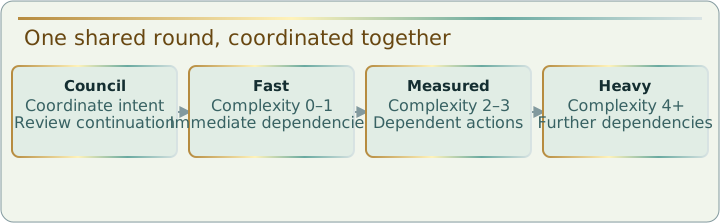
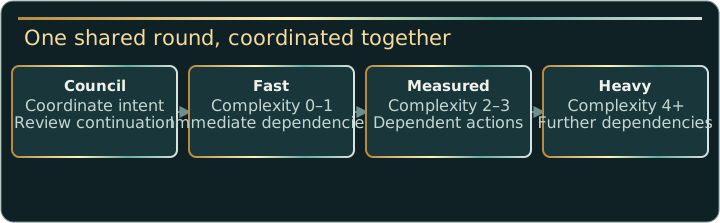
Council: establish the moving parts
Describe visible positions, immediate pressures and the opposition's apparent intent. Confirm ongoing requirements at their agreed continuation point, reset ordinary reaction availability for the new round, and gather the party's coherent Main Intents. Ask about dependencies: who needs a path, who supplies it, who might interrupt it?
Place actions by complexity: 0-1 in Fast, 2-3 in Measured, 4+ in Heavy. Complexity concerns dependencies, not simply the amount of damage or the BU price. A high-output direct action can be fast; a modest result with several dependent parts can resolve later.
Resolve intersections, not a checklist of isolated attacks
Annotated example. At the sluice, Mira wants to divert a narrow flow; Neri wants to carry the snapped timber clear once the pressure falls; a Watcher wants to drive Neri away. The table places the immediate Watcher attack in Fast and the dependent repair in Measured. Mira's required preparation is made explicit before the repair can use it.
If Neri tries to reach the timber before the Watcher closes the route, resolve a timing clash where their opposing intents meet. Each rolls d20 with the suitable attribute, applicable PB and modifiers. Highest goes first; a tie is simultaneous or resolved from stronger fictional position as agreed. Losing timing does not erase Neri's entire intent. They can pivot to a different reachable approach if the changed scene supports it.
If Mira and the Watcher directly oppose control of the same current, a contest can determine whose effort prevails. The question is now force/control, not merely timing. Choose suitable approaches and apply the actual permissions and stakes. Do not call every opposed roll “initiative.”
Reactions interrupt the moment, not the whole round
A default independent reaction has one available slot per round, a valid perceived trigger, immediate Complexity 0-1 and self/touch or a single target scope. Pause the triggering event, resolve the response and continue from what changed. Spending the slot does not guarantee canceling the event or create unlimited reach.
Example. Neri catches a worker slipping beside them. Their proximity and available hands support the action. Catching workers on both distant banks is a different scope. A separate authored grant may change reaction capacity or permitted behavior; it must be in the creature/character record.
Movement and position stay continuous
Use each participant's whole-round movement allowance. A Medium character with 30 ft can move 10 in Fast and 20 in Measured; they do not regain 30 because a reaction occurs. Ordinary swim/climb use half walking speed rounded up. Flight/burrowing need actual permission and speed.
Agree extra movement through an acquired rule or an appropriate Cost. Where the situation permits, movement may accompany an intent or occur independently. Positions should answer practical questions about reach, paths and interference. A grid is optional; consistent distances or zones with agreed translations can also work.
Track what will matter next
| Record | Why it matters |
|---|---|
| Intent and track | Shows what is trying to happen and what depends on it |
| Position and movement used | Determines reach, available routes and remaining movement |
| Reaction availability | Prevents accidentally responding several times without a grant |
| Current / maximum Vitality | Distinguishes injury from the build's ceiling |
| Consequences | Records actual penalties, restrictions and their ending conditions |
| Continuing work | Records each capability's requirement and next continuation point |
| Objectives and environment | Shows progress, warning signs and changed options |
| Resolved markers | A convenience for the current round; not a permanent condition |
Advancing a digital phase does not apply damage, expire effects or edit another player's sheet. Review actual endings before moving on. At the next Council, clear previous-round intent/resolved markers and establish the new situation. Keep consequences that have not ended.
Optional surprise treatment. Prepared enemies may complete a round before surprised participants respond, depending on the situation or an agreed roll. This is a suggestion, not a compulsory surprise mechanic or an automatic reward for every ambush.
Rescue is part of the scene
At zero Vitality a character collapses. A contextual rescue countdown-roughly a minute as guidance-creates urgency; it is not ten guaranteed safe rounds. Make the danger clear. Stabilization uses an action track, a suitable Fieldcraft approach or actual primitives, agreed resolution and Cost. No universal stabilization DC is prescribed.
Successful stabilization stops dying without granting healing or consciousness. Healing above zero normally ends dying and wakes the character unless another consequence prevents it. Active dying requires rescue before assisted rest. Massive damage can be outright lethal: establish those stakes in advance and use final post-defense damage and the current value before any zero clamp.
Review creations and choose consequences
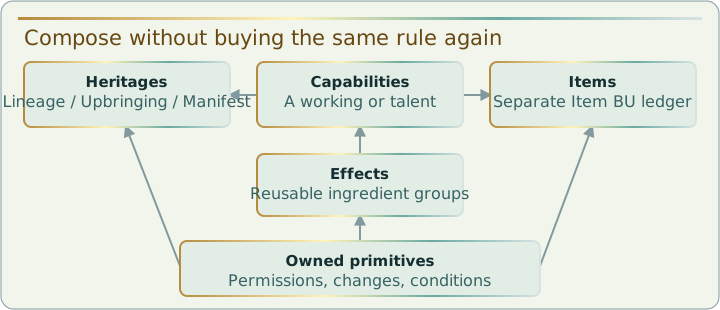
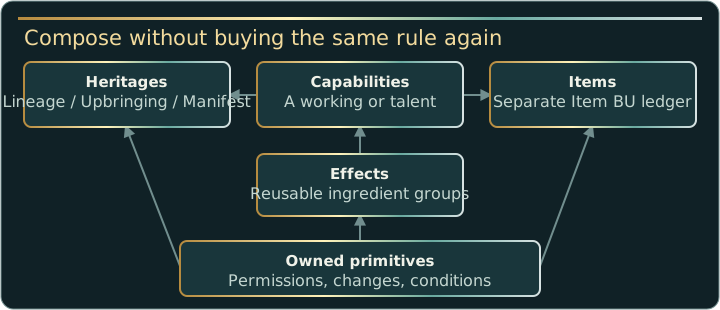
SwordWeave gives players a construction language. Your job is to help the table understand what a creation does, how it fits the world and what a particular attempt puts at risk. An unusual idea is an invitation to examine the situation. Begin with the result the player wants.
Core rule. Establish access, actual scope, stakes, resolution and consequences before commitment. Let the player clarify or revise their intent. Apply the agreed outcome, then continue from the changed situation. The Rule of Cool supports coherent and exciting exceptions; state their scope so an exceptional moment does not accidentally become an unrelated permanent ability.
A review you can use at the table
Read a proposed component with its author. Ask these questions of the definition; do not make a player fill out a form to perform every ordinary action.
| Review | What you need to understand |
|---|---|
| Result | What changes, who benefits and who or what can be affected? |
| Permission | Which owned ingredients support the change? Is any proposed behavior absent from them? |
| Conditions | When does it apply? What prevents it? What does a broad phrase such as “protected” mean here? |
| Composition | Which ingredients are actual acquisitions and which are references to purchases already counted? |
| Stacking | Do additional occurrences apply? Do sources share a uniqueness restriction? Is a grant being confused with another numerical bonus? |
| Use | How does the actor perform it, and what uncertainty requires resolution? |
| Continuation | Does it end immediately, last for a stated duration, or require maintenance? What can interfere? |
| Price | What suggested BU acquisition price fits this table's scope and restrictions? Keep Item BU separate. |
An author's price is a proposal. Library and builder suggestions are useful comparisons. You may accept the proposal or ask for an adjustment, including a cheaper version if its limits make the original price excessive. Explain which part creates the concern. “It affects every target without discrimination or effort” is actionable feedback; “that sounds overpowered” leaves the author guessing.
Keep acquisition and execution separate. A purchased ingredient can support many uses without being bought again. A broad or hurried use can still incur Strain and agreed Cost. Buying another ingredient is one way to establish missing access; increasing effort alone does not silently grant a new behavior.
Review a water-working
Example. Mira owns Verb II, a Water domain permission, Near Range and d8 output. She proposes redirecting ordinary water away from a broken canal gate. Read the actual permissions. Check the water's quantity, distance, resistance and where it will go. Moving water is one question; creating a new permanent gate, locating an unseen saboteur or healing a wounded worker are different results.
For a small flow with time to work, you might agree negligible Cost and no roll. In a collapsing sluice, redirecting the whole surge before it reaches the workers is a demanding attempt. Make its reach, recipients, timing and stakes explicit. Mira can narrow the channel she controls, enlist another character or accept a continuing restriction instead of forcing the whole result at once.
Do not charge her again for the Water permission because it appears in both an effect and its parent capability. Do not assume the d8 ingredient makes every manipulation deal damage. Output applies when an appropriate authored construction and the proposed use establish damage or healing.
Write a consequence people can use
A consequence should change decisions at the table. It can be damage, a mechanical penalty, a restriction, lost access, an obligation, exposure, an environmental change or another narrative result. A number is useful where the result is numerical. An understandable restriction is useful where a number would hide what happened.
Core rule. Record the actual consequence, its cause, applicable timing or trigger and how it ends. A familiar name does not import another game's condition package.
| Record | Example: holding the diverted channel |
|---|---|
| Cause | Mira keeps the surge diverted while the workers repair the gate. |
| Change | She must keep directing that channel and cannot use this working for a separate water manipulation at the same time. |
| Applies | While she continues the channel; the table agrees its place in the shared round. |
| Interference | Losing the necessary access or being unable to continue the directing task threatens it. A wound alone is not a universal cancellation rule. |
| End/recovery | The restriction ends when she releases the channel or the repair removes the need for it. |
This is a possible ruling for this scene. It does not establish a universal one-capability limit. Several maintained capabilities can coexist; their agreed requirements and costs accumulate. Multiple effects inside one maintained capability share its one upkeep track and one Strain appraisal.
Contrast three possible costs before choosing one:
- Mechanical: an agreed amount of Vitality or a stated numerical penalty.
- Restrictive: hands, voice, attention or access must remain committed to the task.
- Narrative: the diversion floods a storehouse, draws attention or leaves a debt to the workers whose route is blocked.
These may combine, but piling on every category is not an automatic measure of fairness. Match the actual effort and scene. Offer a smaller scope or a different approach when a player dislikes the proposed trade-off. Maintaining a working can spread pressure across time and generally be cheaper upfront than forcing a larger result in one execution; there is no compulsory discount formula.
Alpha rule pending - damage-triggered Vitality upkeep. Additional repayment triggered by incoming damage, including threshold and counter/reset/excess handling, is undecided. This edition does not impose that numerical scheme. Agree any temporary table treatment explicitly. Ordinary continuation requirements remain usable; this does not change non-Vitality upkeep.
Build creatures that change the scene
A creature is useful when its behavior gives the party something to understand and respond to. Write what it wants, how it acts, what reveals its methods and when it stops fighting. A numerical baseline helps construct it; a purpose makes it playable.
Choose a foundation and check the arithmetic
For positive creature budget B, use rank r = sqrt(B/25), base attribute points ceil(3r), PB 1 + ceil(r), and baseline Vitality max(1, ceil(B/2)). Allocate the available nonnegative points among Physical, Mental and Magical. Resolve explicit authored modifications after the foundation. Do not use the player's 10-point starting allocation or level Vitality formula for this creature baseline.
| Creature BU | Rank | Attribute points | PB | Baseline Vitality |
|---|---|---|---|---|
| 25 | 1 | 3 | 2 | 13 |
| 50 | Approximately 1.414 | 5 | 3 | 25 |
| 100 | 2 | 6 | 3 | 50 |
| 225 | 3 | 9 | 4 | 113 |
| 400 | 4 | 12 | 5 | 200 |
Choose the proficient attribute and relevant acquired training. Check current values, practices, saves, DC, movement and senses. A high title or budget grants neither immunity nor extra actions. Give every ability its actual ingredients and readable behavior. The Canal Watcher record later in this book is complete, with definitions, totals, check bonuses and two useful workings.
Give the creature a small readable repertoire
Optional design guidance. Start with one recognizable signature behavior, one practical alternate approach and a reason to change tactics. A creature that controls a passage and retreats when its nest is safe can create more play than a long list of nearly identical damage powers.
For each ability, record what it does, the eligible targets, access, range, delivery, typical expression, chosen resolution and ending/continuation terms. Its normal expression is a starting use, not an unconditional entitlement to any amount of scaling. If it has an additional action, reaction or special rhythm, write the grant explicitly.
Roles suggest behavior, not hidden bonuses
| Role | Useful question | Give the players a response |
|---|---|---|
| Melee pressure | What route or person does it threaten? | A visible approach, space to retreat or a competing objective |
| Ranged pressure | What path and target location does it use? | Cover, interrupted sight, movement or interference |
| Defender | What is it protecting? | A way around it, a motive to address or a limited defense scope |
| Ambusher | What does it know and how does it conceal itself? | Detectable signs and a consequence of revealing its position |
| Controller | What options does it restrict? | Clear scope, conditions and an ending or counter-approach |
| Support | Who benefits and what sustains the help? | A visible dependency the party can disrupt or negotiate |
| Solo threat | How does it interact with several coordinated intents? | Explicit action economy, readable tells and meaningful objectives |
Do not assign a role and silently add a bonus. Actual mechanics belong in actual definitions. If a resistance applies only to Magical Fire, an ordinary Physical attack is not reduced by that label. If a transformation changes appearance, it does not automatically copy a target's abilities.
Test three situations
Before publishing, test the creature's ordinary use, a situation favoring its strengths and a situation exposing its limits. Check whether the proposed actions need missing access. Check quantities, Item BU, actual defenses, upkeep and termination. Ensure privately sourced dependencies are not exposed through a public template.
In the platform, preserve the selected immutable version. A template is reusable; a play copy records one creature's current state. Two copies of the same Watcher should not share damage or consequences. Updating the public template should not secretly rewrite an existing run's pinned content.
Prepare encounters around choices
An encounter is a situation with participants and competing aims. It can be social, exploratory, combative or several of those at once. Prepare what is happening and what will change; give the party more than one possible useful decision.
Write a one-screen preparation
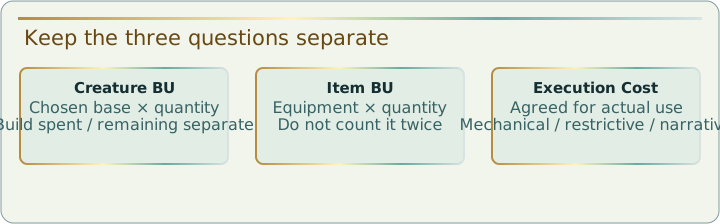
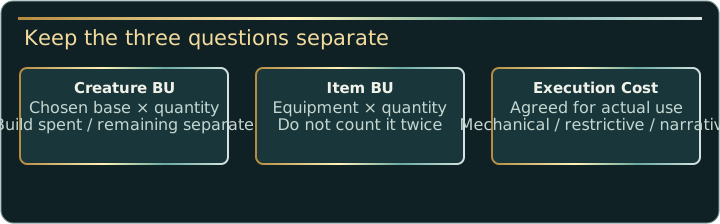
Record a name, a short opening description, the objective/pressure, useful environmental facts and the participants' motivations. Add the chosen templates, pinned versions and quantities. Record Party BU and Party Item BU separately; party size is optional. Linked characters are a convenience, not a requirement.
Manual totals are the primary workflow. If you calculate from linked owned/shared characters, inspect each contribution and explicitly apply the result. Refresh on demand when sheets change; do not silently rewrite a saved preparation. A shared character's visibility does not give permission to change their gameplay state.
Read the budget comparison honestly
Enemy monster BU is the chosen base budget multiplied by quantity. Enemy Item BU is the resolved equipment budget multiplied by quantity. Do not add mirror credit as another creature budget, and do not count equipment in both columns.
Worked comparison. Two 25-BU Watchers with no equipment yield 50 creature BU and 0 Item BU. A party with 50 Party BU and 8 Party Item BU totals 58. Enemy combined total is 50: enemy minus party -8; ratio 50/58, about 0.86. With two party members, creature counts match. Each Watcher holds half the enemy creature budget.
These facts are not an “easy” rating. Water control in a narrow sluice, an exposed approach, an evacuation task or a successful negotiation can matter more than that difference. Look for concentrated output, control, area effects, support and burst opportunities. Comparable BU totals do not guarantee comparable difficulty.
Choose a group or shuffle one
Choose creatures for the scene's purpose, or use a suggested group as a starting point. If shuffling, specify whether a BU limit applies per creature or to the whole group. An optional separate boss maximum and Item BU limit answer different questions. Review the resulting group before accepting it; a random roster is not automatically a coherent encounter.
If the budget is missing, you can still save and run the scene. Omit comparisons you cannot calculate. If party size is unknown, do not pretend to know whether the enemies outnumber them. If a ratio has zero or absent party denominator, show the totals rather than a fabricated ratio.
Offer pressure that can be seen
Optional preparation tool. Track a visible problem through a few named stages, such as rising, spilling and breaking. Describe what advances it and what can reverse it. This is a scene-specific clock, not an imported universal round timer. Tell the players about warnings before a consequential boundary arrives.
The sluice can rise while participants argue, spill after a support breaks and change routes when the walkway floods. A successful diversion can stop that pressure. Avoid advancing it merely because someone asked a rules question out of character.
Start, resume and conclude
Starting a digital encounter creates one independent private play copy per creature at the pinned preparation version. Repeated creatures get readable names. Resume continues an existing run; starting another run creates fresh copies and preserves the earlier one. Do not confuse opening a template preview with starting a run.
Conclude when the scene's practical question has changed or been answered, not only when all enemies reach zero. End the run while preserving the records. Deleting a preparation does not delete its playable copies. The template remains reusable; a new run need not inherit the previous creatures' damage.
Consequences, recovery and continued play
The review chapter explains writing a consequence. In play, keep its actual effect visible and give the player a way to understand its duration or ending. A dramatic injury, an obligation, lost access or an exposed location can matter without being converted into more damage.
Match the consequence to the attempt
If the character strains to hold a beam, exhaustion or committed hands can fit. If they redirect water, flooding another area can fit. If they openly expose forbidden magic, witnesses or obligations can fit. These are examples; agree the applicable consequence before commitment rather than selecting a surprise punishment afterward.
A 0-6 Strain grade helps discuss the demand; it is not a compulsory Vitality invoice. Scale, impact, complexity, conditions, opposition and urgency matter. A normal use can have negligible Cost. Maintaining a result can distribute pressure instead of demanding the whole expression upfront, but there is no universal discount.
Recovery does not erase every story
DM and players agree whether rest effects apply. A short pause may be 15 or 30 minutes; a long rest is overnight sleep or equivalent recovery, not necessarily eight hours. Time alone does not trigger healing.
The short-rest allowance is half maximum Vitality, rounded up, across short rests until a completed long rest refreshes it. Only actual healing consumes it. At maximum 13, allowance 7: healing from 10 to 13 consumes 3 and leaves 4 for a later rest. Long-rest healing is separate, normally to full; partial recovery may be agreed, and completed long rest still refreshes the short-rest allowance.
An injured hand may need treatment or a specified recovery condition even after Vitality is restored. A promise remains until fulfilled. State those ending terms rather than relying on a vague “rest removes it.” If a consequence is meant to recover quickly, say so.
Keep maintained work understandable
Record each maintained capability, its continuation point, requirement and ending terms. One capability has one upkeep track even with several effects; several capabilities can coexist and their requirements accumulate. Loss of access until a task is completed follows that condition, rather than disappearing at the next Council.
A hit alone does not universally cancel a working. Interference requires actual access, timing and resolution. If the actor cannot perform a required task, they cannot continue it. A completed instant action cannot be interrupted retroactively, although its continuing result may be disrupted by a valid new action.
The numerical question of additional Vitality upkeep repayment triggered by damage is explicitly pending in the review chapter. Keep ordinary agreed continuation usable and do not silently impose an unresolved threshold.
Build adventures from what people do
An adventure can be a short situation, a chain of related encounters or a region of unresolved pressures. Prepare the relationships that let choices matter. You can sell or share adventures while the mechanical framework and official playable options stay openly available.
A compact adventure record
Optional preparation format. Write the premise, three people/groups with aims, a few useful locations, an opening pressure, clues to the actual situation and possible changes if nobody acts. List any necessary component definitions or platform collection links. Include the definitions needed offline rather than forcing a reader to purchase another book to use a mechanical option.
For the canal adventure, a merchant wants the route reopened, a river community wants the spawning beds safe and a repair crew wants reliable support. Their aims can align or conflict. The old channel, damaged sluice and settlement storehouse connect those aims. An adventure grows from which relationship the party changes first.
Reveal information through several approaches
If understanding the cause is important, make it discoverable through more than one sensible route: inspection, a witness, physical evidence or an appropriate working. A clue should provide something actionable, not merely announce that another clue exists. A missed check can change the route or stakes without making the entire story unreachable.
Do not promise that every method gives identical detail. Tremorsense, a witness and a document can provide different useful facts. Extraordinary knowledge still needs its actual permission. A high roll does not invent access that the approach never supplied.
Let outcomes leave different worlds
If the party repairs the sluice with the Watchers' help, the settlement gains allies. If they evacuate and abandon it, the route may remain closed. If they destroy the Watchers and release the pressure, the spawning beds may be harmed. These possibilities are not prewritten ending gates; they explain how the world responds to actual choices.
Optional guidance. Prepare the next scene from the unresolved consequences, not by restoring the original situation so that your planned fight still occurs. Ask players which thread interests them. A campaign can follow their growing creations and relationships as much as a published plot.
Rewards and long campaigns
Agree advancement pacing and BU awards. No compulsory class table, spell list or encounter XP formula is required. Spending BU buys acquisitions without undoing level progression. Keep equipment BU separate. At higher levels use the literal cumulative thresholds and continuing bracket procedure, not an improvised +10-only replacement.
Invite players to author or refine abilities between sessions. Review the same questions as at creation: scope, recipients, conditions, stacking, actual purchases and Costs in use. Check mirrored drawbacks rather than treating the debt ceiling as automatic free credit. A campaign's changing fiction can support a new heritage, obligation, training or capability without forcing a class label.
Publish reusable material clearly
Distinguish an original definition from a reused ingredient and keep provenance/version references. Public creations need publicly accessible dependencies; a private source should not leak through a published record. Public, followers-only and private visibility describe access to content, not new ownership or gameplay editing rights.
For compatible publications based on SwordWeave's openly licensed text, credit the system, link the license and identify changes. You may sell your own compatible work under the applicable licenses without paying a SwordWeave royalty. Clearly separate your original protected adventure text/art from openly designated mechanical material. Do not imply official endorsement or use another creator's assets without permission.
Prepare a first session people can enter
A first session should let new players make useful decisions before they understand every family of primitive. Prepare a visible problem, a few people with clear motives, and several plausible approaches. Teach the procedure as those approaches arise. You do not need to perform every rule in one evening.

Before anyone makes a character
Tell the group what kind of situation you are offering. “A canal settlement needs help before a storm” gives players more useful direction than a long list of permitted ancestries. Discuss tone, interpersonal expectations, subjects to avoid, and an easy way to pause or revise a scene. Nobody needs to justify a personal boundary in public.
Agree the starting progression budget, equipment allowance, and whether example constructions are accepted. A 25-BU start is useful for learning because the ledger is small. It is not compulsory. Do not promise that every possible capability at an example price will be valid in this campaign.
Ask for a purpose, a connection, and one ordinary competence from each character. A reason to cooperate can be small: shared employment, a borrowed boat, or an interest in the same missing person. They need enough to enter the scene together, not a completed biography.
Check their records with them. Ask each player to explain a capability, its ordinary use, one limitation, and the bonus they will add to a check. If someone cannot answer, help rewrite the capability before adding more options. A readable narrow build is a stronger teaching tool than a large unexplained package.
Prepare facts instead of a sequence
Write what exists, what people want, and what is changing. Avoid “first they persuade, then they fight, then they repair.” A player may repair immediately, persuade someone unexpected, or leave to get help. Your prepared facts should survive those choices.
For the sluice example, the gate is physically jammed, a downstream bed needs protection, workers know a passage, and the rising water threatens routes. Those facts support several solutions. If the party creates a new safe path, use it. If they persuade the Watchers, the creatures do not need to attack anyway to satisfy your outline.
Give important information through more than one source. A worker knows the passage; a painted maintenance arrow points toward it; an old map shows it. You can still hide optional secrets. The immediate problem should not stop because one die failed to reveal the only usable route.
Teach the first roll without shorthand
Describe the uncertainty before naming a practice. Show the full calculation: die, current attribute, applicable training, other modifiers, and DC. Then show the combined sheet bonus and explain that it already includes those contributions.
Use a small consequence the group can understand. A failed diagnosis might cost time and change a route. If injury or death is a real stake, establish it clearly. Do not use a first-session failure to teach that the DM can attach an unrelated punishment after the roll.
When advantage appears, explain conditions and cancel opposing stacks. One remaining stack means two dice; two means three. Select the die and add the static bonus once. A visible example is easier to remember than a paragraph of probability theory.
Introduce a round when timing matters
Use Council, Fast, Measured, and Heavy when actions meaningfully depend on or oppose each other. Explain that the round is shared. Gather coherent Main Intents and ask which need another result. Give the opposition visible behavior.
At first, keep the number of independent enemy workings small. A Watcher turns a current; a second guards a spawning bed. Their different intentions create a useful scene without requiring a hidden action list. Complexity determines track placement; output size is a different question.
Track movement and one ordinary independent Reaction Slot. A player moving 10 ft in Fast with Speed 30 has 20 ft left, not a new allowance in Measured. A reaction needs an actual trigger, opportunity, and scope. Explain these when someone proposes a response, rather than interrupting the opening scene with every exception.
End with a playable next step
Reserve a few minutes for the changed world. Who trusts the party? What remains damaged? Which consequences still apply? What do the players want next? A concise record can make the next session easy to begin.
Ask one question about comprehension and one about enjoyment. “Which rule was hard to find?” produces a different answer from “Which choice did you want more of?” Treat those answers as evidence. The published book cannot substitute for observing your particular table.
Agree any BU rewards separately from the fictional gratitude or treasure. Do not award a mandatory amount just because the scene used combat. Let the table know how advancement will work in this campaign.
A workshop in understandable rulings
The following cases are optional example rulings, not an extra mandatory tariff. Each shows how a DM can preserve creativity while identifying missing access, changed scope, and consequences. Use the actual circumstance at your table.
The unseen target behind a wall
A player says, “I have Far, so I hit the guard in the next room.” Ask how the actor locates that guard and how the working is delivered. Ordinary hearing may reveal an approximate sound without fixing the exact location. A granted sense can supply more information if its rule actually does so.
A projected bolt is blocked by total cover on its path. Direct manifestation avoids intervening projected-cover penalties, but still needs valid targeting and the corresponding behavior. Far does not establish either. The player can target a known spot with an appropriate area construction and accept uncertainty, move to gain sight, use a relevant sense, or propose another authored targeting method.
Say which part is missing. “You know someone spoke in the room, but your present sense does not locate their body precisely; the wall also blocks this projected path” lets the player revise the attempt. “No, your spell cannot do that” does not explain the permission problem.
A flood rather than a bowl
Mira's Water and Verb II support reshaping existing water. A bowl and a surging street are eligible subjects of different scale and pressure. Ask which portion she wants to change, where it goes, how soon, and whether the result must persist.
Offer alternatives tied to those facts: a narrow safe lane, help from workers with boards, or a slower diversion before the storm peak. An agreed cost might restrict Mira while she maintains the lane, damage an outlet, or create a later obligation. Do not convert every larger expression into fixed Vitality damage.
A larger cost does not give her Life access or guarantee rescue of every person in the water. If she wants to heal them as well, review that extra behavior explicitly. Maintaining the channel can spread pressure over time without a compulsory percentage discount.
A small character and a large sword
The base equipped-slot rule is one for an ordinary item and two for a two-handed item. Size does not automatically multiply that final requirement. The Rule of Cool can support an unusual sword with its own authored slot cost or consequence.
Discuss how the character carries, braces, and uses it. A three- or four-slot requirement can make the choice meaningful. A restriction in cramped spaces may fit another concept. Record the actual item terms; do not create a secret size formula that changes unrelated equipment.
Keep Load, Item BU, ordinary value, and equipped use separate. A sword can be expensive in the setting without a large Item BU figure. Extra slots do not increase carrying capacity. Giving an unusual item permission to work in this scene does not grant automatic reach, damage dice, or resistance.
A strong argument and a frightened person
An Influence check resolves uncertainty in an approach. It does not erase a motive or establish mind control. Ask what the speaker offers and what the listener reasonably believes.
A guard who fears punishment may accept a credible written authorization, a witness, or a plan to share responsibility. A large number alone is not the offer. If the response is secure once those facts are established, no roll is necessary. If uncertainty remains, name what success changes: a temporary passage, a private conversation, or willingness to hear evidence.
A capability that overrides agency belongs to a different construction and needs explicit behavior, recipients, resolution, limits, and consent at the table. Do not use ordinary negotiation as a covert substitute for that permission.
A moment that matters more than a formula
A player wants to leap farther than ordinary movement allows to catch a falling companion. Establish location, available movement, actual reaction opportunity, and the physical route. The table may agree extra movement with a consequence or a bounded cinematic exception.
State the exception before resolution. Perhaps the leap reaches the companion but leaves both hanging from the ledge, or spends a resource and makes retreat difficult. If the proposed consequence is unacceptable, the player can choose another response. Spending a Reaction Slot alone grants neither unlimited distance nor guaranteed rescue.
Record the reason for the ruling: unstable ledge, visible falling ally, reachable handhold, agreed exertion. This preserves consistency without turning the exceptional rescue into permanent flight.
A lasting injury without a hidden package
A character accepts “burned hands.” Ask what that does. A specific -2 to delicate Finesse checks is different from an inability to hold a tool, a reduction of Physical, or loss of an acquired permission.
Record recovery. Dressing and an agreed rest may clear a minor consequence; a severe injury can need another stated treatment. Healing Vitality does not automatically clear either unless the consequence says so. Avoid leaving a player with an undefined indefinite penalty.
Narrative description can coexist with a mechanical rule. The wrapped hands show what happened; the record explains how to play it. A later revision should be discussed, not silently broadened during an important action.
An ambiguous new primitive
A player proposes “Always succeed at hiding.” Ask what information, recipients, conditions, and resolution the rule intends. It could mean a bonus, a result floor, invisibility, erasing evidence, or overriding others' perception. Those are different effects.
Help produce a narrower first version: a specific bonus to concealment through movement under stated conditions, or an authored sense-obscuring behavior with limits. Review price and stacking afterward. Do not assume a chosen BU number makes an unreadable rule understandable.
Test normal, stretched, and outside-scope uses. If a primitive's definition supports contradictory outcomes, fix the definition before judging its cost. A clear inexpensive rule is more useful than a grand title with a large number.
Creatures from a purpose to a record
A creature begins with an encounter use, not a difficulty label. Ask what it wants, how it changes the scene, what players can perceive, and what can stop the confrontation without killing it. Then build the actual permissions supporting that behavior.
The records here are original authored examples using the current creature foundation and reference anchors. Example custom prices require table review. They are not new compulsory catalogue entries. Unspent budget is shown honestly; it grants no hidden ability.

The foundation arithmetic
Choose a positive base budget B. Rank is sqrt(B/25). Base attribute points are ceil(3 × rank); PB is 1 + ceil(rank); baseline maximum Vitality is max(1, ceil(B/2)). These are creature baselines, not the character's 10-point allocation and level-based Vitality formula.
Allocate nonnegative base attribute points and choose the proficient attribute. Read the full current parent attribute for each practice check, then its actual training and modifiers. Digital practice-allocation slices satisfy the allocation ledger; a small slice is not a second reduced check modifier.
| Chosen budget | Rank | Attribute points | Baseline PB | Baseline Vitality |
|---|---|---|---|---|
| 25 | 1 | 3 | 2 | 13 |
| 50 | sqrt(2) | 5 | 3 | 25 |
| 100 | 2 | 6 | 3 | 50 |
| 225 | 3 | 9 | 4 | 113 |
At B 50, rank is not rounded to 1 before the other formulas. ceil(3 × sqrt(2)) is 5 and 1 + ceil(sqrt(2)) is 3. Round at the specified stage. If an explicit agreed Vitality override or active primitive changes the result, record it separately.
Canal Watcher: a small guardian
Use the complete 25-BU Canal Watcher record in Worked records. Its 20 spent BU supports Verb II, Water I, Near, and d8. It has five remaining, no equipment, no mirror credit, and no unlisted action economy. Physical 2, Mental 0, Magical 1; Magical proficient; PB 2; DC 8; maximum Vitality 13.
Its value in a scene comes from turning a current near a spawning bed. Telegraph that concern before it attacks. Give it a path to negotiation: a credible diversion preserving the bed. Its location near useful water supports its capabilities; a dry bank changes its opportunities.
One Watcher can warn and manipulate a small channel. Two can guard different objectives, disagree about people, or cooperate. Do not treat quantity as an automatic license to apply the same consequence to every character. Each creature has its own intent, position, state, and reaction availability.
Sluice Warden: a sturdier protector
Purpose. A constructed keeper braces damaged waterworks and prevents sudden releases. It is patient when shown a safe repair plan and forceful when someone tears a control away. Its visible tell is a rising arm pressed against the gate brace.
Base budget 100; rank 2; six base attribute points allocated Physical 3, Mental 1, Magical 2. Magical is proficient; baseline PB 3 and Vitality 50. One acquired Physical increment changes current Physical to 4. Magical-selected DC is 5 + 3 + 2 = 10.
| Acquisition | Meaning | Creature BU |
|---|---|---|
| Verb II | Change existing eligible states | 8 |
| Water I | Bound grounded-water subject | 4 |
| Near | Reach up to 30 ft with valid targeting | 4 |
| d8 | Output die permission | 4 |
| Structure II | Basic spatial/group arrangements within actual access | 8 |
| Braced Resistance | Halve Physical damage, rounded up, while both feet and one hand brace the fixed sluice | 8 |
| Physical increment | Add +1 Physical at this accepted scope | 12 |
| Physical save training | Add PB to its Physical save | 4 |
| Total acquired | No mirror credit | 52 |
| Remaining | 100 - 52 | 48 |
Braced Resistance is an authored conditional defense with a proposed 8-BU price. It affects covered Physical damage, not every source, every consequence, or allies. Breaking the brace removes its qualification; merely naming it a Warden does not grant permanent armor.
Derived checks and saves. Physical practices +4; Mental practices +1; Magical practices +5. Saves Physical +7, Mental +1, Magical +5. Current Physical affects carrying capacity but does not change the base allocation ledger. Large size gives walking 40 ft, ordinary swim/climb 20 ft, six equipment slots, and capacity 80 + 5 × 4 = 100 Load.
Guiding Wall. Use Water, Verb II, Near, and Structure II to organize a located band of existing water into a temporary directed obstruction. State shape, affected route, opposition, and continuation. The normal example is a short lane beside the gate, maintained while braced. It does not automatically immobilize every creature or negate attacks; resolve actual crossings and interference.
Pressure Strike. Project existing water along a path within 30 ft. Attack +5 against the target's DC; normal hit expression 1d8 Magical Water. Cover applies to the projected path. Larger output or additional targets needs appraisal, not an automatic extra Main Intent.
Equipment. A Medium fixed-hook brace has Item BU 4, Load 2, and two final equipped slots. Its authored rule gives +2 to Prowess checks to hold a gate while the hook is firmly anchored; it affects that check, not Physical. Such qualifying Prowess is +6. Item BU stays separate from the 52 creature BU. Unequipping it removes the conditional equipment contribution and frees its slots, but its carried Load remains.
Counter-approaches. Show the brace and control route. A player can negotiate a safer flow, unanchor the hook, or draw the Warden away from the fixed sluice. A strong defense becomes an observable choice rather than a concealed statistic.
Bellhouse Custodian: an asymmetric solo
Purpose. The Custodian guards a mechanism that records binding promises. It wants the bells in their proper order and will pursue someone who removes a marked counterweight. Its tell is a slow raising of two separate hammer arms: one protects the mechanism, one threatens the route.
Base budget 225; rank 3; nine base attribute points allocated Physical 4, Mental 2, Magical 3. Magical proficient, PB 4, Vitality 113. Magical-selected DC 12. Large walking 40 ft and swim/climb 20 ft; capacity 100 Load; six slots. Physical practices +4, Mental +2, Magical +7; saves Physical +4, Mental +2, Magical +7.
| Acquisition | Bound rule | Creature BU |
|---|---|---|
| Verb II | Reshape/redirect eligible existing states | 8 |
| Metal I | Grounded metal subject only | 4 |
| Far | Reach up to 60 ft | 8 |
| d10 | Eligible output die | 8 |
| Structure II | Basic spatial/multiple-target arrangements | 8 |
| Plated Resistance | Halve Physical Metal damage, rounded up; no other source/domain defense | 8 |
| Second Response | One additional independent Reaction Slot per round, same ordinary trigger/scope limits | 12 |
| Total acquired | Explicit authored grants; no mirror credit | 56 |
| Remaining | 225 - 56 | 169 |
The conditional scope and 8/12-BU custom prices are example authoring choices. The large remaining budget is not converted into automatic damage, extra phases, or secret abilities. Its base foundation already differs greatly from a low-budget creature. You can develop the record further through real acquisitions when the campaign needs that, rather than spending numbers merely to fill a bar.
Hammer Sweep. Manipulate existing metal within 60 ft through an actual supported path. Normal single-target attack +7, 1d10 Magical Metal on a hit. A line affecting several recipients is a different declared expression supported by Structure II and appraised for scale, targeting, and consequences; the normal attack line does not silently contain it.
Hold the Counterweight. Redirect a located metal counterweight to hold the central lift. Continuing the example binds one hammer arm to that task. Releasing it changes the lift's position as agreed. It is a restrictive upkeep requirement, not a compulsory Vitality payment.
Second Response. Two slots are available at Council because the explicit acquisition says so. Each response still needs a perceived valid trigger, immediate eligible scope, and remaining movement or other actual access. A boss title, Large size, or 225 base BU would not provide these slots without the authored grant. The Custodian retains one coherent Main Intent by default.
Practical solo design. Threaten an objective as well as Vitality. The party may split between restoring bell order, keeping the lift open, and negotiating the promise's meaning. Tell them what the arms are doing. Let interference change opportunities. A second response makes the creature more responsive, not immune to every plan.
Review before running
Read each creature's definition aloud in the voice of a new DM. Can you identify its attack bonus, damage source/domain, sense, path, reaction capacity, and ending conditions? If not, repair the record before it appears in a tense scene.
Test a favorable situation, a counter-approach, and a changed environment. The Watcher loses useful water; the Warden loses its brace; the Custodian must protect a lift while negotiating. Such tests reveal dependencies that a total BU comparison cannot.
Keep build and appraisal ledgers separate. Two Wardens are 200 enemy creature BU plus 8 Item BU, not 104 creature BU because each spends 52, and not 208 creature BU with equipment counted again. Quantities create independent creatures; they do not merge their Vitality into one shared bar unless a deliberately authored exception says so.
Run an encounter through its whole life
Preparation, active play, and aftermath need different records. A compact preparation can become a useful run sheet without carrying every paragraph into every round. Keep definitions accessible, but track only the state that is changing now.
Prepare the choices
Write the objective, opening situation, visible pressure, and plausible alternatives. Put distances, barriers, resources, and sensory conditions where you can find them. A roster alone is not an encounter: it does not say why people are present or what a good outcome might be.
Record Party BU and Party Item BU separately, with party size if known. Manual totals are sufficient. Linked character totals can help, but access to a sheet is not editing permission. In the digital workflow, calculated totals replace manual values only when the GM chooses to apply them; later changes should be refreshed intentionally.
Record each template's chosen base budget, exact version, Item BU, and quantity. A pinned definition makes the preparation reproducible. Updating a version can change the creature; review that change rather than assuming the same name means the same mechanics.
Use comparisons as facts
Enemy count compared with party size tells you how many independent positions and responses may matter. A budget concentrated in one creature tells you that one loss or control effect can change the scene sharply. Several support creatures can create different pressures from a single opponent with the same total.
For a party of three default starting characters, Party BU is 75 before equipment. Two Watchers contribute 50 creature BU and zero Item BU. If party equipment is 8 Item BU, combined party is 83 and enemy is 50. Difference is -33; ratio is 50/83. This arithmetic says nothing automatic about safety. A flood, rescue duty, surprise treatment, or difficult targeting can dominate the actual scene.
Do not label this “easy” solely from the ratio. Describe control, area effects, support, burst, terrain, information, and alternative objectives. Comparable totals are not a promise of comparable difficulty.
Start with independent state
Each creature needs its own current Vitality, position, consequences, reaction availability, and maintained work. Name repetitions clearly. Watcher 1 may negotiate while Watcher 2 remains angry; sharing a definition does not make their decisions or injuries identical.
In the platform, starting a run creates independent private play copies from the prepared pins. Starting another run creates fresh copies and preserves the earlier run. Previewing or adding a template does not create a creature immediately. Paper play can achieve the same separation with one short state line per creature.
Council is a coordination point
Present the changed battlefield. Resolve agreed continuing requirements, reset ordinary independent reactions, and ask for coherent Main Intents. Record track placement and dependencies. Avoid carrying last round's resolved marker as a permanent status.
You can speak for several enemies without hiding their observable plans. “The Warden braces the gate while the Watcher turns toward the eastern channel” provides usable information. What the characters cannot perceive can remain uncertain, but all opposition should not become a private sequence of surprises.
Resolve the changed scene
When intents intersect, decide whether the question is timing, directly opposed effort, hitting, or resisting. Use the matching procedure. Do not add a clash and a contest and an attack and a save to the same moment merely because all four exist.
A failed timing roll changes who acts first; it does not universally delete the loser's intent. A disrupted route can require a pivot. A reaction pauses its triggering event, resolves a valid response, then resumes from the new facts. Positions and movement used stay continuous across tracks.
Advancing the phase is an organizational action. It does not automatically damage creatures, expire consequences, heal characters, or resolve an upkeep requirement. Apply actual rules and endings deliberately. Digital state controls should support that work rather than invent it.
End without erasing history
Mark the immediate result: objective achieved, retreat, negotiated agreement, changed control, or unresolved danger. Ending the encounter does not delete playable copies or erase consequences. A creature can remain injured; a promise can remain binding; a damaged place can matter next session.
Record who witnessed the result and which relationships changed. Ask players what they want to follow. Archive the run when useful. A future replay or new run starts its own state, not a retroactive rewrite of this encounter.
Adventure: the gate that will not open
Original teaching adventure. A canal settlement faces rising water and a jammed sluice. Two guardians fear for a downstream spawning bed. Workers need safe access to the mechanism. This adventure teaches a visible problem, ordinary tools, supernatural access, negotiation, shared timing, and consequences that can be restrictive or environmental.
Preparation. Use two 25-BU Canal Watchers from Worked records, no equipment, 50 total enemy creature BU. This is a starting roster, not a difficulty guarantee. A party such as the three workshop characters has 75 Party BU; record its actual equipment separately. Reduce or omit opposition if your group's needs suggest it. The guardians do not attack simply because the record contains an attack.
Locations and routes in text
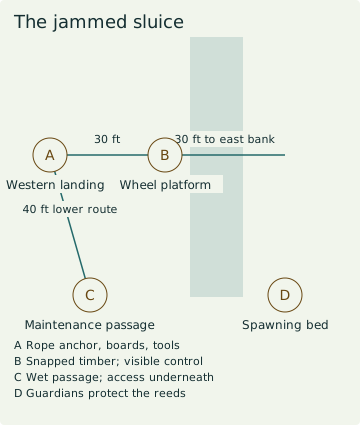
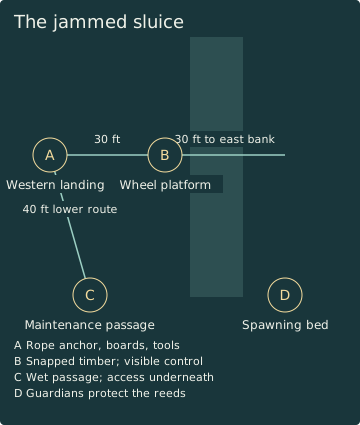
- A: Western landing
- B: Wheel platform
- C: Maintenance passage
- D: Spawning bed
- A, western landing, to B, wheel platform: 30 ft.
- B, wheel platform, to the east bank: 30 ft.
- A, western landing, to C, maintenance passage: 40 ft lower route.
- A Rope anchor, boards, tools
- B Snapped timber; visible control
- C Wet passage; access underneath
- D Guardians protect the reeds
Opening and immediate facts
Read or paraphrase: “Brown water climbs the gauge beside the sluice. Workers lean against a rope that shudders with each surge. Across the channel, a small river spirit points urgently toward reeds below the gate. Someone calls from a maintenance door: the upper wheel is jammed.”
Give visible distances from the map. The central gate is 30 ft from the western landing. The east bank is another 30 ft beyond it. A lower maintenance route runs 40 ft beneath the western wall. The spawning bed lies downstream, outside the immediate gate platform. The schematic labels measured routes; room footprints and line lengths are not to scale. There is no imported diagonal-movement rule.
The water is rising because a snapped timber blocks the wheel, not because someone casts a hidden spell. The guardians are protecting eggs and young river life. Workers want to prevent a release into the houses. All three concerns can coexist in a successful plan.
People with understandable motives
Ressa, repair worker. Wants workers safe and the gate under control. Knows the passage and how the manual wheel should move. Offers tools and directions freely to people helping. Fears an uncontrolled release because her family lives downstream. She is not a quest dispenser waiting for an Influence roll to reveal obvious facts.
Senn, boat runner. Wants a boat unloaded before the quay floods. Has strong rope and a small flat-bottomed boat. Can help ferry people or haul material, but needs someone to secure the mooring. A fair plan can recruit that help without a supernatural compulsion.
The two Watchers. One points toward the bed; the other watches the gate. They can communicate through gesture and ordinary conversation at this table. Their Water capabilities do not grant mind reading. They believe people will open the gate without considering the downstream life. Showing a credible protected flow addresses their actual objection.
Area A: the western landing
A solid lower post can anchor rope. Spare boards, a hook, and a marked maintenance arrow are available. Give these facts immediately when inspected. The post can support a rescue line; it is not infinitely strong. Agree demanding loads or sudden pressure with the actual circumstances.
The landing becomes less safe if the water continues to rise. Telegraph the change: water covers the lowest step, then the rope strains against its angle. Do not advance a hidden countdown every time a player asks a question. Use fictional time and the table's agreed urgency.
A player can recruit workers, examine the jam, or establish a line toward the wheel. Ordinary tools remain useful. A Near working from the landing can reach the gate at 30 ft if the actor can locate its eligible target; it cannot reach every point beyond it automatically.
Area B: the wheel platform
A snapped beam is caught between wheel and brace. It is visible from a close safe angle. A Reason or Knowledge check can resolve diagnosis under pressure if uncertainty matters. If someone has secure access and enough time, simply explain the jam.
Removing the beam without controlling the release risks a sudden flow. Establish that before commitment. Torren might hold the wheel with tools; Mira might redirect a narrow portion of water; Ilex might coordinate workers. Their chosen sequence affects complexity and track placement. The DM does not require one fixed “repair capability.”
A Watcher can move toward the platform to prevent an uncontrolled opening. Telegraph its intent. If timing matters, resolve the actual clash. If two actors struggle over the wheel, resolve the contest. Use the question that exists, rather than forcing both procedures onto every interaction.
Area C: the maintenance passage
The lower passage is wet, narrow, and partly blocked by debris. An arrow and Ressa's information reveal it. A printed map on the workshop wall provides a third source. No single failed search prevents discovering every alternative.
The route reaches the underside of the wheel. It can support a careful removal while someone controls the upper mechanism. Water level and tools matter. The party may prefer this route because it avoids direct confrontation on the platform; it introduces a different exposure and rescue problem.
If someone slips, locate them and explain the actual danger. A nearby catch can use an eligible reaction. A remote rescue requires relevant access and reach. Stabilization, healing, and escape remain separate questions if a character collapses.
Area D: the spawning bed
The reeds visibly shelter small river life. A Watcher points to them before using violence. Characters who investigate learn why the guardians resist. A credible protected flow can turn opposition into cooperation.
The bed is not a mandatory sacrifice. Players can use boards, a temporary diversion, a slower gate opening, or another plan. An extraordinary attempt must still have its eligible subject and behavior. Water shaping supports a flow plan; it does not automatically heal the eggs, rewrite the guardians' agency, or repair every structure.
Pressure and possible escalation
Choose changes from the visible situation. The lower step floods. The wheel tilts. A mooring loosens. A worker calls that a storehouse is taking water. Give warning and a usable response before a route disappears when the fiction allows it.
Do not attach a fixed number of rounds to the whole adventure unless your table intentionally agrees a timed treatment. Negotiation might resolve before a combat round begins. A secure repair can take minutes. A sudden slip can require the shared rhythm immediately.
If the group refuses the problem, portray a plausible aftermath. Workers evacuate, the guardians protect what they can, and the canal route may close. Their later adventures begin from that result. The world changes without punishing players simply for choosing another goal.
Three plausible resolutions
Cooperative diversion. The party explains a safe downstream route, recruits workers, and controls the release. The Watchers help instead of attacking. Costs can be sustained attention, damaged boards, or a repair obligation. Celebrate the actual plan rather than requiring a fight for completion.
Forced opening. The party drives off the Watchers and removes the beam. If they do not protect downstream life or houses, apply those established consequences. Defeating the guardians does not automatically solve the hydraulic problem. Their independent states and choices continue until the threat ends or they retreat.
Evacuation and delayed repair. The party secures people and accepts temporary closure. The immediate threat to life ends, but boats and supplies cannot pass. The group may need materials or specialist help next session. This is a different success, not a failed version of your preferred solution.
Aftermath and rewards
Record saved people, damaged places, guardians' attitudes, equipment use, current Vitality, and remaining consequences. Agree recovery from the actual shelter and time available. A night spent repairing in the rain is not automatically a full long rest.
If this completes a significant campaign objective, discuss advancement according to your campaign agreement. No universal BU award is attached to two defeated Watchers. Ressa's gratitude, a new route, and a promise of passage are fictional results whether or not the ledger changes.
Possible next questions: Who installed the brittle beam? Why has the upstream flow changed? What old channel became visible? Use a question the players cared about. The adventure has taught how to respond to a situation, not how to follow one mandatory plot.
Adventure: the bellhouse of borrowed names
Original teaching adventure. A hilltop bellhouse stores public promises in metal counterweights. An old agreement now appears to bind the wrong families. The Custodian refuses to release the central lift while its records conflict. The party must establish what changed, protect people using the lift, and choose what to do with the agreement.
This is a situation about evidence, obligation, and an asymmetric guardian. It can end through restoration, negotiation, changed terms, or force. The adventure does not presume the promise is just because an ancient mechanism preserves it.
Preparation. Use the 225-BU Bellhouse Custodian from Creatures from a purpose to a record. Optional two Canal Watchers, reflavored only in story as rain-fed caretakers, add 50 creature BU without changing their Water mechanics. Total with both is 275, no Item BU. This can be a severe threat to low-budget characters. Compare your actual party, telegraph danger, and offer meaningful noncombat routes; do not claim the example is balanced by its page count.
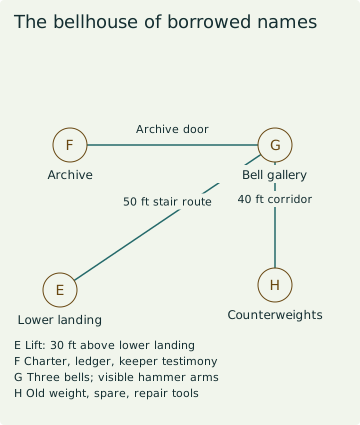
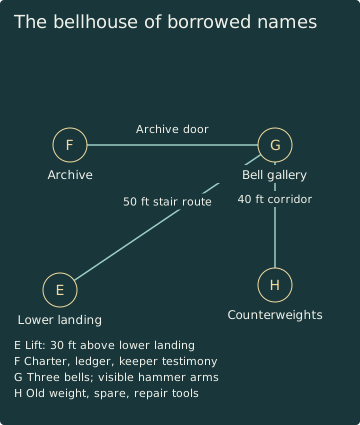
Locations and routes in text
- E: Lower landing
- F: Archive
- G: Bell gallery
- H: Counterweights
- E, lower landing, to G, bell gallery: 50 ft stair route.
- F, archive, to G, bell gallery: through the archive door; no distance specified.
- G, bell gallery, to H, counterweights: 40 ft corridor.
- E Lift: 30 ft above lower landing
- F Charter, ledger, keeper testimony
- G Three bells; visible hammer arms
- H Old weight, spare, repair tools
Opening and what is wrong
Read or paraphrase: “A bell sounds once, then stops halfway through its answering note. The lift hangs above the lower landing. On the hill, bronze arms brace two different counterweights. A keeper holds a cracked metal plate: the names stamped on it do not match the charter.”
The record was not maliciously altered by a hidden mastermind. Years of repair replaced one counterweight with an old spare whose binding marks belonged to another agreement. A hurried keeper failed to check the replacement. You can choose a different cause for your campaign, but establish it before clues depend on it.
The central question is not “win the boss fight.” It is what the party will do with conflicting evidence and a mechanism that acts on the marked metal. People below need a safe route; the keeper needs an understandable resolution; the Custodian needs a credible account of the bells' order.
Area E: the lower landing
The landing gives sight of the lift, 30 ft above. A stair ascends 50 ft along the outer wall to a gallery. A service path leads around the hill, longer but sheltered. The schematic identifies these alternatives and labels measured route distances. Read those labels instead of measuring the drawing.
Ordinary ladders, ropes, and workers can support a rescue. Flight or mobility grants change the route only within their actual rules. A single character reaching the lift does not automatically transport everyone. Locate passengers and explain who needs help before resolving a rescue.
The lift remains held while the Custodian maintains Hold the Counterweight. A loss of that requirement changes its state at the agreed instant. Give characters visible information about the braced arm and actual supports; do not hide a falling-lift consequence behind an innocent control button.
Area F: the archive room
There are three useful sources: the paper charter, a maintenance ledger, and the keeper's account. The charter lists the original parties. The ledger records the replacement. The keeper saw the old spare taken from storage. Each offers a route toward the mistake.
Inspection can reveal obvious differences. A Knowledge or Reason check can resolve reading a damaged entry under pressure. Ilex's Paper access can stabilize the physical sheet at Touch; it does not create missing words or prove truth automatically. Ordinary careful copying can also preserve the record.
Optional discoveries include an earlier dispute, an unfulfilled repair promise, or evidence that the original agreement unfairly burdened one group. These add decisions. They are not necessary to discover the mechanical replacement error.
Area G: the bell gallery
Three bells face different paths. Their visible marks correspond to the charter's three witness places. A worker can explain the ordinary order. The Custodian compares actual ringing and metal marks; it does not read every person's thoughts.
Players can show the mismatch, restore the old counterweight, propose a temporary suspension with an accepted obligation, or ask whose authority can change the agreement. Decide the Custodian's response from its purpose and the evidence. An Influence check may resolve uncertainty about a credible proposal, but it does not rewrite the mechanism's metal by itself.
If someone removes a counterweight without support, the Custodian responds. Telegraph which arm moves and whether the lift is threatened. Its two Reaction Slots are explicitly authored; they are not an automatic privilege of every solo creature. It has one coherent Main Intent by default.
Area H: the counterweight chamber
The chamber contains the substituted weight, the old damaged original, and tools. Existing Metal I and Verb II can support reshaping or redirecting eligible metal, but deleting a social obligation or changing a person's identity is not simply more metal manipulation.
A physical repair can restore the original mechanism while leaving the moral question unresolved. A table might agree a bounded exceptional working to transfer a mark with consequences; state its actual scope. Do not secretly grant foundational law rewriting because a character rolls high against a mechanical task.
The chamber is 40 ft from the gallery through an open service corridor. A closed maintenance door can block a projected path. Valid direct manifestation still requires a target location and supported behavior. Map lines and walls have practical meaning, not merely decorative shapes.
A confrontation with several useful jobs
If the party chooses force or the scene escalates, give them several purposes: hold the lift, keep the archive safe, distract the Custodian, or restore the bell sequence. Killing it is not the only useful Main Intent. Different positions and dependencies keep the shared round coherent.
The Custodian's normal Hammer Sweep is one target, attack +7, 1d10 Magical Metal on a hit. A larger declared expression requires the actual access and appraisal described in its record. Its Plated Resistance covers Physical Metal damage only. Other eligible sources and domains are not secretly resisted. Announce visible deflections so players can understand their options.
Hold the Counterweight commits an arm. A player who makes that maintenance unnecessary may change the creature's choices; one who disrupts it may endanger the lift. Show these trade-offs before resolution. A solo threat is more interesting when the scene offers decisions than when it simply attacks until its Vitality reaches zero.
Resolutions and what they leave behind
Restore the original record. The replacement mistake is corrected. The lift operates. The original agreement remains, including any unfair terms the party discovered. People may thank them and still ask for further change.
Negotiate a temporary release. The keeper and relevant people accept clear terms: who will witness the correction, when the bells will be checked, and what protection applies meanwhile. Record the obligation. The Custodian can accept it if the established purpose supports that response; an unexplained good roll is not a universal override.
Replace the agreement openly. The party helps the affected people choose new terms. This can require time, witnesses, ordinary records, and a reviewed extraordinary working if the mechanism needs one. Do not assume destroying a counterweight is identical to lawful agreement, or that ancient machinery determines the table's moral answer.
Destroy or abandon the mechanism. The immediate guardian threat may end, but the lift, records, and community face new problems. Apply the visible consequences. Give the players a world that can respond without declaring every unconventional choice a failure.
Debrief the adventure
Ask which evidence mattered and which assumptions the characters changed. Check rescue outcomes, equipment, Vitality, obligations, and any maintained working left active. Agree rests through the actual shelter and circumstances.
For future sessions, choose a thread the players pursued: repaired trade, disputed authority, a promised witness, or an unexplored service route. Record new acquisitions only through the campaign's agreed advancement. The adventure demonstrates flexible preparation with a complete creature record, not a compulsory setting for all SwordWeave tables.
Build a campaign that can respond
A campaign needs continuity more than a complete encyclopedia. Keep a small record of places, people, pressures, and promises that have already mattered. Let player choices create the next preparation.
Make factions useful at the table
For each group, write a desire, a resource, a constraint, and a visible next step. Canal workers want safe routes and possess tools, but cannot replace a major gate overnight. Guardians want protected habitats and can change water, but disagree about human cooperation. A records office has documents and authority, but depends on people accepting its legitimacy.
These facts let you respond to negotiations, delays, and discoveries. They do not need a compulsory numerical influence score. Add a campaign tracker only if it helps your group, and label it as an optional tool.
Avoid deciding that one faction is secretly correct about everything. Give people partial information and understandable conflicts. Players can learn, choose allies, and revise their own assumptions.
Let time change something visible
Between sessions, ask what each active pressure does if nobody changes it. A damaged gate stays closed. A keeper seeks a witness. A guardian moves a spawning bed. Show signs of those developments when the characters return.
Do not make every pause cause disaster. Safe downtime can be valuable. The pace of change should follow the world and the agreed campaign tone. A recurring clock is optional guidance, not a core mandate to punish rests.
Award growth transparently
Discuss whether progress follows major objectives, regular review, smaller awards, or another agreed rhythm. No compulsory XP schedule applies. Explain when an award changes cumulative progression and which purchases it supports.
Keep ordinary treasure value, Item BU, Load, and acquisition BU distinct. A valuable heirloom can be mechanically ordinary. A useful item can have low setting value. An equipment reward needs its actual rule and availability, not just an impressive price tag.
Review proposed new ingredients with the player. If a reward would force their character into a role they do not want, offer alternatives. Growth should support the next choices rather than turn the construction game into a fixed class ladder.
Repair a rule without rewriting trust
When an authored rule causes problems, name the observable issue. It may be unclear targeting, duplicated acquisition references, unbounded duration, or an automatic action the author did not intend. Discuss revisions between scenes when possible.
Keep a brief change note and the version used in play. Agree replacements and state adjustments. Changing a maximum does not automatically heal current Vitality; changing access does not silently erase consequences. Do not use a rules correction to invalidate an earlier choice made under the old agreement.
Preserve useful session records
At the end, record current goals, important positions, ongoing requirements, consequences and their endings, rescue/recovery state, and acquired changes. A concise record beats a transcript that nobody can search.
Shared sheets have actual permissions. A DM preference shows controls but does not grant private access. A character being linked to an encounter does not authorize the GM to edit it. Decide who can make changes and preserve independent creature state across runs.
Prepare what you will actually use
Before the next session, choose a likely opening, two or three pressures, and a few adaptable resources. Reuse a creature definition when it fits, but change its motives or location openly. If you change its mechanics, record a new definition rather than relying on an old name.
Keep one unanswered question for each player if useful. Those questions can guide scenes without determining their answers. A campaign remains a shared story because the preparation creates choices and the players' responses change it.
Watch the decisions inside a whole encounter
This chapter slows one encounter down so you can see the decisions behind the spoken description. It uses the published workshop records, including their limits. Read the conversation, then study the changing record. The point is to make the shared rhythm usable when several people act together, not to establish a compulsory script for a canal adventure.
Original annotated example. A retractable footbridge has stuck above a narrow spill channel. A fallen timber blocks the arm that would lower it. Workers want a crossing for their carts. Two Canal Watchers fear that a sudden release will wash timber into a spawning bed. The party wants a safe crossing. Nobody needs the guardians dead. This is a separate teaching scene, not an additional required sequence in The gate that will not open.
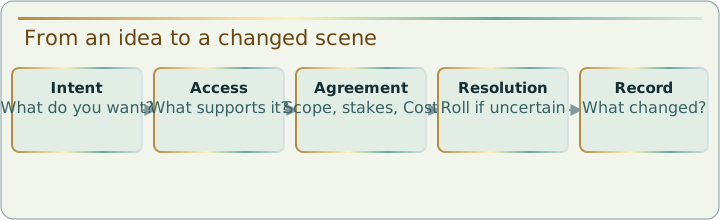
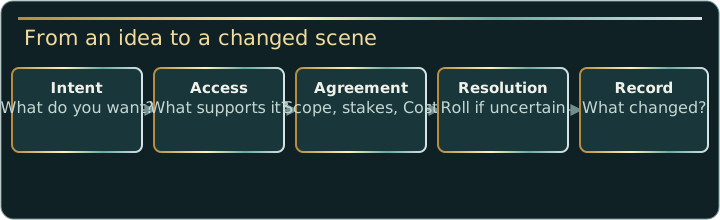
Carry only the records this scene will use
Mira, Torren and Ilex are the three starting characters in the player workshops. Each has a progression budget of 25 BU and 24 positive BU acquired, with no mirror credit. Party BU is therefore 75, not 72. For this example, their ordinary equipment has no extraordinary acquisition costs: Party Item BU is 0. An item with an added rule would change that column, even if nobody used it during the encounter.
| Participant | Current / maximum Vitality | DC | Relevant combined checks | Movement and response |
|---|---|---|---|---|
| Mira | 12/12 | 11 | Magical practices +6; Knowledge +5; Physical practices +3 | Medium walking 30 ft; one ordinary independent Reaction Slot |
| Torren | 12/12 | 12 | Physical practices +7; qualifying two-handed rope Finesse +9; Awareness +6 | Medium walking 30 ft; one ordinary independent Reaction Slot |
| Ilex | 12/12 | 12 | Mental practices +7; Fieldcraft +4; Mysticism +5 | Medium walking 30 ft; one ordinary independent Reaction Slot |
| Watcher A | 13/13 | 8 | Physical practices +2; Mental practices +0; Magical practices +3 | Small walking 25 ft; ordinary swim/climb 13 ft; one ordinary independent Reaction Slot |
| Watcher B | 13/13 | 8 | Same definition as A; separate state | Same definition as A; separate state |
The Watchers each use a chosen base budget of 25, with 20 acquired and 5 remaining. Their ingredients are Verb II, Water I, Near and d8. Water Impact is a single-target projected attack +3 against DC, dealing 1d8 Magical Water on a hit under the example's normal expression. Turn the Current redirects existing located water within 30 ft. Their unused budget adds no invisible sense, new action, healing or water creation.
The enemy appraisal is 50 creature BU plus 0 Item BU. Enemy minus party is -25 and the ratio is 50/75, approximately 0.67. There are two enemies and three party members. Each enemy holds half the enemy creature budget. These are facts about the roster. They do not say the crossing is safe, that the Watchers must lose, or that a flooded route cannot cause a severe consequence.
Establish space before introducing timing
Use these stated distances, or draw them on a small sketch. The party begins on a broad western landing. The timber and lowering arm are 20 ft along a walkway. The walkway has a solid post at its start and a smaller brace beside the arm. Both Watchers stand in shallow water beside the walkway, each within 30 ft of the timber and the central portion of the channel. The spawning bed is farther downstream, outside the immediate work area.
A person at the timber can see both Watchers. Mira can locate the narrow channel she wants to redirect from the landing. Ilex can speak to the guardians without shouting over an impossible distance. The walkway offers no cover against the first projected attack. If someone later moves behind the solid landing wall, that path changes. Do not announce a permanent battlefield-wide accuracy penalty just because water is present.
Describe two warnings. Loose boards knock against the bridge arm. A Watcher repeatedly points downstream, then at the timber. These are useful observations, not hidden prizes for a successful check. The workers tell the party that lowering the bridge with the timber still in place could break the arm. Their account is ordinary information from people who know the machinery.
This exchange gives the group enough information to coordinate. It has not given them a free successful repair, and it has not forced them into combat. The threats and resources now have recognizable relationships.
First Council: say what depends on what
Mira intends to redirect a narrow portion of the existing channel so the timber can be worked without washing loose downstream. This is supported by Water I, Verb II and Near. She does not claim control of every stream or permanent protection for all living things. The table agrees that directing this particular lane requires her to keep attending to it; while she does so, this working cannot be redirected to a separate water task. That is a scene-specific restrictive upkeep agreement.
Torren intends to secure the timber with rope. He will move 10 ft early, then the remaining 10 ft as the channel settles. He has 30 ft for the whole round. Both hands will be free for threading and tying after he sets his ordinary hook aside as part of the declared task. The table accepts that mundane handling within this intent. It does not establish a universal rule that every equipment change is an unlimited free action.
Ilex intends to explain the safe plan to the Watchers. They name the spawning bed and offer to keep the timber tied until it reaches the landing. This addresses the actual objection. Ilex is not rewriting the guardians' agency. The DM decides Watcher B is willing to consider a demonstrated plan; Watcher A remains distrustful and intends to strike Torren before the timber moves.
Watcher B intends to keep the current away from the bed, opposing Mira's channel because it mistakes the proposed flow for a release. Its immediate control and Mira's immediate control meet in Fast. The question is whose opposed effort shapes that water, so the table selects a contest. It does not add a separate setup DC check to resolve the same opposed question a second time.
| First-round intent | Placement in this example | Relevant dependency |
|---|---|---|
| Mira directs the narrow lane | Fast, Complexity 1 | Located existing water; Watcher B opposes the same flow |
| Watcher B turns that flow back | Fast, Complexity 1 | Same water and actual control contest |
| Watcher A strikes Torren | Fast, Complexity 1 | Visible target within 30 ft and clear projected path |
| Torren secures the timber | Measured, Complexity 2 | Reach the arm; channel settles; anchor and tie the line |
| Ilex explains the plan and points out the tether | Measured, Complexity 2 | Visible demonstration supports the explanation |
These complexity choices belong to the described dependencies. A different approach can change them. They are not prices attached to water magic, persuasion or rope. No participant receives another Main Intent because they are in a later track.
First Fast: resolve one question at a time
Mira rolls 13 and adds her combined Magical bonus +6 for 19. Watcher B rolls 11 and adds its combined Magical bonus +3 for 14. Mira wins the actual control contest. Describe a narrow lane turning toward the safe bank while the guardian's contrary flow curls around it. Her success establishes that lane under the agreed maintenance restriction. It does not damage the guardian or acquire another Water primitive.
Watcher A attacks Torren through the clear path. Its d20 result is 14; 14 + 3 = 17 against Torren's DC 12. The attack hits. Its d8 result is 5. Torren has no applicable Water resistance in the example record, so he loses 5 Vitality, going from 12 to 7. His ordinary coat does not secretly supply armor. He has not also failed a saving throw: this expression uses an attack, not both procedures by default.
Torren could propose a valid response if his actual position and permissions support one. Spending a slot alone would not make the attack miss, halve its damage or provide a distant counterattack. His player chooses to continue the repair and preserve the slot. A reaction is an opportunity for an eligible action, not a mandatory defense calculation on every hit.
The hit does not automatically end Mira's lane. It struck Torren, but even a hit on Mira would require the actual interference rule or a relevant consequence. The alpha has no settled additional damage-triggered Vitality-upkeep repayment scheme. Do not introduce one here because the scene contains injury.
First Measured: the setup makes another choice secure
Torren has moved 10 ft in Fast. He moves another 10 in Measured, reaches the timber and has 10 ft of the round's walking allowance unused. He secures the rope with both hands. Steady Hands qualifies for this precise threading and tying work, so his Finesse is +9. It is not added to every Physical check or to his DC.
The table had agreed DC 14 for making the tether secure before the timber shifts. Torren rolls 9: 9 + 9 = 18. The tether holds. On a failure, the agreed outcome was an insecure line and a changed opportunity, not an unexplained disappearance of all rope. On this success, the workers can see the timber is secured. It has not yet been pulled out.
Ilex explains the tether and points to Mira's safe lane. Watcher B can observe the proof that answers its concern. The DM does not require Influence merely to insist that every social action has a die. Watcher B agrees to inspect the downstream route next round. Watcher A sees the same facts but has a different judgment: it will not consent until the timber is moving away from the bed.
If Watcher B were frightened of a hidden obligation or distrusted Ilex specifically, an Influence check might resolve that uncertainty. The check would need a stated question and outcome. The record's +7 does not automatically overwrite every motive. Here the proposed arrangement is credible enough for B to accept without that uncertainty.
Read the first-round state aloud
No Heavy action remains, so the group reviews the actual changes before the next Council. A digital phase control can organize that review; it does not apply it for you.
| Record after round one | Actual state |
|---|---|
| Torren | 7/12 Vitality; beside the timber; 20 ft movement used; reaction unspent; tether secured |
| Mira | 12/12; safe landing; narrow lane active; directing requirement continues |
| Ilex | 12/12; plan explained; no reaction spent |
| Watcher A | 13/13; distrustful; Water Impact resolved; no persistent effect from that attack |
| Watcher B | 13/13; failed to reverse Mira's flow; now willing to inspect the safe route |
| Objective | Timber tethered; lowering arm still blocked; bridge not yet safe |
| Environment | Narrow safe lane visible; loose board remains beside the arm |
This summary takes less time than retelling the conversation. It makes the next decision possible. A single “party winning” marker would hide the injury, the differing guardians and the unfinished objective.
Second Council: change intentions when the world changes
The new Council refreshes the ordinary independent Reaction Slot for each participant. It does not refresh current Vitality, short-rest allowance or the whole list of consequences. The group replaces the previous round's intent markers with these new declarations.
Mira accepts the continuation requirement and intends to keep the lane directed. Nothing has changed its scale or opposition enough to demand another identical roll. The table can simply continue the established working while its terms hold. This is her meaningful contribution this round; she does not also announce another complete water attack without reviewing compatibility and a coherent intent. Her choice here does not establish that every upkeep requirement consumes a Main Intent; other actual requirements can permit other compatible work.
Torren intends to pull the timber toward the landing using the secured rope. The table agrees a Prowess check, DC 14, because the timber is caught under uneven pressure. His +7 applies. Steady Hands does not apply: pulling a load is not threading or tying a rope. The announced failure is that the timber stays caught and loosens the small brace, creating an immediate risk of the loose rope end dropping into the channel.
Ilex intends to carry and guide that end beside Torren. They move 20 ft along the walkway early in the round. Their help makes the chosen approach physically possible and puts them near the loose end. The table has not granted a numerical help bonus, an extra roll or a success entitlement merely because they said “I help.” If a bonus were proposed, its actual rule or agreed exception would need to be stated.
Watcher A's intent is to guide stray splinters away from the bed. That works on a different small portion of existing water from Mira's lane. Watcher B inspects the downstream release. They have each changed their coherent Main Intent after seeing the tether; they are not secretly attacking as well because their roster role says enemy.
Second Measured: a failure creates a response
Torren rolls 5: 5 + 7 = 12 against DC 14. The pull does not free the timber. The small brace shifts as announced, and the loose end of the line begins dropping. The scene changes at the point of failure. Nobody needs to retroactively reveal a second hidden penalty.
Ilex is beside the line, conscious, able to perceive it and has a free hand. They propose catching the falling end. The table agrees that this is an immediate Complexity 1 response affecting one reachable object. It uses their available independent Reaction Slot. They have the opportunity; the wet rope still makes success uncertain.
The table selects Fieldcraft, DC 12. Ilex's combined bonus is +4. They roll 8, totaling 12, and catch it. The reaction is now spent for this round. It pauses the triggering fall, resolves the catch, and continues the scene from the new fact. The timber has not been removed. Catching this line does not catch every loose object elsewhere on the bridge.
Torren does not get another full pull immediately because the reaction succeeded. His attempted intent has resolved. The party can prepare another approach at the next Council, or pivot within any actual unresolved part of the scene as agreed; this particular failed pull is not silently rerolled until it works.
Second-round review: keep a consequence separate from failure
Torren remains at 7/12. The failed pull did not inflict damage because the pre-agreed outcome was environmental. Ilex's reaction is spent. Mira's lane continues with the same restriction. The damaged brace changes how the next pull can be made. Watcher A has redirected stray splinters; Watcher B confirms a safe downstream route.
The DM says, “The tether is still sound. The smaller brace is loose. A worker can place a board under the rope, but you need to draw the timber along the landing side rather than straight upward.” This is new actionable information produced by the failure. It does not establish that a failed roll always awards a clue. It follows from this mechanical problem becoming visible.
Ask whether the group still wants the same objective. They can stop and wait for a repair crew, secure the bridge in its raised position, or make the supported pull. Continuing is a choice. The shared rhythm should not make a player feel that the only permitted next decision is another attack.
Third Council and resolution: the objective decides the ending
At the third Council, Ilex's ordinary reaction is available again because a new round has begun, not because the catch was erased. The secured line remains a changed fact. The workers place the board while everyone can see the route. Mira continues directing the lane. Ilex guides the tether from the landing side. Torren proposes the revised pull. Watcher A moves a small flow away from the board; Watcher B signals when the downstream path is clear. Ordinary preparation and their actual Water access support those acts. Neither guardian gains Life control or a free healing effect because it has become cooperative.
The table agrees that removing the caught timber remains uncertain but the announced failure is now simply that it stays lodged and the group must use a slower repair. Torren rolls 8 and adds +7 for 15 against DC 14. The timber comes free. It is pulled toward the landing rather than released downstream. The lowering arm can move.
Do not demand a new check for every secure subsequent step. Workers familiar with the mechanism lower the bridge carefully once the obstruction is gone and the line is safe. If a separate unresolved problem existed, it would need attention; the DM has not prepared one merely to lengthen the encounter. Mira releases her lane once it is unnecessary, ending its directing restriction. The Watchers leave the route open.
End when the crossing is practically safe, not when the two healthy guardians lose all Vitality. A three-round scene has involved injury, opposition, setup, reaction, negotiation, a failed action and a changed plan. It used no initiative roll, extra boss action, compulsory damage tariff or secret concentration rule.
After the bridge: a recovery ledger that tells the truth
Torren is at 7/12, with all 6 of his short-rest allowance unused. The group takes a protected pause and agrees that it qualifies as a short rest. He restores 5, reaches 12/12 and retains 1 allowance. He does not lose the sixth point merely because this pause ended, and he does not refresh to 6 by taking another short pause immediately.
Later, a separate event deals 3 actual damage, leaving Torren at 9/12. At a second agreed short rest he can use the remaining 1, reaching 10/12. The other 2 missing Vitality is not paid by an empty allowance. An agreed long rest can restore him to 12 and refresh the allowance to 6; its healing does not spend that pool. These are ordinary examples without a DM-adjusted recovery amount.
The bridge's loose brace still needs replacement. Ressa's promised introduction still matters. Neither is healed by Torren's recovery. The final record distinguishes personal state, environmental repairs and relationships. That distinction gives the next session something understandable to begin with.
What this encounter would reveal in a review
Ask whether the players could name the objective and the guardians' concern before commitment. Ask whether Mira's maintenance restriction was clear enough to guide her second-round choice. Check that Torren's +9 appeared only during qualifying rope work. Check that Ilex's response consumed the available slot and that it did not replay Torren's failed pull.
If the scene felt slow, remove redundant questions before changing the rules. You can shorten the record review or give obvious facts earlier. If it felt arbitrary, look for unannounced failure stakes, unknown distances or a changed definition. These are repairable preparation issues. Raising or lowering enemy BU would not automatically correct them.
Try one variation as a thought exercise. Put Watcher A behind the landing wall; its projected path is blocked until it changes position. Empty the channel; neither Water capability creates a new supply. Place the timber 50 ft from Mira; her Near permission no longer reaches it from the landing. Give Ilex no free hand; catching the line needs a changed setup. Each alteration changes a specific part of the plan, not the entire construction language.
Design pressure that offers useful choices
Encounter design begins with what the participants can decide. A difficult number can make a roll uncertain, but it cannot supply a meaningful reason to roll. Terrain, competing aims, information and actual creature permissions produce the decisions that make a scene memorable.
Optional design method. Write a sentence naming the decision before choosing a roster: “Do we hold the crossing while the last cart passes, or abandon the cart to protect the spawning bed?” Then list the facts that make both answers plausible. A good dilemma permits ingenuity to change its terms. It is not a rule that a player must always sacrifice one objective.

Sketch a field of opportunities rather than a decorative arena
Draw the routes people can use and the things that interrupt them. Put ordinary resources on the sketch: a cart that can block a path, a wall that offers actual cover, a stair, a rope anchor, a water supply, a bell that can be heard from another location. Include locations where someone can withdraw or change the angle. A map becomes useful when its marks answer a practical question.
For a compact outdoor scene, three connected places may be enough: an exposed crossing, a protected bank and an elevated observation point. Give their distances. Explain whether the elevation changes sight, cover or ordinary climbing. Do not label every raised platform as a numerical advantage unless the actual circumstance or an explicit rule supplies it.
Consider senses separately from reach. A creature with a long-range working may not locate targets behind reeds. An observer on a tower may locate them but still lack the required reach or path. A tremorsense grant may help locate someone through one surface but say nothing about a flying target. Let the actual definition create useful distinctions rather than treating every sense as a universal radar.
Mark which barriers block projected delivery and which merely obstruct it. The published projected-path defaults are -2 for minor obstruction, -4 for standard half cover and a blocked trajectory for total cover. Direct manifestation requires its actual support and targeting even when those intervening projected penalties do not apply. A wall is not rendered irrelevant by a broad ability name.
Put the controller's limitation where people can see it
The Sluice Warden is a useful control example. Its Guiding Wall organizes a located band of existing water within 30 ft through Verb II, Water I, Near and Structure II. The temporary obstruction has a stated shape, crossing question and continuation requirement. It does not become an unconditional immobilization label on everyone in the area.
Give the Warden a visible brace. Its Braced Resistance halves covered Physical damage, rounded up, while both feet and one hand brace the fixed sluice. A character who wants to move it away, loosen the hook or negotiate a different flow has a recognizable counter-approach. Present the brace before the party spends several attempts against a defense it could not know existed.
The fixed-hook brace also gives +2 to Prowess checks to hold the gate when anchored. Warden Prowess is normally +4, becoming +6 for that condition. It does not become Physical 6, raise every Physical practice or add to a water attack. The equipment contributes 4 Item BU, separate from the 100 chosen creature budget and 52 acquired creature BU.
Example design test. A rope pulls the Warden away from the fixed sluice. Review the actual opposed effort and anchoring, rather than declaring that “controller” means immovable. If the brace condition ends, the resistance no longer qualifies. Its acquired Physical increment remains part of current Physical; losing an equipment condition does not undo an unrelated purchase.
Make support change an understandable relationship
A support role needs a recipient, an actual benefit and a dependency. “The bell keeper makes allies stronger” is not a playable record. It could mean training, a static bonus, extra output, healing, information or an additional reaction. Choose what the support actually does before deciding whether the group contains too much of it.
Ordinary support can be concrete without numerical automation. A creature can warn an ally that a route is closing, hold a rope, move a shielded cart or negotiate for a pause. That activity occupies its actual intent and opportunity. It does not secretly grant +2 to every friendly roll, and a whispered warning cannot locate something the supporter itself cannot perceive.
Authored review example. An author proposes a primitive: “While you audibly count the gate's turning rhythm and an ally can hear you, add +2 to that ally's Prowess check to steady this gate.” The table must decide recipients, distance of ordinary hearing, whether multiple qualifying sources stack and its proposed acquisition price. This is not a new free primitive issued by the book. Once accepted, its condition gives both teams meaningful options: break hearing, change the gate or make the steadying task unnecessary.
If two support creatures maintain two separately accepted capabilities, their requirements accumulate on each actual maintainer. If several effects are contained in one maintained capability, that capability has one upkeep track, with the full scope still appraised. Nesting ten effects is not a technique for concealing the demand they create.
Review burst before the first damaging expression
Burst matters when an actor concentrates an unusually strong expression in one moment. Identify who can be affected, actual dice type and count, defense scope, timing and Cost. A d10 output permission does not automatically supply ten d10 or a second Main Intent. A high chosen creature budget does not decide how many dice the normal expression contains.
The Bellhouse Custodian's normal Hammer Sweep is one target, attack +7, 1d10 Magical Metal on a hit. Structure II can support a reviewed multiple-recipient arrangement, but that is a different declared expression. Locate the recipients, describe the line and path, review the output and consequences, and choose the actual resolution before committing. Do not announce the normal single-target line, then apply it to everyone after a favorable roll.
Warn the party through observable preparation: hammer arms rising together, marked metal turning toward a route, the Custodian leaving its lift task. These tells do not necessarily reveal an exact damage number. They reveal that a choice is arriving. Players can take cover, move, interfere, secure the objective or accept the danger for a reason.
Avoid adding burst merely to compensate for a solo being outnumbered. A powerful opening that removes a new player before they understand the scene can reduce decisions sharply. Review with the actual party record. An objective threat, an explicit extra response or a position that can change may produce more useful play than an unexplained damage increase.
Keep area effects connected to target information
An area is not automatic knowledge of its contents. A character who cannot locate a hidden target can propose affecting a known spot with actual area support. Establish the spot, dimensions, delivery and who might be there. Friendly participants and bystanders matter if the definition affects them. “Enemies only” is a recipient filter that needs its own understandable basis, not an assumption on every hostile working.
If a wall hides the room, a projected path into it may still be blocked. If a supported direct arrangement can affect a known area, the uncertainty about contents remains. A granted method such as a specifically authored scrying or “any qualifying recipient within range” can change targeting. Read the grant rather than making every high tier equivalent to omniscience.
Example. A party hears footsteps on the far side of a wooden screen. They can put a marked cone of a reviewed working across the doorway if they know its position and have the appropriate access. They cannot assume that the footsteps belong to all of the desired targets, or that a friend is absent. Give the players the information their senses support and let them choose whether to act on that uncertainty.
Design an ambush without assigning a universal surprise package
Prepare what the ambushers know, what hides them and what signs remain. Broken reeds, a quiet path, an oddly placed light or a watch animal's behavior can support discovery. Do not decide that noticing any one sign prevents every danger. Nor should a failed awareness check force every character into a fixed imported condition called surprised.
There is no universal surprise mechanic in this edition. A table may choose the suggested treatment in which prepared enemies complete a round before surprised participants respond; circumstances or an agreed d20 check can change it. If you use that optional treatment, explain what made preparation meaningful and who was actually caught unaware. It is not a permanent entitlement for the side that says “we ambush.”
Consider whether the first event can be an environmental change instead of a lethal attack. A dropped barrier, a stolen key or a severed towrope can create an urgent encounter with choices. Use real permissions and opportunities. A creature cannot teleport into a concealed position merely because an ambush would be dramatic.
Give a solo more than one practical question
The Custodian has 225 chosen BU, 56 acquired and 169 remaining. Its foundation provides maximum Vitality 113, PB 4, Physical 4, Mental 2 and Magical 3, with Magical proficient. It has two independent Reaction Slots because Second Response explicitly grants the second. It still has one coherent Main Intent by default. Neither the budget nor the word solo supplies an invisible exception.
Its Plated Resistance covers Physical Metal only. An Iron Knock from Torren deals that source/domain and is halved, rounded up; a normal roll of 5 would become 3. Mira's Canal Impact is Magical Water and is not covered by that resistance. Other declared defenses can apply only if actually present. Explain visible deflections so the party can reason about the distinction.
Design competing jobs around the creature's purpose. One actor can protect passengers, another restore a bell sequence, another talk to the guardian. Hold the Counterweight binds one arm to a continuing task. Disrupting that task can threaten passengers; making it unnecessary can free the arm without turning a rescue into a punishment. These relationships let players change what the solo needs to do.
Test the scene when the party wins an important contest early. If the guardian's task becomes unnecessary, can the encounter conclude? If you would introduce immunity to preserve three more attack rounds, revise the preparation instead. The purpose of an asymmetric creature is to create a situation, not guarantee a fixed fight duration.
Build groups whose members have different reasons to act
Two Watchers can share mechanics without sharing judgment. One distrusts machinery; the other wants the river and settlement to cooperate. A Warden protects the gate because that is its installed purpose. Those motives can divide a group naturally. You do not need a private mind-control effect to let one enemy refuse another's plan.
With larger groups, give repetitions names or positions and choose a few readable intent patterns. Three creatures may hold a route while two move toward a cart. Each remains an independent creature. Apply its own damage, position, reactions and conditions. Do not merge Vitality into a group pool unless you deliberately author and review that exception.
Enemy count is useful because independent intents and responses add work. It does not mean the GM must play a dozen nearly identical animations. Use concise declarations and shared definitions, then resolve the actual intersections. If the record overwhelms you, reduce the number of independent participants or split the scene into connected pressures rather than hiding state in a single anonymous bar.
Rehearse a scene by changing one important fact
Before play, test a favorable case, a counter-approach and an unexpected choice. Move the opponent away from its useful domain supply. Have the party negotiate immediately. Remove the most obvious route. Put an untrained but determined character in the key position. Can you still explain the question and the actual records?
Check whether each essential clue has another sensible route and whether a failed attempt changes the next choice. Count the distinct goals, not merely the creatures. A scene with one narrow exit and only unavoidable damage may need another opportunity. A scene with no pressure may be a useful conversation rather than a combat encounter; do not force it into rounds to justify the roster.
Write down the one flaw this rehearsal finds. “The guardian's weakness is invisible” suggests adding a tell. “The lift has no safe outcome once held” suggests a support or release route. “Every failed search stops the adventure” suggests multiple information sources. This kind of revision makes the preparation more usable without pretending a numerical simulation can predict table enjoyment.
From an idea to an adventure someone else can run
Writing an adventure for another GM asks more of your notes than preparing for yourself. You know which facts you intended to improvise. A reader does not. Give them enough cause, location, motivation and consequence to respond to a plan you never imagined. You can remain concise without hiding the answers they need.
Original design workshop. This chapter develops The Lanterns Beneath the Road as an adventure outline. It is a worked writing method, not a third fully statted compulsory adventure. Use the two complete adventures elsewhere in the guide for ready-to-run examples. Any new supernatural mechanics in a finished version would need their own definitions and audit.
Find a premise with an immediate human use
Begin with a practical disruption. “A road settlement's night lanterns have begun illuminating an old path beneath the paving” gives the group a place, a visible change and a question. Add a reason to care: a missing courier followed the light, and the regular supply wagon cannot travel safely. You do not need to decide the entire buried civilization first.
Write the premise in a sentence the players can understand without lore. Then write the cause in a different sentence for the GM: a recent repair exposed an older signaling route; its keeper is trying to summon people to a neglected inspection point. The players' first description need not reveal the cause. Your preparation should know it, so the clues do not contradict each other when discovered in a different order.
Choose what remains genuinely open. Is the keeper trustworthy? Who will maintain the older route? What should happen to the regular road? These questions can be answered through play. The cause of the lights need not change whenever a player makes a convincing guess. Responsive storytelling uses their choices without making evidence meaningless.
Turn the premise into people and pressures
Give each important participant a desire, information, resources and a limit. The wagon owner wants a safe route and knows where the lights begin, but cannot excavate alone. The road mason wants the repair accepted and remembers which stone shifted, but fears liability. The old keeper wants the inspection restored and can guide people through the route, but does not know how the settlement has changed.
Those facts produce negotiations. The owner can lend a wagon. The mason can identify a hatch. The keeper can describe the actual mechanism. No one needs to carry the complete explanation in one monologue. Nor should everyone lie until a player rolls sufficiently high. A person with partial knowledge can speak truthfully and still leave a useful question.
Pressure comes from what happens if nobody acts: another wagon reaches the unsafe paving, the courier remains unaccounted for, and a damaged lantern housing loses its signal. Describe a warning before each irreversible change when circumstances allow. These are authored scene developments, not compulsory countdown stages or a universal cost for waiting.
Write conclusions the players need, then their evidence
Decide which conclusions are necessary for the immediate problem. The lights follow a route; the route begins at a repair hatch; the courier reached an inspection chamber; closing the hatch without checking the mechanism could trap them. Each conclusion needs concrete evidence. “There is a mystery here” is not enough to make the next decision.
| Necessary conclusion | Evidence through observation | Evidence through people or records |
|---|---|---|
| The light follows a path | Marks appear in an ordered line under loose paving | An old route sketch uses matching marks |
| The new repair exposed its start | Fresh mortar stops beside a shifted stone | The mason remembers lifting that stone |
| The courier followed it | A broken lantern handle and identifiable footprints enter the hatch | A witness saw the courier crouch there |
| The inspection chamber has a second access | Air and distant sound reach a side opening | The keeper's maintenance record shows a service route |
The alternative sources need not provide identical detail. Footprints suggest a route; a witness gives a time; a sketch identifies a second access. A player can combine them. If one source is destroyed, the situation remains understandable through another sensible approach. Optional secrets can still require effort and may remain undiscovered.
Checks can address risk, incomplete material or an uncertain interpretation. They should not suppress facts someone can plainly observe. A soaked diagram can be preserved through Ilex's actual Paper working at Touch, but that working does not restore nonexistent words or verify the keeper's honesty. Distinguish the physical clue from the conclusion drawn from it.
Connect places through routes the players can choose
The outline needs only four working locations: the road's lantern line, the repair hatch, the inspection chamber and the side service opening. Connect them through known or discoverable routes. The hatch is direct but narrow. The side opening is longer but offers a route for bulky equipment. A surface detour reaches the settlement without using either underground path.
Give useful distances and barriers. Is the chamber 30 ft below the hatch or 300? Can a person at the top locate someone below by hearing? Does a bend block a projected path? Can a rope reach? Which sections are stable enough for a cart? You need these answers before a mobility or sensing primitive becomes relevant.
A map should be legible to a person who has not read every paragraph. Label scale, access, level changes, barriers, objective locations and important resources. Put the encounter's main question beside the map rather than relying on a decorative compass rose. If the map omits a passage mentioned in the prose, the omission is a usability fault, not a mysterious feature.
Make the first description actionable in several directions
Write an opening that shows the situation and invites a decision. “Three lanterns shine through cracks in the road. A wagon has stopped beside fresh mortar. The mason holds a broken brass cover, and someone calls that a courier is missing.” Readers can paraphrase this without performing a page of narration.
Immediate options are to inspect, ask, protect traffic, follow the route or search for the courier. Do not put the adventure's only starting clue in a successful private check. Give the GM what each obvious approach can reveal. They can then respond confidently when a player asks an unexpected ordinary question about the mortar, lantern or wagon.
Avoid using an unavoidable lethal hazard to force participation. A visible road problem can be compelling without killing a named ally if the group hesitates. If the tone includes harsh time pressure, agree that tone and describe the actual signs. The players should know enough to choose intervention, delegation or withdrawal.
Prepare outcomes as changes rather than ending labels
Write what a few broad results would change. Restoring the inspection route makes traffic safer but creates a maintenance obligation. Closing it after rescuing the courier leaves the old keeper without a route. Moving regular traffic creates a dispute about land and trade. Leaving changes who responds and what they can accomplish. These are consequences of choices, not four mandatory endings selected from a menu.
Include the cost of a seemingly successful plan when it is predictable. Excavation can damage the surface road; a temporary closure can delay supplies; a public accusation can affect the mason's standing. Establish those stakes before a player commits when their character could understand them. Do not reward ingenuity with an unrelated concealed punishment.
If a player finds a credible way to preserve several aims, let the situation support it. The workshop is not built around a required moral sacrifice. A good dilemma invites thought; it does not need to protect your favorite tragic ending from a better plan.
Write encounters as reusable situation records
Each location can have a short encounter record: visible situation, pressure, goals, people, routes, facts, ordinary resources and any actual creature definitions. If combat is plausible, give the opponents' motives and conditions for stopping. If no creature is needed, do not insert one simply to use a budget table.
For a mechanical guardian, you may adapt a published complete record only where its mechanics make sense. Reusing a Canal Watcher in a dry lantern chamber would require a useful supply of existing water or different reviewed definitions. A story reskin does not convert Water I into Light I. If you create a new mechanic, reproduce it offline with actual pins and rights for digital use.
Party budgets can be reference values while writing. Label them as editable examples, never balanced guarantees. Identify what makes the scene demanding: a narrow approach, limited information, incompatible objectives or concentrated output. A reader can adjust those facts along with the roster, rather than assuming that changing a 100 to a 75 corrects every problem.
Prepare a handout that a player can actually use
A handout should answer a question or support a choice. A rough route sketch can show a service opening and missing section. A maintenance receipt can identify a replaced plate. A witness note can name the time the courier entered. Include enough plain text for accessibility and for a GM who cannot print color artwork.
Distinguish what is known from interpretation. A stamped date is evidence of that stamp, not proof nobody altered the object. If the document is intentionally misleading, explain its cause and the discoverable mismatch in the GM notes. Do not make every written clue unreliable; players need a reason to investigate rather than abandon all inference.
Keep the handout physically usable. Short readable lines, sufficient contrast, labels and blank margins are often more helpful than simulated staining across every word. An atmospheric fragment can accompany a clean transcription. The art should increase comprehension, not make a simple route impossible to read at the table.
Review the adventure in the order a reader might use it
Read the opening without looking ahead. Can you explain what the characters perceive? Pick the least expected obvious option and follow its information. Check that the reader can find the relevant person, location or creature without a long search. Then imagine the group learning the cause early. Does the situation still contain choices?
Check an unsuccessful approach. If they fail to interpret the sketch, can they ask the mason, inspect the hatch or find another route? Check departure. Does the world have an understandable response that does not punish the group for failing to follow your plot? Check a direct extraordinary approach against actual permission and targeting.
This is an editorial rehearsal, not a human playtest. You still need people to run the adventure to discover unclear instructions, pacing and unexpected assumptions. Record what the rehearsal covered and what it did not. A polished layout or a valid budget does not prove that the scene teaches itself to a new table.
Package the work so its mechanics remain open and usable
Put the adventure's required rules and definitions where a reader can use them. Link a platform collection as a convenience, but include the offline record needed for play. Identify which version belongs to the adventure. A later public template change should not silently alter the edition in someone's printed book.
Separate compatible mechanical material from any protected setting text, map, artwork or plot under the publication's explicit rights notices. SwordWeave's open mechanical framework can support someone else's commercial work with attribution under the applicable license. Access to an official image or a purchase of a PDF does not by itself define every reuse right. A clear notice helps both the creator and the reader.
Keep download and print preparation distinct. An attractive digital edition is not automatically ready for every printer. A physical product requires the chosen trim, bleed, binding gutter, image resolution, color handling and a reviewed manufactured proof. Do not write press-ready on a file solely because it exported without an error.
Price an idea by reading what it changes
The Library's reference prices provide a common conversation, not a compulsory tariff for every authored rule. A new primitive needs a readable behavior before it can have a useful price. A very high number cannot make an ambiguous permission fair, and a low number is not automatically wrong for a narrow rule that contributes little to the campaign.
This workshop examines proposals at the level where they affect play. The prices below are authoring examples for table review, not newly issued canonical entries. When a comparison uses a published reference anchor, it says so. Acquisition, equipment and execution remain separate throughout.
Begin a review with a testable sentence
Ask the author to describe a normal use and a limit. “I want to recognize damaged structures” could support a practice bonus, a sense, expertise or an information-producing working. Those proposals have different effects. Start with the experience they want rather than guessing a large package from the title.
Use a plain first sentence: “Add +2 to Reason checks to identify the cause of visible damage to a manufactured structure after inspecting it at ordinary reach.” This gives the operation, recipient, check, purpose and condition. It does not identify damage through walls, locate hidden traps automatically or improve attacks against the structure. The author can decide whether those limits match the concept.
Now test the sentence. Does it help with an old crack under clear inspection? Yes, if a check is actually needed. Does it reconstruct a missing blueprint? No. Does inspecting one wall qualify every structure in the city? No. Would an ordinary inspection already make the answer certain? Possibly; then the bonus does not create a reason to roll. These tests reveal practical scope before price.
Compare a check modifier with a changed attribute
Ilex has Mental 5 and PB 2 from Mental proficiency. Their Knowledge, Reason, Awareness and Influence checks are each +7. Their selected Mental DC is 12. A proposed +1 only to Knowledge makes that check +8 while the others and DC remain unchanged. A proposed +1 Mental at an accepted attribute scope makes Mental 6 and its trained practices +8, and selected DC 13 before other modifiers.
These two proposals are not interchangeable. The attribute also contributes to formulas and saves that actually use its current value. A practice-specific bonus does not. Compare their breadth and stacking before accepting equal prices simply because both say +1. Respect actual caps and permitted operations in the construction; this example does not waive those requirements.
Example review response. “Your 4-BU proposal affects one kind of Knowledge task. That seems understandable here. If you want all Mental uses to increase, write an attribute rule instead and review that wider effect.” The response identifies a choice. It does not claim that 4 is the universal correct price for all knowledge or that the table must accept a proposed attribute increase.
Distinguish training from repeated numerical benefit
A proficiency grant establishes the trained state at its stated scope. The chosen proficient attribute already trains its practices and save. Granting the same proficiency again does not repeatedly add PB. An explicit expertise grant, a direct modifier and advantage are different contributions with their own rules.
Torren has Physical-trained Finesse +7. Steady Hands adds +2 during its qualifying rope task, making +9. A second capability referencing that very same acquired occurrence of Steady Hands does not add +2 again. It is another route to an existing acquisition, not another purchased occurrence. A genuinely separate acquired contribution must qualify and obey its authored stacking or uniqueness rules.
Suppose two sources grant advantage and one grants disadvantage on that +9 rope check. Cancel opposing stacks, leaving one advantage. Roll two d20, keep the higher and add +9 once. With three advantages and one disadvantage, two remain: roll three d20, keep the highest and add +9 once. Bias changes the resolution dice selected; it does not turn +9 into +18 or supply training where none exists.
Review an apparently harmless permanence clause
“The bridge stays repaired” contains more than a duration. It may imply new material, structural strength, indefinite resistance to weather or an information claim that the work is safe. Ask what was actually changed. Ordinary repair can produce a lasting ordinary bridge. A supernatural result can persist if its definition supports that outcome; permanent does not mean indestructible.
A proposed water support is different. Mira reshapes existing water, and this example's support needs continued direction. Renaming it a permanent support does not create stone or make the canal freeze forever. If the author wants a new structural material, review the required behavior and subject. If they want an ordinary repaired support using tools, those ordinary acts remain available without buying every workshop step.
Test interference and ending. Can the bridge be struck? Does removing its anchor matter? Does releasing a maintained support remove the support immediately or according to a stated ending? A clear lasting result can be easier to manage than an undefined permanent enchantment with every possible immunity implied.
Review the phrase any within range
An authored targeting method can change the usual specific-target requirement, but it needs a practical meaning. “Any fish within range” asks how qualifying recipients are identified, what happens to hidden or unknown fish, and which behavior applies. Range alone does not answer those questions. “Any” is not a free omniscience clause attached to every high-tier working.
Perhaps the proposal means a visible shoal the actor can locate. Perhaps it means a specialized influence on every eligible fish within a defined water volume, using an expressly granted method. Those versions differ in knowledge and discrimination. Write whether the actor learns locations or merely changes the eligible area. An effect that influences a region need not automatically report every recipient by name.
Example limit. A reviewed weather working affects an agreed valley without personally locating every raindrop. It still needs the actual domain, behavior, scope, recipients and consequences. It does not make every individual-target attack legal through a mountain. Scope-specific exceptions should be described at that scope.
Ask what a restriction costs the author in practice
A condition that says “only at night” matters differently in a campaign about midnight journeys from one set mostly in daylight. A bonus “only while wearing the coat I always wear” may provide little practical restriction. A lost ability “until the broken bell is repaired” can be severe when the bell is inaccessible. Review the fiction and expected use with the player.
There is no compulsory percentage discount for a condition. Conditions are part of the authored proposal. You may accept the price, ask for a different price or change the scope. Avoid treating the player as an adversary for wanting a concept that is convenient. Your shared goal is a readable rule that supports the agreed campaign.
Test whether the condition can be observed and voluntarily managed. “While calm” may require a subjective argument every round. “After a protected pause to prepare the instrument, until its string breaks or it is put away” gives actual events. That can be a useful revision even if the acquisition price remains the same.
Review a mirror without rewarding a fictional inconvenience twice
An eligible mirrored drawback is an actual acquired rule with its scope, conditions and restrictions. A character's Water working requiring existing water is already limited by its definition. That limitation does not automatically become additional mirror credit. If a player wants a separate accepted drawback, write what it changes beyond the underlying permission.
At level 1, suppose positive acquisitions cost 27 and an accepted eligible personal drawback gives 2 credit. Net spent is 25. Actual used debt is 2, within the level 1 ceiling 4, and positive acquisitions remain below the next-level creation ceiling 35. The debt ceiling is a limit, not an automatic gift of 4. If the drawback only provides 2, it cannot fund 31 positive BU as if all 4 appeared by default.
Ask what the drawback means when it is inconvenient. If a rule revokes flight from its bearer until a stated task is completed, an ally gaining flight does not suppress that loss. If two records refer to the same drawback, their references do not double its credit. If a chosen operation has no automatic opposite, do not invent one from the title. Set To has no automatic mirrored inverse.
Keep an item proposal in its actual ledger
A fixed-hook brace can have Item BU 4 for its conditional +2 Prowess contribution. A creature carrying it still uses its chosen base creature budget for encounter appraisal. Equipping it makes its qualified contribution available and consumes its stated slots. Carrying it while unequipped still contributes its Load but not the equipped conditional bonus.
For two Sluice Wardens, the chosen creature total is 2 × 100 = 200. The two braces add 2 × 4 = 8 Item BU. Combined enemy is 208. Their acquired creature total is 2 × 52 = 104, which describes their builds rather than replacing the appraisal's chosen 200. Do not put the equipment into 208 creature BU and then add it again for a fabricated 216 total.
An ordinary item can have Item BU 0 and meaningful setting value. A rare brass key might be priceless to the characters but have no extraordinary acquired rule. The availability of a device, its money price, its burden, its final equipped slots and its Item BU answer different questions. A single large number cannot communicate all of them.
Reuse a component without multiplying ownership
Mira's River Hand references Guided Water, an effect containing Verb II, Water I and Near. Canal Impact reuses those acquisitions and also references d8. The four distinct acquisitions total 20. Adding her 4-BU Knowledge proficiency gives 24 spent. Arranging them in two capabilities does not cost 40 before Knowledge. The ledger counts actual occurrences, not every route by which the interface reaches one occurrence.
Now imagine an author deliberately buys a second permitted occurrence of a static modifier. That is a different ownership question. Verify its identity, stacking, uniqueness and actual accounting. A second card with the same acquisition identifier is not proof of a second purchase. Conversely, do not automatically erase a genuinely separate acquisition merely because its rule has similar text.
In a paper record, give acquired occurrences short identifiers and let compositions reference them. “W1: Water I, 4 BU” can appear under both capabilities. This simple practice makes ownership visible without requiring an account. It also exposes accidental duplicate charges before someone changes the character to compensate for them.
Test the ordinary, stretched and impossible expressions
For each accepted creation, write three uses. One should be a normal expression, one should stretch its scale or circumstances while retaining its actual behavior, and one should be outside its access. The author and DM can explain the boundary together. This is a review tool, not a requirement to annotate every action during play.
For Water I and Verb II, redirecting a cup is ordinary. Redirecting a surging channel before a rescue is a demanding but related expression. Creating a new living body from water is outside the stated grounded water reshaping permission. A large execution Cost can appraise the channel; it does not buy Life or a new verb on the fly without an actual agreed construction or bounded exception.
For Torren's Iron Knock, striking a located target through existing metal at Touch is normal. Using it while hanging one-handed over a drop may be demanding or incompatible with its needed opportunity. Reshaping a lock into a key is outside its Verb I expression. A title that suggests strength does not convert a direct force action into every alteration of metal.
Finish a review with a usable decision
Accept, revise or postpone the actual proposal. Write one sentence explaining the reason and the agreed version. “Accepted at 4 BU for checks identifying visible structural damage after close inspection; no remote detection” tells the player what they own. “Needs another review” without a question tells them very little.
When you postpone, offer a playable narrower version if possible. The player may begin with a specific sense or check benefit and develop the wider concept later. Do not promise the future version automatically, but do not leave them unable to play their character while you discuss every theoretical edge case.
Record exceptional rulings separately from permanent acquisitions. A desperate one-time rescue can be allowed with agreed consequences without becoming a new always-available capability. A permanent accepted mechanic belongs in the authored record and ledger. That difference prevents both accidental free upgrades and surprise revocation of something the player thought they had purchased.
Give consequences a shape people can live with
A consequence is useful when the player understands its actual change and can decide what to do next. It can be numerical, restrictive, environmental or narrative. It can be severe without dealing damage, and it can be gentle without being meaningless. The cause, timing and ending make it playable.
The cases in this chapter are optional contextual agreements. They illustrate how to write and administer consequences. They do not create a compulsory injury list, resource pool, exhaustion ladder or fixed price for improvisation.
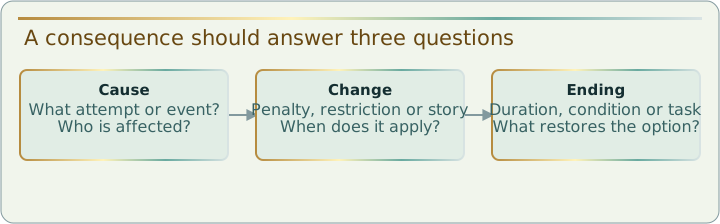
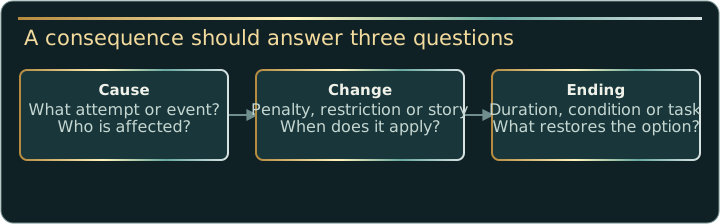
Separate the attempted price from the uncertain result
Before commitment, explain whether Cost applies when the attempt begins, when it succeeds, when it continues or after a stated event. Explain what failure means as a separate clause. “You accept aching hands to hold the rope; the check determines whether the worker reaches the landing” differs from “on a failed check, the rope burns your hands and the worker remains exposed.”
Neither arrangement is universally required. The scene and proposal decide. What matters is that the player can understand the trade-off before choosing. A failed roll does not automatically refund a paid Cost, and it does not automatically demand all possible Costs. There is no universal interruption refund.
Example conversation. A character wants to brace a heavy beam immediately. The table offers a stated shoulder restriction that applies if they make the sudden lift, whether the following secure-support check succeeds or not. The player proposes a lever instead. That changes the approach and may change the agreed restriction or uncertainty. The negotiation is part of play, not an attempt to evade an undisclosed tariff.
Write an injury without importing a condition package
“Strained shoulder” can be purely descriptive or have an actual rule. Decide which. A clear restrictive version is: “Until treated and an agreed rest has occurred, you cannot carry another person without reviewing further effort and consequence.” A numerical version might be a stated penalty to a bounded class of checks. These have different effects; do not switch between them whenever one becomes inconvenient.
Record whether an extraordinary permission remains available. An injured shoulder might affect lifting but not every Magical check or all walking. If it does affect a capability's required motion, say so. Names like blinded, stunned or poisoned do not import another game's complete mechanics. Write the actual lost sense, action restriction, numerical change and ending that this consequence uses.
Healing current Vitality does not automatically clear the shoulder restriction. If the agreed remedy is treatment and rest, follow that remedy. If a healing working explicitly treats the injury within its access, resolve that actual behavior. A die permission by itself is not a healing construction, and recovering points is not automatically repairing every narrative harm.
Make loss of access bounded and visible
Temporary loss of access can be a meaningful consequence when it has a cause and return condition. A character overextends a working and agrees that the affected capability cannot be used until they repair its focus. Write what is affected: the one capability, its particular delivery method or an actual domain permission. These are different restrictions.
Do not broaden the restriction to every related primitive without agreement. If a focus supports a single named capability, losing it does not automatically delete every acquisition beneath the character's heritage. Conversely, if the focus is the actual source of a broad granted permission, losing that source can matter at its stated scope. The record should show the relationship.
Give a reachable recovery route where the fiction supports it. Replacing a string, finding a witness or making a protected preparation can create useful play. An indefinite “until the DM says so” restriction makes planning difficult. The creator's direction allows contextual judgment; it does not require obscuring every ending condition.
Let a narrative cost change a relationship
A character may accept public exposure, an obligation or damage to a place. Write who learns what and what the recipient can reasonably do about it. “The lock keeper saw your forbidden working and expects an explanation before lending tools again” is a usable relationship. “Everyone hates you now” is an undefined global change unless the scene actually supports it and the table agreed that scope.
A promise needs terms. Name the promised task, the beneficiary, the expected time or circumstance and what fulfillment looks like. An obligation to repair a damaged landing is not an automatic prohibition on every other adventure. The group can negotiate a deadline, delegate with consent or face an understandable consequence of failing to keep the promise.
Separate moral judgment from bookkeeping. A public accusation can be justified and still change a relationship. A successful rescue can create gratitude without erasing the cost accepted to perform it. The world can have complicated responses without the GM using them to punish a player for solving a problem creatively.
Administer upkeep at the agreed maintenance point
Upkeep is an ongoing requirement of a maintained capability. Council is a useful agreed continuation point within the shared rhythm. Record the requirement, the capability, the next point and the ending terms. Do not silently charge a standing requirement several times because its capability contains several effects.
Mira's directed lane can require continued directing. The Custodian's Hold the Counterweight binds one arm. Another reviewed capability might require an ongoing audible chant, a resource contribution or a stated numerical penalty. None of those automatically become Vitality damage. Several maintained capabilities can coexist when their actual requirements permit it; the requirements accumulate rather than imposing an imported universal concentration slot.
When the player cannot meet a requirement, explain the timing of the resulting change. If a chant must remain audible and the actor becomes unable to vocalize, continuation is threatened by a real circumstance. If a restriction ends when the repair is complete, completing the repair matters. A new round alone does not erase a consequence whose stated condition persists.
Compare continuation with an increased instant expression
A character can ask to hold a modest effect over time instead of forcing a much greater result immediately. That often distributes effort or makes the initial demand smaller. There is no mandatory discount percentage. Compare the actual work: an ongoing narrow diversion versus moving the entire surge at once, or a steadily supported lift versus a sudden violent displacement.
Name what makes the continuing option manageable and what it commits. A narrow diversion may preserve hands or access for other ordinary tasks if the agreement permits, or require continuous attention that prevents a separate use of that same working. An instant increase may incur a severe contextual consequence but leave no maintained task afterward. The player can compare real choices.
Do not let nesting hide the scale. One capability with a water lane, a lighting effect and an unrelated defensive grant still has the full combined demand to appraise. One upkeep track means one organized maintenance record, not one tiny price no matter what is packed inside it.
Preserve the one expressly pending upkeep question
Alpha rule pending. Additional Vitality upkeep repayment triggered by incoming damage, including threshold, counter reset and treatment of excess damage, remains undecided. This book does not resolve or impose that numerical scheme. Do not derive it from these examples or automate it because an older guide described an additional payment.
If a table needs a temporary treatment, agree it explicitly and label it as their choice. Ordinary continuation upkeep, restrictive requirements, narrative consequences and contextual interference remain usable. A hit is not a universal cancellation rule. The unresolved numerical detail does not make every sustained capability unusable.
Keep the pending decision in the rules register when revising a creation or writing an adventure. Do not conceal it by replacing all upkeep with damage, or by asserting that damage never matters. Damage can matter through the actual injury or interference in the scene. The specific additional-payment formula is what remains open.
Offer a recovery scene rather than an automatic reset
A short rest is a short pause, perhaps 15 or 30 minutes. A long rest is overnight sleep or equivalent rest, not necessarily eight hours. The group agrees whether the actual circumstances earn either effect. Safe shelter, interrupted sleep, ongoing work and immediate danger can matter. Elapsed time alone does not apply recovery.
Before the pause, explain any proposed adjustment. “The shelter is noisy and you must take turns watching; we can agree a partial overnight recovery” lets the players choose their arrangements. A later surprise reduction after they already relied on full recovery can break trust. The creator's example permits a 70% recovery after a poor night when agreed; it is an illustration, not a compulsory five-hour formula.
At maximum Vitality 13, ordinary short-rest allowance is ceil(13/2), which is 7. At 10/13, using 3 reaches full and leaves 4. If later damage leaves 8/13, the remaining 4 can restore to 12, not 13. A completed agreed long rest refreshes the allowance; long-rest healing is not charged against it. Ordinary rounding is upward, but you do not add fractional points to a healing ceiling the record cannot hold.
Keep rescue urgency separate from a timer puzzle
At zero Vitality a character collapses. Explain the immediate danger and the contextual rescue countdown; roughly a minute is guidance, not ten guaranteed safe rounds. A drifting body, inaccessible platform or dangerous current can make location and assistance important. Do not keep a player uncertain whether their character is dying while everyone argues over unrelated bookkeeping.
Stabilization needs a dedicated action track, suitable Fieldcraft or actual primitives, and agreed access, resolution and Cost. There is no universal stabilization DC in the shared rules. Success stops the rescue countdown without restoring Vitality or consciousness. Healing above zero normally ends dying and wakes the character unless another actual consequence prevents it.
An active dying character needs rescue before assisted rest. A stabilized character can recover through an agreed assisted rest. Distinguish those states visibly. Massive damage can be outright lethal under its actual rule; use final post-defense damage and current Vitality before clamping a display at zero. Do not turn a zero-clamped number into evidence that every extreme blow caused the same outcome.
Revise a consequence when its meaning proves unclear
If a record says “exhausted” and people disagree about its effect, pause to clarify the original intent. Agree a specific rule and ending. Do not silently choose the broadest possible restriction in the middle of a costly action. If the ambiguity has already affected choices, acknowledge that and make the transition understandable.
Keep a short revision note: previous wording, agreed new wording, who is affected and when it applies. A lighter clarification does not necessarily refund a past Cost; a harsher rule should not be applied retroactively without discussion. The aim is a usable shared record, not a legal argument about who first chose an imprecise word.
At the end of a scene, ask what remains. Current Vitality, used short-rest allowance, obligations, lost access and environmental damage have different endings. A concise review helps players feel the continuity of their decisions. It also prevents a later session from inheriting either an accidental clean slate or a list of penalties nobody remembers agreeing to.
Run places, conversations and journeys with confidence
Not every useful scene needs an enemy roster. Exploration can ask where to go, what to learn and what to risk. Conversation can ask whose cooperation is possible and what changes their judgment. A journey can give the group decisions about routes, relationships and resources without becoming a mandatory ration simulation.
The methods here are optional GM practice. Use as much structure as your table needs. Do not turn a preparation aid into a new core subsystem unless the group deliberately wants that procedure and understands its terms.

Describe a place in the order people can act
Start with orientation: entrances, visible people, obvious danger and useful features. Then offer distinguishing details the characters would notice. In an archive, the nearest desk, the dripping roof and a keeper protecting a box are more immediately useful than a paragraph about the stone's age. You can add atmosphere while the players choose where to look.
Answer ordinary questions directly when the facts are evident. A character can tell whether a door is open, a rope is within reach or a worker can hear a loud voice. An uncertain structural weakness, hidden compartment or disputed interpretation can require an approach and perhaps a roll. Avoid making the group buy information about every object through repeated awareness checks.
When a player asks for a detail you did not prepare, choose a plausible answer and preserve it. A corridor either has a window or does not. Once a plan relies on that window, changing it to protect an intended challenge would invalidate the conversation. You can discover complications through play without rewriting established facts whenever an idea works well.
Make incomplete information useful instead of useless
Give an actionable fragment. A witness knows where the courier went, but not why. An old map shows the route, but not its present condition. A granted sense locates vibrations through a surface but does not name their source. Each clue supports a next choice while leaving uncertainty.
State what is observed and what is inferred. “You hear two distinct footfalls behind the screen” differs from “there are exactly two guards and no one else.” Players can choose to inspect, speak, retreat or use a supported area expression. They do not need certainty to make a plan, but they need an honest account of what their characters know.
If information is essential for progress, prepare more than one route to it. If it is an optional advantage, it may reasonably remain hidden. This distinction lets failure matter without making the entire adventure dependent on one die. A failed interpretation can change time, expose a mistaken assumption or encourage another source, following the agreed stakes.
Treat a negotiation as changing proposals
Write the listener's aim, concern and available authority. A keeper can lend a key but cannot promise that an entire council will approve. A worker can describe a fault but may not be able to command a crew. A guardian may accept a safe diversion but reject an unsupported assurance. These limits make the conversation concrete.
Let players make an actual offer. Evidence, a witness, a practical compromise or a shared risk can change the answer. Select Influence when uncertainty about that approach matters. Do not require a sequence of rolls merely to continue speaking, and do not make a high number force every requested concession regardless of motive or authority.
Example exchange. The party asks the keeper to release a lift before the records are repaired. She fears people will blame her if it fails. They propose a supervised release with a signed repair obligation and a worker on the lower landing. That addresses her actual concern. The DM can accept the secure arrangement or resolve remaining uncertainty. An unrelated threat would create a different conversation and consequence.
Keep a lie distinct from missing knowledge
If an NPC lies, know why and what evidence can expose it. If they are mistaken, know what they believe. If they simply lack information, let them say so. Treating every uncertain answer as deceit makes ordinary inquiry feel pointless and gives the GM too much freedom to revise truth afterward.
A check can address reading demeanor or comparing claims within the actual approach. It does not automatically reveal every concealed thought. A capability that reads memory or detects a specifically defined falsehood needs its actual subject, behavior, targets, resolution and limits. Its title cannot grant universal truth detection.
Use contradictions that matter. A ledger date differs from a witness's recollection; a claimed repair uses material not present at the site. Players can investigate the cause. A tiny irrelevant inconsistency may provide atmosphere, but it should not always turn into an ambush designed to punish reasonable suspicion.
Share spotlight without rationing every sentence
Ask quiet participants a concrete question about the current situation: what does their character inspect, whom do they trust, or which approach do they support? Give them time to answer. A confident speaker can help explain a plan without deciding every other character's intent. During Council, hear each coherent intent before resolving intersections.
Use the party's varied ordinary and acquired skills. Ilex can compare records, Torren can judge a repair route and Mira can assess available water. Do not insist that each person uses their most expensive capability in every scene. A player's clever ordinary observation can be valuable even when their character has no purchased mechanic for that exact topic.
When people split up, cut between meaningful decisions rather than every footstep. Keep the others' next choices visible. Agree how much real time a solo conversation should occupy. These are table-management choices, not a mechanical action tax on exploration or a reason to deny a character an ordinary private conversation.
Give journeys decisions at a useful scale
Choose what a route decision covers: a morning, a dangerous crossing or a whole ordinary stretch. Describe what distinguishes alternatives. A ridge route has visibility but exposure; a river route has water and trade but damaged locks; a sheltered road is slower but permits rest. Those differences should matter through actual events, not secretly predetermined failure on every unchosen route.
Track only resources the group has agreed are relevant. If ordinary supplies matter, state what is consumed, who has them and how replenishment works. If the campaign abstracts routine provisioning, do not suddenly demand a detailed ration count after several sessions. Neither approach is universal SwordWeave law.
A new movement mode can change routes within its actual grant. Flight might cross a gap but not carry a wagon or navigate unknown weather without support. Burrowing might pass through eligible material but not reveal every underground destination. Greater range can affect a remote known subject but does not supply sight. Review the actual travel problem, not just the most impressive word on the sheet.
Make weather a circumstance people can plan around
Rain can obscure a route, swell a ford or make a shelter uncomfortable. Describe those facts and warning signs. Do not attach an all-purpose disadvantage stack to everyone merely because the scene says storm. A particular slippery grip or uncertain sight can affect a particular approach through the agreed circumstances.
A character can propose ordinary precautions: cover documents, anchor rope, wait for a gust or choose a sheltered path. Let those acts change the question. A weather-working needs its actual access and regional scope; influencing a storm does not automatically clear every personal consequence or repair a damaged road.
If weather pressures a rest, explain that before the group settles. They can find better shelter, assign ordinary watch duties or accept an agreed partial recovery. The presence of rain is not an automatic denial of all rest, and a convenient shelter is not secretly unsafe solely because you prepared an interruption encounter.
Let a campaign remember people rather than only milestones
Keep a small relationship record. For each recurring person, note what happened, what they believe about it and what they want now. Ressa saw a careful repair; the keeper received a promise; one Watcher saw violence while another saw a rescue. Their different knowledge can produce different future responses without a compulsory favor score.
Record what changed in places too. A bridge is usable but still needs a brace. A service door is open. A bell sequence is restored while its charter remains disputed. Returning to a place can reveal those consequences. Do not restore every scene to its original state just so another party can face the same planned obstacle.
Choose a few active developments between sessions. A crew may gather materials, a witness may travel or a guardian may relocate a bed. Give the group signs of changes relevant to their next choices. You do not need to simulate every faction daily or make all unattended problems immediately become disasters.
Negotiate growth before it changes the next scene
Explain the campaign's advancement agreement and review proposed acquisitions before someone relies on them. A new ingredient can be invented or selected with table approval. Spending acquisitions does not reduce progression. Equipment rewards need their own Item BU and ordinary record. Money, social standing and progression can all matter without being the same resource.
If a player wants to reorganize a heritage, preserve actual acquired occurrences and their references. Moving an ingredient from Upbringing to Manifest does not automatically charge again, remove it or increase its strength. If the new definition changes mechanics, review the change, version and accounting explicitly.
At high budgets, keep the same clarity. Bigger scenes may require more recipient, domain and dependency decisions, but a high level is not permission to skip access. Explain cumulative advancement thresholds accurately rather than inventing a simple replacement from memory. Invite the player to describe what the new purchase lets them do that they could not do before.
Adjust tone when the group's interests change
A campaign may begin with practical rescue and grow into political intrigue or strange exploration. Discuss that shift. Existing characters can remain useful through ordinary competence, changed relationships and reviewed acquisitions. Do not force a mandatory rebuild because you have become interested in a different genre.
Revisit boundaries as well as mechanics. A plot about debts and public promises can become uncomfortable if it unexpectedly turns into coercion or humiliation. Give the group a way to pause, redirect or remove material without demanding personal explanations. A safety discussion is not a character weakness and never earns or costs BU.
Ask what players want more and less of. Their answers can guide the next situation without granting them automatic success or giving away every secret. Your enjoyment matters too. A sustainable campaign gives everyone useful choices and a reasonable preparation burden.
Keep a small, reliable record at the table
You do not need to write a transcript to preserve an encounter. You need the few facts that affect the next decision. Separate a stable definition from changing state, and separate a player-facing warning from information the characters do not yet have. Paper cards, a notebook or the platform can all support that work.
The tools below are optional recording formats. Complete the fields that serve your group. None creates an extra action economy, fixed damage timer, compulsory condition package or hidden difficulty calculation.

A stance can summarize behavior without granting a bonus
When many participants act, a short behavioral phrase can help: guarding the bed, withdrawing toward cover, bracing the gate, bargaining for a witness. Call it a stance in your notes if useful. It summarizes an intention and visible posture. It is not a universal mechanic with an automatic modifier, defense or action.
Distinguish that summary from an actual authored conditional rule. The Warden's bracing is relevant because Braced Resistance has a precise qualification and because its brace item supports a bounded check. A different creature saying “defensive stance” receives neither benefit by default. A player can understand the posture and propose an approach without needing to memorize invented stance packages.
When the stance changes, explain the observation. The guardian leaves the gate; the keeper lowers a weapon; the ambusher backs toward the side door. That can change sight, paths, conditions and intent. Apply the actual facts, not an assumed all-purpose advantage from a posture label.
Keep a declaration line for each active participant
| Record field | A usable entry |
|---|---|
| Desired result | Draw the timber to the landing without releasing it downstream |
| Approach | Secure tether, guide the lane, then pull along the board |
| Opportunity and access | At the timber; ordinary rope; Mira's located Water working within 30 ft |
| Placement | Measured because the pull depends on setup and route |
| Chosen uncertainty | Prowess DC 14 for the actual caught load |
| Stated failure | Timber remains caught; revised route needed |
| Cost and timing | Only the separately agreed requirements; no hidden damage bill |
| Completion | Mark resolved when the declared pull has been answered |
You can speak the line instead of writing every field. Use more detail where ambiguity or stakes justify it. A secure ordinary door opening may need only a description. A desperate rescue over a closing gap benefits from clearer opportunity, timing and consequence.
Record objective advancement as changed facts
“Timber tethered,” “safe downstream route verified,” and “bridge arm freed” are useful changes. They show what later tasks can use. A progress counter can be an optional summary if the table wants one, but it should correspond to actual established facts. Do not require filling three boxes if a coherent plan has already solved the situation.
Distinguish progress from an irreversible outcome. A tether enables a pull; it does not guarantee the bridge will lower. Negotiating with one guardian changes that guardian's behavior; it does not mind-control the other. A repaired mechanism can resolve the practical problem while leaving a political disagreement. Keeping those facts separate makes outcomes richer without requiring more rolls.
If progress stalls, identify the actual uncertainty or missing ingredient. The group may need a tool, information, support or a different approach. If there is no meaningful uncertainty left, resolve the secure work. Do not keep a scene open merely because everyone has not used their preferred attack.
Use a current-state line that fits on one card
For a repeated creature, write name, pinned definition, current/maximum Vitality, location, movement used, reaction slots remaining, current intent and any ongoing requirement. Add a consequence with its ending only when it exists. The Watchers share a definition but keep separate lines. Watcher A at 13/13 guarding the bed is not interchangeable with Watcher B at 7/13 negotiating on the bank.
When the record changes, say why. Damage from a resolved hit changes current Vitality. A moved creature changes location and used movement. A spent response changes availability. Advancing a phase merely changes the organizing marker. It does not heal, damage, end a consequence or apply another person's sheet edit.
Keep maximum and current values visibly separate. A new maximum from a reviewed build change is not automatic healing. A carried item being unequipped frees its slots but not its Load. These distinctions prevent a compact record from becoming inaccurate simply because only one number is shown.
Prepare a pause summary for interrupted sessions
End mid-scene with a concise snapshot: round and phase, unresolved intents, locations, movement used, reaction availability, current Vitality, consequences, maintained requirements and immediate pressure. State whether a triggering event is paused for a response. That lets the next session continue without replaying a completed attack or granting another reaction because real-world time passed.
Tell the players what their characters can still perceive. Keep private preparation private, but do not hide the state they already knew. Ask each participant to confirm their own changing record. A character linked to an encounter is a budget reference and quick link, not automatic authorization for the GM to edit it.
The platform's synchronization and independent play copies can preserve this state across devices. Use its actual permissions and conflict handling. Offline cached gameplay does not make a newly started run possible without connectivity. Paper play can use the same snapshot without the service; the procedure remains understandable without an account.
Close with a review that produces the next preparation
Ask four concrete questions: what changed, what remains, which decision mattered and what the group wants to pursue next. Record the answers alongside actual recovery and acquisitions. A short discussion can reveal that the most memorable moment was a negotiated repair, not the largest damage roll.
If a rule was hard to use, preserve the exact question. “We did not know whether the wall blocked this delivery” is useful for a definition review. “The encounter was bad” is an experience worth hearing but needs a follow-up about the decision, information or pace that caused it. Do not assume every complaint can be corrected by changing BU.
For the next session, prepare a changed opening and a few unresolved pressures. Bring forward obligations, injuries and relationships through their actual ending terms. Leave completed difficulties completed. SwordWeave's construction tools support a world that responds to the table; a reliable record makes that responsiveness possible.
Public sample encounters
The platform includes 30 original System encounter preparations, three for each of ten bestiary environments. Their creatures are pinned to public definitions; their party budgets are editable references, never difficulty ratings. The books' offline sluice example remains usable without these links.
Explore the public sample encounter collection or the public encounter catalogue.
- Caravan at the Rooted Ford: a first-session crossing, 100 creature BU and 0 Item BU.
- Voices Over the Sinkhole: rescue and unstable terrain, 400 creature BU and 0 Item BU.
- A Debt Before the Last Gate: negotiation under pressure, 1,150 creature BU and 10 Item BU.
Read the opening, objectives, terrain, tactics, alternative approaches and consequences before using a roster. Adopt or clone a preparation into your account when useful; it does not grant editing permission to someone else's live sheets.
Printable preparation tools
These compact forms are optional aids. Complete only the fields useful for your scene. They describe your decisions; they do not create new mandatory mechanics.
Encounter worksheet
| Field | Your preparation |
|---|---|
| Situation and opening image | What can the participants immediately perceive? |
| Objective and pressure | What do people want, and what changes if nobody acts? |
| Party reference | Party BU; Party Item BU; optional size; linked sheets if useful |
| Opposition | Names; chosen base BU; Item BU; quantities; pinned versions |
| Budget appraisal | Separate totals; combined difference/ratio if calculable; count and concentration |
| Environment | Distances; paths; cover; available resources; visible warnings |
| Tactical notes | Control, area effects, support, burst, dependencies and counter-approaches |
| Alternatives | Negotiation, escape, repair, diversion or another plausible objective |
| Aftermath | What relationships, consequences and places change? |
Consequence worksheet
| Field | Record |
|---|---|
| Cause | The attempt, event or agreement that created it |
| Actual change | Numerical effect, restriction, loss of access or narrative result |
| Recipient and scope | Exactly who/what is affected and what remains possible |
| Timing | When it applies, recurs or can be triggered |
| Ending or recovery | A duration, task, condition or agreed procedure |
| Owner of the record | Who keeps it visible and updates authorized state? |
Between-session review
Ask what the group accomplished, what remains unresolved, which costs or continuing effects still apply, and what each player wants to pursue. Check acquisitions, mirrored drawbacks, Item BU and pending rules changes together. Save the records and their versions so the next session begins from the world you actually created.
You have enough to run a game when the participants understand their characters, the situation offers useful choices, and the table can agree and record an attempt. The purpose of the tools is to support that conversation and the story that follows it.
Worked records and table references
The following constructions reproduce their ingredients so they can be used without a live catalogue. They are examples, not additional mandatory character choices. Acquisition costs use the reference anchors; execution stakes remain contextual.
Mira: a complete starting character
Concept. Mira grew up repairing canal boats. She wants to reopen the abandoned trade route and discover why the river no longer follows its old course. She knows the work of water better than court etiquette and needs companions who can help her reach the old locks.
| Field | Starting record |
|---|---|
| Foundation | Level 1; 25 character BU; Medium size |
| Base attributes | Physical 3, Mental 3, Magical 4: total 10 |
| Proficient attribute | Magical; baseline PB 2 |
| Extra training | Knowledge proficiency |
| Vitality | Maximum 12; current 12 |
| Short-rest allowance | 6 remaining until a completed long rest refreshes it |
| DC | 5 + 2 + 4 = 11, using Magical |
| Movement | Walking 30 ft per round; ordinary swim/climb 15 ft |
| Equipment | Six equipped slots; capacity 40 + 5 × 3 = 55 Load |
| Acquisition | 24 spent; 1 unspent; no mirrored credit |
Her practices use the full parent attribute. Prowess, Finesse and Fieldcraft are +3; Awareness, Reason and Influence +3; Knowledge +5; Mysticism, Communion and Intuition +6. Those are combined check bonuses, not numbers to which the same attribute and PB are added again. Saving throws are separate: +3 Physical, +3 Mental and +6 Magical. The chosen proficient Magical attribute supplies PB to its saving throw as well as its practices; further grants and direct modifiers follow their actual scope.
| Acquired primitive | Bound definition | BU |
|---|---|---|
| Verb Access II | Permission to change existing states/properties within owned domain access: reshape, redirect, combine, separate, transfer or stabilize | 8 |
| Water Domain I | Grounded water is an eligible subject; no permission to control every grounded domain or abstract meaning of water | 4 |
| Near Range | Permit eligible workings up to 30 ft; use actual target location and path | 4 |
| d8 Output | Permit d8 output in an appropriate damage/healing construction; no automatic number of dice or new behavior | 4 |
| Knowledge Proficiency | Add PB to applicable Knowledge checks where that training is not already supplied | 4 |
River Caravan Upbringing organizes Verb II, Water I and Knowledge proficiency: 16 BU of the existing ledger. It describes canal work, communal repairs and the habit of asking where a current will go. It does not add a second charge for those acquisitions.
Guided Water, an effect. References Verb II, Water I and Near Range. It permits guiding or reshaping existing grounded water that Mira can locate within 30 ft. Define the actual volume, route and opposition for the attempted use. It supplies neither an invisible-target lock nor unconditional control of every flow.
River Hand, a capability. Uses Guided Water to redirect streams or transfer water between vessels. Ordinary small tasks can need no roll or meaningful Cost. A surging canal may require resolution, more time, help or agreed consequences. Duration and upkeep are agreed for the actual working. The d8 acquisition can support a separately defined water impact; River Hand's description alone is not a healing power.
Sample use. Mira diverts a narrow stream from a worker's legs. The table agrees that reshaping the existing water is within access; the worker is visible and 20 ft away. They choose a Magical check under current conditions, DC 12, before commitment. With Magical proficiency her combined bonus is +6. A roll of 7 gives 13. The diversion succeeds with the pre-agreed restriction: she keeps directing this channel until the worker crosses. There is no second purchase of Water I and no automatic d8 damage.
A complete ordinary item
Canal hook. A Medium two-handed pole with a hook used to draw a rope closer or brace a light object. It has no extraordinary ingredient: Item BU 0, Load 2, final equipped requirement 2 slots. A carried spare still adds Load but uses no equipped slot. Its length gives no automatic Near Range permission for extraordinary workings.
Mira can carry and equip one hook: 2 of 55 Load and 2 of 6 equipped slots. Two hooks contribute 4 Load; equipping both requires 4 slots. Ordinary price and availability are setting decisions, not BU. A backpack organizes them without increasing capacity by default.
Example authored augmentation. “While this hook is equipped and braced on a stable support, add +2 to Prowess checks to hold a gate open.” Record a proposed Item BU price, such as 4, for review. The condition and check are exact; it neither increases Physical nor helps every attack. The hook's two slots and Load 2 remain unless another explicit rule changes them. The augmented hook is a different item record, not a free benefit in the ordinary hook above.
Read a creature: Canal Watcher
Purpose. A river spirit guards a spawning bed beside a damaged sluice. It wants a safe flow, not slaughter. It warns anyone disturbing the gate and can negotiate if someone demonstrates a workable diversion.
| Field | Complete example record |
|---|---|
| Chosen creature budget | 25 BU; 20 acquired/spent; 5 remaining; no mirror credit |
| Foundation | Rank 1; attribute points 3; Physical 2, Mental 0, Magical 1 |
| Training | Proficient Magical; PB 2 |
| Practices | Prowess/Finesse/Fieldcraft +2; Awareness/Reason/Knowledge/Influence +0; Mysticism/Communion/Intuition +3 |
| Save bonuses | Physical +2; Mental +0; Magical +3 from the proficient attribute; no extra save-training grant |
| DC | 5 + PB 2 + chosen Magical 1 = 8 |
| Vitality | Maximum/current 13/13; unused short-rest allowance 7 if agreed rests apply |
| Size and mobility | Small; walking 25 ft; ordinary swim/climb 13 ft |
| Senses | Ordinary sight and hearing; no granted sense through walls |
| Items | None: Item BU 0; six equipment slots; carrying capacity 20 + 5 × 2 = 30 |
The baseline follows r = sqrt(25/25) = 1; attribute points ceil(3r) = 3; PB 1 + ceil(r) = 2; Vitality ceil(25/2) = 13. It uses the same fully stated Verb II, Water I, Near Range and d8 definitions as Mira, totaling 20 BU. It has no Knowledge proficiency purchase.
Turn the Current. A capability referencing Guided Water's Verb II, Water I and Near Range ingredients. Redirect or reshape existing located water within 30 ft. State the actual path, volume, recipients and opposition before resolving. This does not automatically move a creature against its will; contest or another agreed resolution can be needed.
Water Impact. Uses those ingredients and d8 output to drive existing water into one located target within 30 ft. Example normal expression: 1d8 Magical Water damage, projected through the actual path. At this table it uses an attack check with Magical training, +3, against the target's DC; it does not also demand a save by default. Appraise changed volume, recipients, timing or effort separately. This sample expression grants no healing, resistance or extra actions.
Behavior and tells. The Watcher points toward the spawning bed before attacking. It prefers turning the current to injuring people. It retreats or talks when the threat to the bed ends. A dry bank deprives it of useful existing water; its unused BU does not grant water creation, armor or teleportation.
In the digital creature editor, practice-allocation slices may be recorded as Physical Prowess 2/Finesse 0/Fieldcraft 0; Magical Mysticism 1/Communion 0/Intuition 0; Mental all 0. Those allocations satisfy its base ledger; the displayed checks still use the relevant full current attribute and applicable training, as listed above.
Progress beyond level 21
Progression does not stop at level 20. Retain the published cumulative threshold at level 21, 286 BU. After that, add 10 each level and the subsequent four-level bracket spikes: +24 at level 25, +28 at 29, +32 at 33, continuing in that pattern. These are additions to the ordinary +10 at those levels. PB still follows 2 + floor((level - 1)/4).
| Level | Cumulative BU | Baseline PB | Baseline maximum Vitality |
|---|---|---|---|
| 22 | 296 | 7 | 374 |
| 23 | 306 | 7 | 391 |
| 24 | 316 | 7 | 408 |
| 25 | 350 | 8 | 450 |
| 26 | 360 | 8 | 468 |
| 29 | 418 | 9 | 551 |
Do not add a spike again to an already cumulative table value. Active PB and Vitality modifiers can change the resolved sheet.
Mirror credit without erasing the drawback
Example, not a mandatory build. A level 1 character has 25 BU and spends 27 on positive acquisitions. An accepted eligible personal drawback supplies 2 credit, giving 25 net spent and 2 actual used debt. The level 1 debt ceiling is 4. The positive build is also below the next-level creation ceiling of 35. Review the drawback's actual rule and obtain the DM's agreement to exceed the ordinary allowance.
Having a ceiling of 4 does not mean the character automatically receives 4 credit. A character spending 23 has 2 ordinary BU remaining, even if the sheet also shows potential mirror headroom. A character proposing 31 positive BU with only 2 valid credit remains 29 net spent: another 4 is not covered merely because a ceiling exists. Overflow still needs explicit agreement and must respect both applicable limits.
Compatible pairs are Add/Subtract, Multiply/Divide, Minimum/Maximum and Grant/Revoke. Set To has no automatic opposite. A personal drawback that revokes flight remains on that person; separately proposing flight for an ally does not repay or suppress it. A narrow condition or non-mirrorable rule must be respected.
At the table: a quick reference
- State an intent. Confirm ordinary circumstances and extraordinary access.
- Locate the target or establish an authored alternative. Declare actual reach, recipients, output and duration.
- Agree uncertainty, stakes, Cost and its timing. Revise the attempt if needed.
- Resolve the chosen check, contest, clash, attack or save; apply bias and modifiers once.
- Record changed positions, current Vitality, movement used, reactions, consequences and ongoing requirements.
| Remember | Default or procedure |
|---|---|
| A check | d20 + current attribute + applicable training + modifiers |
| Trained / expert | PB / twice PB where actually granted |
| Bias | Cancel opposing stacks; N net stacks means N + 1 dice, keep appropriate extreme |
| Shared round | Council → Fast (0-1) → Measured (2-3) → Heavy (4+) |
| Reaction | One independent slot per round; valid trigger, immediate Complexity 0-1, self/touch or one target |
| Movement | One round allowance; split among tracks/reactions as the situation permits |
| Continuing work | One upkeep track per maintained capability; requirements of several capabilities accumulate |
| Damage defenses | Matching resistance half rounded up; vulnerability double; immunity zero |
| Collapse | Rescue promptly; stabilization stops dying but does not heal or wake |
| Short rest | Finite allowance ceil(max Vitality/2); consume actual healing, carry unused recovery |
| Long rest | Agreed overnight recovery; normally full healing, refresh short-rest allowance |
| Purchases | Count acquisitions once; character BU, Item BU and execution Cost remain separate |
Glossary
Acquisition: an owned occurrence of a primitive, recorded in its ledger. References to it in several compositions are not extra purchases.
Attribute: Physical, Mental or Magical; use its current numerical value directly.
BU, Build Units: the acquisition measure. It is not automatically money, a spell resource or an encounter difficulty rating.
Capability: a working or talent organized from actual primitives, effects and readable rules.
Clash: a timing resolution when opposing intents meet; distinct from a contest of effort.
Complexity: the dependencies of an action, used in placing it in the shared rhythm; distinct from power or Strain.
Consequence: an actual change with a cause, applicable timing and ending/recovery terms.
Cost: the agreed pressure or consequence of an attempted execution; may be mechanical, restrictive, environmental or narrative.
Council: the coordination/continuation point at the beginning of a shared round.
DC: a difficulty target; a character's selected-attribute DC is distinct from their three saving throws.
Domain: the subject that an extraordinary permission can affect.
Effect: a reusable grouping of ingredients or outcomes; it is not an automatic new purchase.
Heritage: Lineage, Upbringing or Manifest: a narrative organization of actual acquired content.
Intent: the outcome an actor wants, stated before the resolution procedure is chosen.
Item BU: the separate acquisition accounting for equipment mechanics.
Load: carried burden; distinct from equipped slots, Item BU and ordinary value.
Mirror: an eligible reversed rule with actual scope and an accepted drawback; not an unrestricted cancellation trick.
PB: proficiency bonus. Apply applicable training once; expertise uses twice PB when granted.
Practice: an approach to a check associated with an attribute; ordinary attempts do not require training.
Primitive: a reusable permission or rule, with its own recipients, conditions and accounting.
Reaction: an immediate eligible response through an available independent slot and actual trigger.
Strain: contextual appraisal of how an attempt pushes the actor and situation, graded 0-6 as guidance.
Structure: the permitted arrangement of a working; it supplies no unrelated domain or verb access.
Template / play copy: a reusable creature definition / one independent creature's state in play.
Track: Fast, Measured or Heavy resolution timing in a shared round.
Upkeep: an agreed ongoing requirement of a maintained working; not necessarily damage.
Verb: the kind of change an extraordinary permission allows.
Vitality: current capacity to remain in action; its maximum and current value are separate.
Credits, rights and edition
SwordWeave by Marius Ion. Rules edition v0.1 alpha, digital publication 12 October 2026. Writing, design and technical preparation assisted by OpenAI tools under the creator's direction. The official source, current catalogue and corrections are at swordweave.quest. The three core books are free: swordweave.quest/books.
The original rules, explanatory game text, worked examples, tables and instructional diagrams in this edition are licensed under Creative Commons Attribution 4.0 International: creativecommons.org/licenses/by/4.0. You may copy, adapt and redistribute that material, including commercially, with appropriate attribution, a license link and an indication of changes. No royalty is required. Reuse does not imply official endorsement.
Suggested attribution: “Based on SwordWeave v0.1 alpha by Marius Ion, swordweave.quest, licensed CC BY 4.0. Changes: [describe your changes].” The bracketed phrase is an instruction to reusers, not a missing credit in this book.
The SwordWeave name, wordmark and brand identity identify the project; this notice grants no trademark or endorsement rights. Instructional diagrams and the original schematic adventure maps are included in the CC BY 4.0 text-and-diagram scope. Illustrations are AI-generated with OpenAI image-generation tools under Marius Ion’s direction; selected system creature art is reused from the original SwordWeave catalogue. Illustration generation records accompany the publication sources. The creator permits sharing the complete illustrated book noncommercially and printing it for personal or table use. Other reuse of separately identified illustrations requires permission; this notice does not assert exclusive copyright in purely generated expression. Keep the complete PDF, print it for your table and share it with friends. Fonts retain their own licenses: Unica One, Aubrey, Syne, Oxanium and IBM Plex Mono use the SIL Open Font License 1.1; embedding does not require licensing your new game text under the font license.
If these books help your games, you can buy the creator a coffee. Support is optional. Reading, downloading, sharing permitted content and playing do not require payment.
Alpha status. This is a complete alpha publication, open to corrections and table feedback. One specific rule remains undecided: additional Vitality upkeep payments triggered by incoming damage, including its threshold and counter handling. It is visibly marked in the upkeep section. Other agreed upkeep requirements remain usable; this edition does not impose that unsettled numerical scheme.
Table sheet: Make the agreement understandable
Optional table tool. Copy or print for your game. These fields record agreements; they do not add rules.
- Wanted result
- Ordinary circumstances / extraordinary access
- Actual scope
- Targets / sense / reach / output / persistence
- Uncertainty
- Secure result / check / attack / save / timing / contest
- Stakes
- Success / failure / Cost / timing / options to revise
- Record
- Changed scene / consequence terms / exception scope
Table sheet: Build an opponent
Optional table tool. Copy or print for your game. These fields record agreements; they do not add rules.
- Purpose
- Want / behavior / tell / nonviolent ending
- Foundation
- Base B / rank / points / allocation / PB / Vitality
- Acquisitions
- Actual permissions / modifiers / price / remaining BU
- Rules
- Senses / movement / attacks / saves / source and domain
- Persistence and gear
- Continuation / endings / reactions / separate Item BU
- Test
- Favorable scene / counter-approach / changed environment
Table sheet: Prepare an encounter
Optional table tool. Copy or print for your game. These fields record agreements; they do not add rules.
- Situation
- Opening / objective / visible pressure / alternatives
- Party
- Manual Party BU / Party Item BU / size / optional references
- Opposition
- Base BU / Item BU / quantity / version / roles / tactics
- Place
- Routes / distances / cover / senses / resources / warnings
- Appraisal
- Separate totals / ratio / count / concentration; no difficulty label
- Aftermath
- Retreat / resolution / rescue / changed relationships
Table sheet: One shared round
Optional table tool. Copy or print for your game. These fields record agreements; they do not add rules.
- Council
- Scene / continuation / reactions / Main Intents
- Fast: Complexity 0–1
- Intent / position / clashes / reactions / result
- Measured: Complexity 2–3
- Dependencies / changed route / result
- Heavy: Complexity 4+
- Further dependencies / pivots / result
- Carry forward
- Movement used / Vitality / consequences / ongoing work
Table sheet: Consequences and continuing work
Optional table tool. Copy or print for your game. These fields record agreements; they do not add rules.
- Cause and subject
- What happened? Who or what is affected?
- Actual change
- Number / restriction / resource / environment / obligation
- Timing and maintenance
- When does it apply or recur? What is required?
- Ending and recovery
- Duration / task / treatment / explicit ending event
- Other records
- What remains when this one ends? Who tracks it?
Table sheet: Prepare a situation, not a script
Optional table tool. Copy or print for your game. These fields record agreements; they do not add rules.
- Premise
- People / place / pressure / useful player choices
- Facts
- What exists? What is wrong? What changes unattended?
- People
- Desire / resource / constraint / credible offers
- Information
- Essential facts / several sources / optional discoveries
- Locations
- Routes / barriers / distances / resources / threats
- Outcomes
- Several resolutions / consequences / next questions
Table sheet: Return to the shared story
Optional table tool. Copy or print for your game. These fields record agreements; they do not add rules.
- Last result
- What changed? What remains unresolved?
- Current record
- Vitality / recovery allowance / gear / acquisitions
- Continuing requirements
- Consequences / maintenance / obligations / endings
- Next purpose
- What do you want to pursue? What do others need?
- Agreement
- Rewards / rule revisions / permissions / absent players
Topic index
Use this alphabetical index for a rule, construction procedure or worked example. PDF page numbers and links refer to this edition; web links go directly to the section.